
What to Do If a Slab Has a Small Corner Chip Near a Joint

Last updated: November 19, 2026
Quick answer: if a slab has a small corner chip near a joint, the usual move is to protect the edge, keep the joint clear, and plan the repair in 3 steps. In the topic “What Should You Do If a Slab Has a Small Corner Chip Near a Joint?”, the first question is whether the chip is stable or active. If the chip is small, stable, and not creating a trip hazard, the usual move is to protect the edge, keep the joint clear, and plan a simple patch before the slab is lifted or repaired. If the chip is loose, widening, or tied to movement at the concrete joint, the repair order matters more than the patch itself.
Key takeaways
- A small corner chip near a joint is usually a finishing and protection problem first, not a full slab failure.
- Keep the joint open and working; do not pack hard patch material into the movement gap.
- A temporary cover can reduce spalling and dust, but it should not lock the joint.
- The repair sequence matters: clean, assess movement, patch the edge, then handle any larger slab work.
- If the chip creates a raised edge or a loose fragment, treat it as a site hazard and have a concrete repair professional review it, especially on a walking route; OSHA warns that walking-working surface hazards can create injury risk. OSHA
What does a small corner chip near a joint mean?
A small corner chip near a joint usually means the slab edge lost a thin piece of concrete where stress is concentrated. That area is weaker than the middle of the slab because the joint already marks a break line and the corner has less support.
The key detail is whether the chip is only at the edge or whether it reaches into the joint itself. A chip that stays outside the joint line can often be patched with a small amount of patch material. A chip that opens into the joint needs more care because the joint filler and the slab edge serve different jobs. For joint guidance, see the concrete joint repair and concrete slab surface care pages.
This is also why size alone does not decide the fix. A 1/4-inch chip at a clean, tight corner may be mostly cosmetic. A larger chip near a moving concrete joint can keep breaking if the edge is not protected first. The goal is not just to fill the gap; it is to stop the same corner from taking more damage.
If the slab is part of a building type with more edge traffic, rolling loads, or frequent vibration, the corner chip can worsen faster. In those cases, the repair sequence should be set around the joint, not around appearance alone.
Should the joint or the chip be fixed first?
The joint should be protected first, and the chip should be patched second. A joint that can move needs room to do that, and patching the corner before checking the joint can trap the wrong material in the wrong place.
Here is the usual order that keeps the repair from failing early:
- Clear loose debris from the chip and joint. Use a brush or vacuum if allowed on the site. Clean edges help patch material bond, and the joint stays readable.
- Check whether the chip is tied to an open movement gap. If the corner loss reaches the joint filler, stop and separate the two repair areas. The patch should not bridge a working joint.
- Trim only loose fragments. Remove pieces that already sound hollow or move by hand. Do not chase sound concrete just to make the chip look square.
- Select patch material that fits the size of the loss. Small corner loss often needs a repair mix made for edge patching, not a thick pour meant for larger voids.
- Shape the edge so water and impact are less likely to hit the weak point again. A slight edge profile is better than a brittle knife edge.
- Keep traffic off the area during cure time if the product label or site rules call for it, or have a professional confirm the reopen time. Even a small repair can fail if a wheel, cart, or boot hits it too soon. OSHA
That sequence matters because a patch placed across a live joint often cracks again within a short time. The point is to repair the slab edge while leaving the concrete joint free to move.
For broader surface issues, the hub on concrete slab surface and edge condition care can sit above this page. This page stays on the narrow question of the corner chip near the joint.
Can a small corner chip be left alone?
A small corner chip can sometimes be left alone if it is shallow, stable, and not in a traffic path. If the edge is solid, the joint is clear, and nobody is catching a shoe or cart wheel on it, the damage may be more of a watch item than a repair item.
That said, “leave it alone” is only reasonable when the chip is not growing. A chip near a joint is under repeated stress, so the first sign of spreading means the decision changes. A loose corner, a flake that rattles, or a chip that exposes more edge each week is not just cosmetic.
The trip hazard question matters here. A tiny loss that is below toe level is one thing. A raised lip, a sharp broken corner, or a fragment that can snag footwear is another. If the damaged spot is in a walking lane, near a doorway, or where carts cross, the safer choice is usually a temporary patch or protective cover rather than waiting. OSHA’s walking-working surface guidance treats uneven or broken surfaces as a hazard to address promptly. OSHA
This is also where a generic “just fill it” answer goes wrong. Not every chip needs full repair, but not every chip should be hidden under hard filler either. If the joint is active, the chip may need to be left open until the bigger slab work is scheduled.
What patch material fits a small edge chip?
The right patch material is one that bonds to the slab edge without locking the joint. For a small corner chip, that usually means a repair product meant for concrete edge patching rather than a rigid fill that shrinks hard or fractures at the margin. The Portland Cement Association notes that joint and crack treatment need to match the type of movement, not just the shape of the damage. (Source: Portland Cement Association)
A simple comparison helps:
| Option | Best use | Main drawback |
|---|---|---|
| Small patch material | Stable chip at the slab edge | Can fail if the joint is still moving |
| Joint filler | The joint gap itself | Not meant to rebuild a broken corner |
| Temporary protective cover | Short-term protection before repair day | Does not restore the edge |
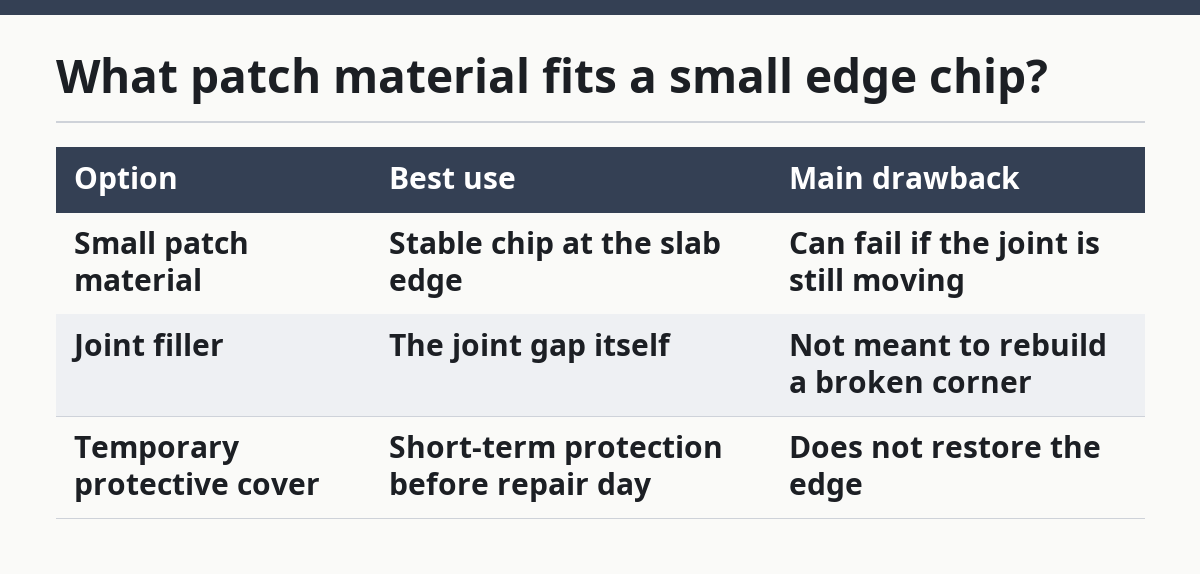
The mistake to avoid is putting joint filler into the chip or patch material into the joint gap as if they were the same thing. They are not. The filler belongs in the joint; the patch material belongs on the damaged corner.
Patch choice also depends on how deep the loss is. A shallow chip needs less build-up and less shape correction. A deeper loss may need more careful placement, but once the corner gets large enough that the edge no longer has support, the repair starts to behave less like a chip fix and more like a structural edge repair. At that point, a contractor should decide whether the patch is still the right move.
How long does a small repair take?
A small repair often takes less time than a full slab job, but the total time depends on cleaning, patch depth, and cure time. The actual patch may be quick, while the waiting period before traffic returns can be longer than the hands-on work.
The important time question is not only “how long to apply it?” but “how long before it can be used?” A small edge repair can look finished while still being soft enough to mark, chip, or pull away. If the area sits in a walkway or near a wheel path, that waiting period matters as much as the placement itself.
Here is the practical effect of timing:
- Same-day patching is possible when the chip is small and the area can be kept clear.
- Short wait before light traffic is common for many repair products, but the exact window depends on the material chosen.
- Longer wait before heavy traffic is normal when carts, forklifts, or frequent doors hit the area.
The repair sequence should match that wait, not the fastest possible finish. A patch that gets stepped on too early can break at the corner and leave a larger, rougher edge than before.
What does a bad repair look like?
A bad repair looks smooth for a day and then starts failing at the edge or across the joint. The most common signs are a patch that bridges the joint, a repair that sits proud of the slab edge, or a spot that chips again as soon as traffic returns.
Watch for these problems:
- The joint is filled solid all the way across, so it no longer moves freely.
- The patch surface is flush in one spot but leaves a hard ridge at the corner.
- The new material debonds and sounds hollow when tapped.
- Water or dirt keeps collecting at the repair edge.
- The chip returns next to the patch instead of staying closed.
A bad repair usually costs more than a careful one because it has to be cut back and redone. That is why the first pass should be modest and accurate rather than thick and aggressive. If the chip is small, overbuilding it often creates a bigger target for future breakoff.
Because the chip is not always the only issue, a professional should look at the slab if the repair area keeps moving, keeps cracking, or shows wider slab distress. The wrong sequence on a joint-area repair can waste time and leave the slab harder to fix later.
FAQ
Is a small chip urgent?
A small chip is not always urgent, but it becomes urgent if it creates a trip hazard, sheds loose pieces, or sits in a high-traffic path. If the slab edge is stable and the joint still moves freely, the repair can often be planned rather than rushed. If the chip is growing, the schedule should move up.
Can I patch it before lifting?
A small chip can sometimes be patched before lifting, but only if the repair will not bridge the joint or interfere with slab movement. The safer order is to keep the joint functional and use a patch material that stays on the damaged corner only. If the joint itself needs work, that should be handled in the repair plan first.
Will the chip spread if ignored?
A chip near a joint can spread if the edge keeps taking impact or if the joint moves against it. Some chips stay the same size for a long time, but corners are weak points, so repeated traffic can turn a small loss into a larger breakoff. If the edge starts crumbling, it is no longer just a cosmetic flaw.
Drafted with AI; not yet reviewed by a person.