When Does a Sunken Slab Become a Problem for Doors and Windows?

Last updated: November 19, 2026
Quick Answer: A sunken slab becomes a problem for doors and windows when the movement is enough to twist the opening, shift the threshold, or pull the frame out of square. At that point, the issue is no longer just cracked concrete; it is a building-opening problem that shows up as sticking doors, misaligned windows, gaps, and hardware that no longer lines up.
Key Takeaways
- Doors and windows usually show slab movement first when the opening stops acting square.
- A sunken slab can change support under a door frame and threshold.
- Windows that once closed cleanly may bind when settlement racks the frame.
- Doors and windows are often the first places settlement shows up.
When a sunken slab crosses from cosmetic to functional
A sunken slab matters for doors and windows once the opening stops behaving like a rectangle. That is the practical line. Small settlement can leave a hairline crack or a sloped floor and still let a door close normally. More noticeable movement changes how the slab supports the jamb, threshold, and sill, and that is when the trouble starts.
The best way to think about it is by function, not by appearance alone. A 1/8-inch crack in concrete may look ugly but do nothing to a nearby door. A modest drop at one side of an opening can be enough to make a latch miss its strike plate, or make a window sash drag because the frame is no longer square. The opening reacts to differential movement, not just to the size of the crack.
The warning signs usually show up in a cluster:
- a door that sticks at the top or bottom on one side
- a lock that suddenly needs extra force to close
- a window sash that rubs, binds, or will not stay aligned
- trim that separates from the frame
- a threshold that no longer meets the door cleanly
- visible gaps along one side of the jamb or sill
A slab can settle without creating all of those at once. One symptom is enough to pay attention to if it is new and getting worse over a few weeks. If the opening still operates smoothly after a season of minor movement, the slab may be shifting without reaching the point where it affects the door or window.
For a broader view of when movement turns urgent, the hub page on slab safety and urgency is the right next stop. This page stays focused on one thing: how the slab starts showing up at the openings. For related context, see foundation settlement signs and when a crack is structural.
How a sunken slab affects a door frame and threshold
A sunken slab affects a door frame and threshold by changing the load path under the opening. The frame is designed to sit in a stable, plumb opening with the threshold bearing evenly below it. When one side of the slab drops, the jamb can tilt, the threshold can pull away, and the door slab itself may no longer meet the frame the way it should.
This is why the problem often starts at the bottom of the opening. A threshold that has separated from the slab by even a small gap can let the door swing oddly or scrape the floor. If the floor inside has settled but the jamb above has not moved the same amount, the door may feel too tight at one corner and too loose at another. The result is a twist, not just a dip.
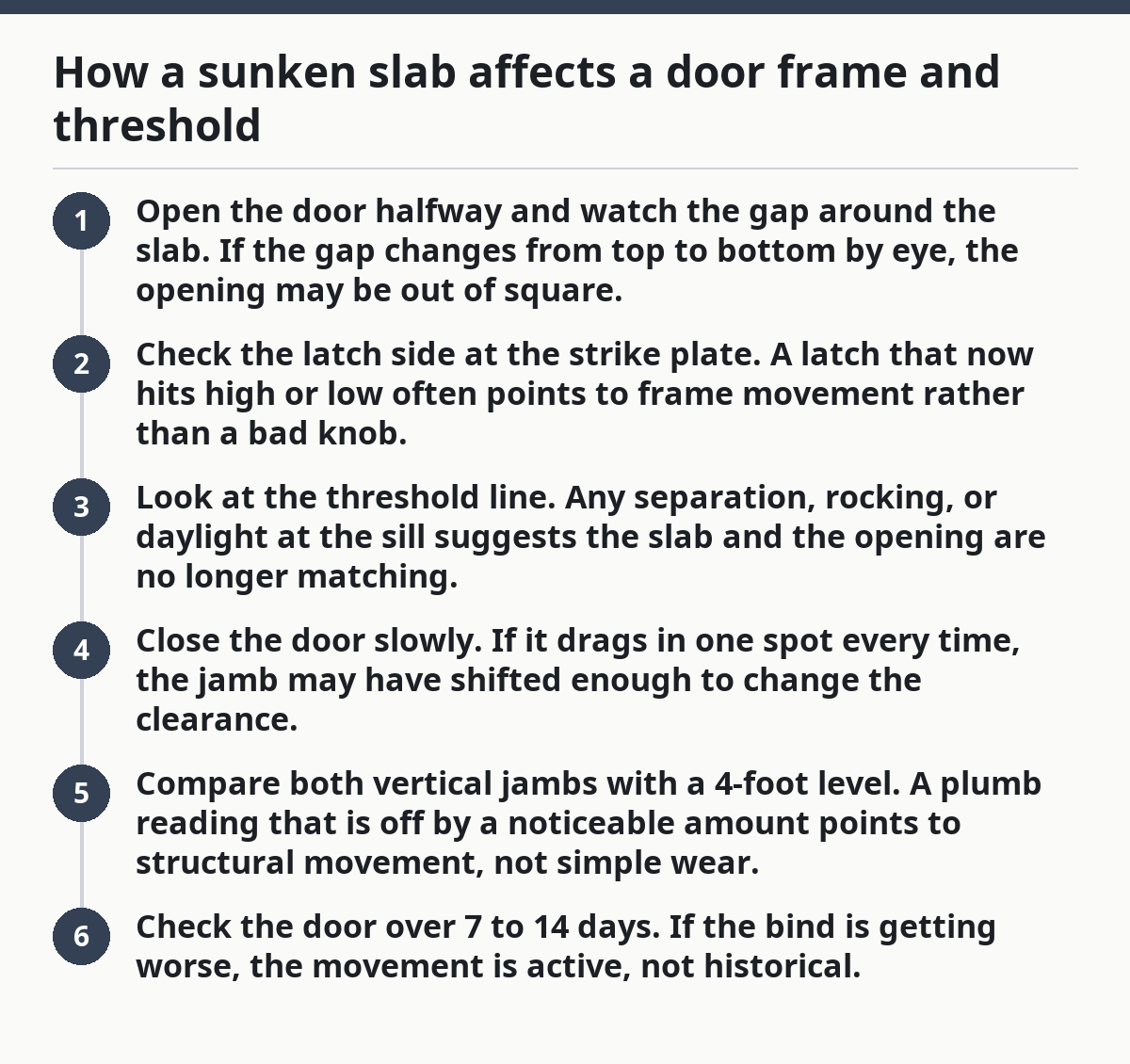
A simple field check helps separate slab settlement from a plain hardware issue:
- Open the door halfway and watch the gap around the slab. If the gap changes from top to bottom by eye, the opening may be out of square.
- Check the latch side at the strike plate. A latch that now hits high or low often points to frame movement rather than a bad knob.
- Look at the threshold line. Any separation, rocking, or daylight at the sill suggests the slab and the opening are no longer matching.
- Close the door slowly. If it drags in one spot every time, the jamb may have shifted enough to change the clearance.
- Compare both vertical jambs with a 4-foot level. A plumb reading that is off by a noticeable amount points to structural movement, not simple wear.
- Check the door over 7 to 14 days. If the bind is getting worse, the movement is active, not historical.
Common mistake: adjusting hinges first and calling it fixed. That can buy a week, but it hides the real problem if the slab is still moving. Another mistake is planing the door edge before checking the threshold. The cost is a door that closes today and still fails after the next round of settlement.
Why windows stop closing after settlement?
Windows stop closing after settlement because the frame is no longer square enough for the sash or moving parts to travel cleanly. That is especially common with double-hung and casement windows, where even a small twist can change how the sash meets the track, latch, or lock.
A window opening depends on even spacing. If the slab beneath a wall settles unevenly, the sill can tilt, the side jambs can rack, or the head can shift just enough to distort the frame. The hardware may still work, but the moving part no longer has the same path. That is why a window can feel tight near the lock and loose near the opposite corner.
The trouble shows up in a few specific ways:
- the sash drags on one side before it reaches the latch
- the lock no longer lines up without lifting or pushing the sash
- there is a daylight gap at one corner after closing
- the sash appears to tilt in the opening
- a casement crank feels unusually stiff at one point in the travel
This is not the same as dirt in the track. Dirt causes a rough glide; settlement causes a pattern. If the same corner binds every time, the frame may have shifted. If the window worked fine last month and now needs force after the floor near the wall started cracking or dipping, the opening deserves a closer look.
A useful check is to compare the diagonals of the visible opening. If the two diagonal measurements differ, the frame is out of square. You do not need a laser to notice a meaningful change; a tape measure and a level will show whether the opening has begun to rack. A difference that is obvious by eye is already enough to affect operation.
The limit here is worth stating plainly: a sticky window is not always a slab issue. Paint buildup, swollen wood, and worn hardware can create the same symptom. This page is not for diagnosing every window problem under the sun. It is for the cases where settlement indicators and opening problems appear together. For comparison, see how to tell if a door is out of square and window frame repair basics.
Settlement indicators that usually show up first at openings
Settlement indicators usually show up first at openings because doors and windows are unforgiving reference points. Concrete can crack in a garage or basement for a long time before the building owner notices. An opening, by contrast, reveals movement fast: the latch misses, the sash binds, the trim gaps, or the threshold separates.
The most telling indicators are the ones that change with time, not the ones that have always been there. A door that has rubbed lightly for years may be ordinary wear. A door that starts binding after a fresh crack, a widening gap, or a new floor slope is a different story. The same is true for windows that used to lock cleanly and now need two hands.
Here is the sequence that often matters most:
- First: a crack or gap appears near the opening, often at the slab edge, corner, or wall line.
- Then: the door or window still works, but it feels different.
- Next: the frame begins to distort enough that hardware alignment suffers.
- After that: the opening becomes a functional complaint, not just a visual one.
If the settlement is active, the symptoms usually worsen over a short span of time. A slab that moved 1/4 inch once and stopped may leave a permanent cosmetic issue. A slab that continues to settle can keep changing the opening for months. That is the point at which a temporary hinge tweak becomes the wrong fix.
One honest trade-off: not every visible sign justifies immediate repair. Some older buildings carry slight misalignment for years and still operate well. The problem starts when function changes. A homeowner who wants a clean cosmetic finish alone may not care about a small out-of-square condition; a homeowner with a front door that will not lock should care immediately. Those are different problems, even if the slab crack looks the same.
What to check before you call it slab-related
A sunken slab is likely the cause only after the opening problem survives a few basic checks. That matters because doors and windows have their own failure modes, and a wrong diagnosis wastes time and money.
Use this order:
- Check the hardware first. Tighten loose screws on hinges, latches, and keepers with a screwdriver. If the symptom disappears, the problem may have been hardware movement, not settlement.
- Look for paint or caulk bridges. A fresh paint line can mimic a binding frame. Cut the paint with a utility knife and retest.
- Measure the gaps on both sides. Use a tape measure or a simple ruler at the top, middle, and bottom of the opening. Uneven gaps point to distortion.
- Inspect the slab near the opening. A crack wider at one end, a step at a joint, or a visible drop at the threshold area supports a settlement diagnosis.
- Watch the opening over 2 to 4 weeks. A stable problem is less urgent than one that keeps changing. Movement over time is the clue.
- Check adjacent finishes. Trim separation, drywall cracks near the corner, and gaps at baseboards around the opening often travel with the same movement.
The result you want is a pattern. Hardware trouble tends to be local and immediate. Settlement trouble tends to involve the slab, the frame, and the surrounding finishes together. If the door or window only behaves badly after the slab changes, the slab is the likely driver.
A standard level, not a phone app, is the right tool here. A 2-foot or 4-foot level gives you a real straightedge against the jamb or sill. A smartphone inclinometer may be useful for rough comparison, but it should not be the only basis for judging whether an opening has shifted.
When the opening problem is serious enough to stop guessing
The problem is serious enough to stop guessing when the door or window no longer functions normally, the movement is getting worse, or the opening is part of a larger structural pattern. That is the line where a homeowner should shift from observation to action.
Three situations deserve prompt attention:
- the front or exterior door will not latch or lock consistently
- a window no longer closes fully or has a gap that did not exist before
- the slab drop is paired with widening cracks, threshold separation, or visible frame distortion
These are not just annoyance issues. A door that does not close properly affects security and weather protection. A window that will not close can affect water intrusion and ventilation control. A frame that is twisting can keep changing as settlement continues.
If the slab movement is small and the opening still works, the issue may be watch-and-measure territory. If the opening has become hard to operate, the problem has moved into repair territory. That may mean a carpenter, a foundation specialist, or both, depending on what is actually moving. I would not treat a sticking door as proof of foundation failure, but I also would not dismiss repeated misalignment as a mere hinge nuisance. Consult a qualified professional and check guidance from the American Society of Home Inspectors and the International Association of Certified Home Inspectors.
This is the point to document what changed: when the sticking began, which side of the frame moved, whether the threshold separated, and whether the symptom is worsening after rain, dry weather, or temperature swings. Those notes make the next diagnosis far faster.
The fastest way to tell if the slab is the opening problem
The fastest way to tell if the slab is the opening problem is to pair function checks with a simple visual survey of the threshold, frame, and nearby slab line. If the opening is sticking and the slab is visibly settling near that wall, the two are probably connected. If the hardware is loose but the slab and frame are stable, the cause is probably elsewhere.
The useful question is not “Is the slab sunken?” It is “Has the slab moved enough to distort the door or window opening?” That is the point where the concrete issue becomes an openings issue. A cracked slab that does not affect function is a concrete problem. A slab that changes the latch, the sill, or the squareness of the frame is a building-opening problem.
When the answer is yes, the symptom set usually includes at least one of these: sticking doors, misaligned windows, frame distortion, or threshold separation. When the answer is no, the reader can keep watching rather than jumping straight to repair.
That distinction can save money and avoid bad fixes. It also keeps attention on the thing that matters most: whether the opening still works the way it should.
Can slab settlement make doors stick?
Yes. A settling slab can twist the jamb, shift the threshold, or rack the opening enough to make a door drag or bind. The sticking usually shows up at the same spot each time, which is a clue that the frame has moved rather than the hinges simply loosening.
Why do windows stop closing after settlement?
Windows stop closing after settlement because the frame is no longer square enough for the sash to travel cleanly. A small change in sill height or side-jamb alignment can keep the latch from lining up, especially on double-hung and casement windows.
What does shifting concrete do to frames?
Shifting concrete can pull a frame out of plumb, open gaps at the trim, and distort the shape of the opening. When that happens, the frame stops supporting the door or window evenly, and the hardware starts working against the distortion instead of against a square opening.
Drafted with AI; not yet reviewed by a person.