How Snowmelt and Spring Saturation Change Concrete Slab Movement

Last updated: November 20, 2026
Quick answer: 3 things usually drive it — snowmelt, spring saturation, and drainage that sends water back to the slab. Snowmelt and spring saturation can make a concrete slab move after it looked stable all winter. The short answer is that water-soaked soil loses support, drainage shifts, and the slab starts to settle, tilt, or gap. This article covers How Snowmelt and Spring Saturation Change Concrete Slab Movement in New York in plain language: what changes in spring, what a contractor should look for, and what drainage details matter most.
Key Takeaways
- Snowmelt changes the ground under a slab before the slab itself looks damaged.
- Spring saturation matters most when water has nowhere to drain and stays against the slab edge.
- A slab that seemed fine in January can start shifting in March because the soil is softer and wetter.
- Drainage, downspout flow, grading, and saturated backfill all affect how much movement shows up.
- A quick visual check can tell you whether the issue is seasonal moisture or something that needs repair work.
Why snowmelt makes a slab start moving after winter

Snowmelt loads the soil with water fast, and that seasonal ground moisture can change support under a concrete slab in a few days. When frozen soil thaws, it often drinks in meltwater unevenly, so one side of the slab can lose support before the other side does.
Picture this: you’ve got a driveway, patio, or garage slab that sat through winter without obvious trouble, then the first warm spell hits and water starts running off the roof, lawn, and driveway edge. The slab is not suddenly “bad.” The soil under it has changed shape and strength.
That change is common in New York because spring brings a mix of thaw, rain, and surface runoff. On a slab near a downspout, a low yard, or a tight side yard, water can pool long enough to soften the base material and wash fine soil away.
What changes first:
- Soil moisture rises around the slab edge.
- Meltwater follows drainage patterns instead of disappearing.
- Soft soil can compress under the slab load.
- Gaps can open where support is lost.
The concrete itself is still hard. The ground beneath it is the moving part.
On the flip side, a slab on well-graded fill with clean runoff usually stays more stable. The difference often comes down to where the water goes in the first 24 to 72 hours after thaw, not just to the concrete mix or age of the slab.
What spring saturation does to the soil under a concrete slab
Spring saturation weakens the soil’s ability to hold the slab in place, and that is what starts the movement. Water fills the spaces between soil particles, so the ground becomes soft, slick, and easier to compress under load.
Picture this: you step near the edge of a sidewalk panel and the grass beside it squishes underfoot. The slab may not sink right away, but the border soil is already losing firmness. That is the kind of condition that leads to slab movement after wet seasons.
The biggest issue is not just wetness. It is prolonged saturation. If meltwater keeps feeding the same spot for several days, the soil stays soft longer and the slab can settle unevenly. A garage slab, walk, or porch landing can then show a lip, a tilt, or a narrow joint opening.
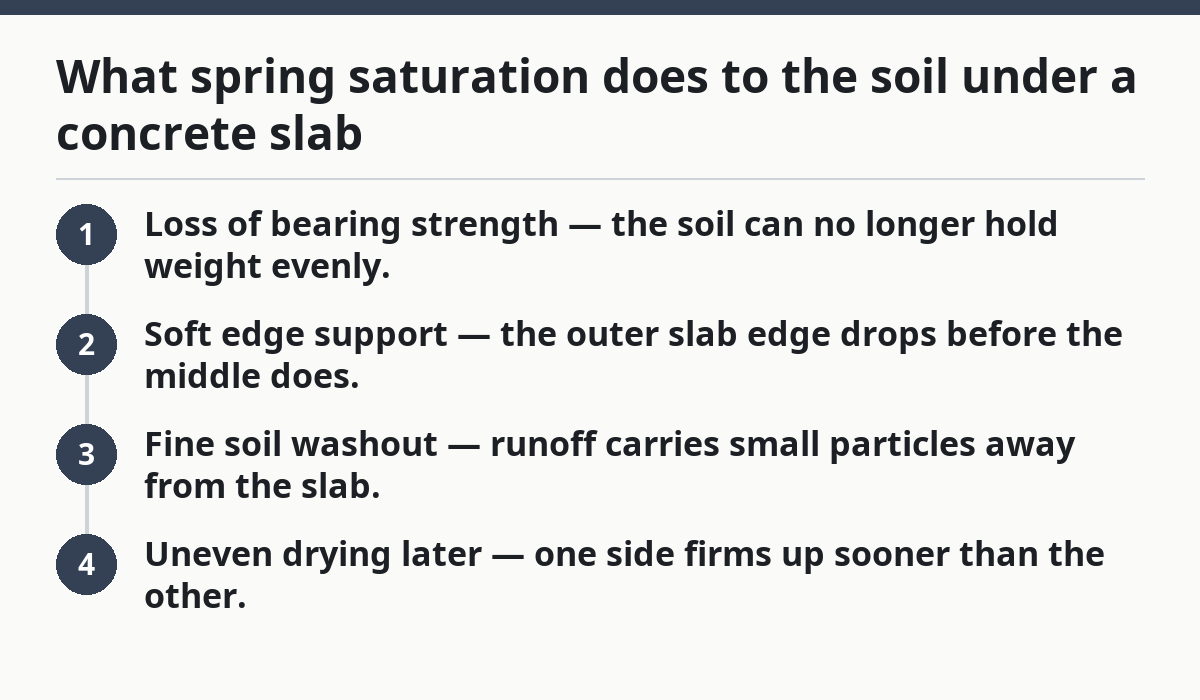
Common soil effects during spring saturation:
- Loss of bearing strength — the soil can no longer hold weight evenly.
- Soft edge support — the outer slab edge drops before the middle does.
- Fine soil washout — runoff carries small particles away from the slab.
- Uneven drying later — one side firms up sooner than the other.
That mix creates the movement a homeowner notices in March or April. The slab did not change on its own; the moisture pattern did.
Here’s the catch: the same yard can behave differently from one spring to the next. A light snow year, a clogged leader, or a wet week after thaw can change how fast water reaches the slab. That is why a good contractor looks at drainage first, not just at the crack or gap on the concrete.
Which drainage patterns make snowmelt worse?
Bad drainage makes snowmelt worse when it sends water back toward the slab or traps it beside the slab edge. A slab in New York often moves more when roof runoff, melting snow, and spring rain all collect in the same low spot.
Picture this: the roof sheds water into a downspout extension that stops too close to the slab, or the yard slopes toward the garage instead of away from it. Meltwater has a straight path to the soil that supports the concrete. The slab sees the result before the homeowner sees the cause.
A few drainage patterns can matter more than others:
- Short downspouts that dump water beside the slab
- Negative grading that sends water toward the foundation or walk
- Low spots where snowmelt lingers for hours
- Blocked drains that force water to spread through the soil instead of leaving the site
The best part? These are often visible without special tools. A contractor can usually spot them during a walk-through with a level, a hose, and a few minutes of observation during a thaw or right after rain.
Drainage matters because the slab is not floating. It depends on the base and the soil staying evenly supported. If one side stays wet while the other side dries, the slab can tip or settle unevenly even if the concrete itself is still sound.
A simple rule: if water can sit against the slab for more than a short time after snowmelt, the odds of movement go up.
How a contractor checks seasonal slab movement in New York
A contractor checks seasonal slab movement by tracing water first, then measuring where the slab has lost support. The job is not just to look at a crack; it is to find the moisture path that caused it.
Picture this: you’re standing on a patio in early spring and one corner feels lower than the rest. A careful inspection starts with the ground around that corner, not with a patch kit or a guess. That is how a real diagnosis begins.
- Look for runoff paths. Check where roof water, driveway water, and meltwater move during thaw. The goal is to see whether water is draining away or collecting beside the slab.
- Check the slab edge. Look for fresh gaps, soil washout, or soft backfill at the perimeter. A narrow void at the edge often points to saturation and loss of support.
- Measure the slope. Use a straightedge or level across the affected area. A visible pitch change tells you the movement is uneven, not just cosmetic.
- Compare dry and wet conditions. See whether the problem shows up more after thaw or rain. If it gets worse when the soil is wet, drainage is part of the issue.
- Check nearby hard surfaces. Driveways, walks, and steps can tell the same story. If several surfaces move in the same wet zone, the ground issue is bigger than one slab.
A good inspection usually ends with one of two findings: water is getting to the base and staying there, or the slab has already lost enough support that repair work is needed. In either case, the water route has to be fixed or the movement can return.
What a bad spring moisture job looks like
A bad spring moisture job leaves the water problem in place and tries to hide the slab problem instead. That can mean patching a joint while the downspout still dumps beside the slab, or lifting one panel without correcting the drainage that caused the drop.
Picture this: the concrete looks neater for a while, but the same wet corner comes back every thaw. That is the sign the root cause was missed. The slab may have been lifted, filled, or patched, but the drainage stayed the same.
Here are the common mistakes and what they cost:
- Ignoring runoff from the roof — the slab keeps settling because the soil keeps getting soaked.
- Fixing only the visible crack — the patch may look tidy, but the movement can continue under it.
- Skipping the perimeter grade — water still sits against the slab after snowmelt.
- Treating every movement the same — a small seasonal shift is not the same as a slab that has lost support across a wider area. A contractor should separate a minor seasonal shift from a structural movement before recommending repair.
The cost is usually repeat work. A slab repaired in the wrong season or without drainage correction often moves again when the next wet spring hits.
A better plan is simple: correct the water path, then address the slab. If the yard sends meltwater toward the concrete, the concrete will keep reacting to that pattern. For related guidance, see the hub on New York slab conditions and weather factors — The Complete Guide and the related page on concrete slab settlement in New York.
When spring slab movement is mostly seasonal, and when it keeps coming back
Spring slab movement is often seasonal when it appears after thaw, eases as the ground dries, and stays limited to one wet area. It keeps coming back when the same drainage problem returns every year or the slab keeps losing support along the same edge.
Picture this: a walkway shifts a little in March, then settles into a stable position once summer dries the soil. That can happen after a wet season. But if the same panel drops again next spring, the ground moisture problem is not finished.
A contractor will usually look at three things:
- Timing — does the movement show up right after thaw or heavy rain?
- Location — is it always the same corner, edge, or low spot? If the movement repeats in the same place, that pattern matters.
- Pattern — does the movement stop when the ground dries, or does it keep widening?
This is where New York conditions matter. A slab in a shady side yard, near snow piles, or below a roof edge can see repeated wetting and drying all spring. That cycle can make movement look modest at first and worse later.
For a broader view of the weather side of the problem, see the hub on New York slab conditions and weather factors — The Complete Guide. This page stays with the spring moisture piece: what snowmelt does, how saturation changes support, and why drainage patterns decide where the slab ends up.
What to ask before you call for slab repair
You should ask about drainage first, then about the slab repair itself. That order saves time and keeps the work tied to the actual cause.
Picture this: you’re calling a contractor after a wet spring and you want a straight answer, not a sales pitch. The right questions help you find out whether the problem is runoff, saturation, or a slab that has already shifted too far.
Use these questions:
- Where is the water coming from?
- Does the yard grade send meltwater toward the slab?
- Is the downspout discharge too close to the concrete?
- Will the fix address drainage, not just the visible gap or crack?
- What signs tell you the soil has stayed saturated too long?
A good contractor should be able to talk about snowmelt runoff, spring thaw, soil moisture, and drainage patterns in plain words. If the answer skips the water path and jumps straight to patching, that is a bad sign.
The best question of all is simple: what happens next spring if nothing changes? If the answer is “probably the same problem,” then the repair plan is incomplete.
Why do slabs move more after winter?
Slabs move more after winter because thawed soil often loses strength right when meltwater and spring rain are putting the most water into it. The concrete did not suddenly fail; the support under it changed. In New York, that happens a lot in the first stretch of warm, wet weather after frost leaves the ground. The U.S. Geological Survey explains that freeze-thaw cycles and soil moisture affect ground movement, which is why spring conditions matter so much.
Does spring rain make slab settlement worse?
Spring rain can make slab settlement worse when it adds to snowmelt and keeps the soil saturated longer. If runoff already has nowhere to go, even a short rain can keep the base soft around a slab edge. That extra wet time is what raises the chance of uneven movement.
Can drainage reduce seasonal slab movement?
Drainage can reduce seasonal slab movement when it moves water away before the soil gets saturated. A better downspout route, better grading, or a dry perimeter can lower the chance of repeated movement after thaw. It will not fix every slab problem, but it often cuts off the cause that keeps bringing the issue back. For drainage standards, see FEMA guidance on directing water away from foundations and the EPA’s runoff resources.
Drafted with AI; not yet reviewed by a person.