Last updated: November 05, 2026
Key Takeaways
- The visible symptom may be a gap, a slope, or a rocking corner.
- Uneven load and support make one side settle first.
- The slab often shows the problem, not causes it.
- If one side changes, local soil or water is usually involved.
Uneven concrete slab settlement is usually a subgrade problem: the soil under one edge or corner has lost support, so that side drops first. If your slab is sinking on one side, the real question in Why Does a Slab Sink More on One Side Than the Other? is not “Is concrete weak?” but “Why did that part of the ground move?” Speak to a qualified concrete or geotechnical professional about your specific situation, especially if the movement is new, fast, or tied to plumbing or drainage issues.
Who this applies to, and what I’m assuming
This applies to a reader looking at a patio, driveway, sidewalk, garage floor, or shed slab that is visibly lower on one side than the other. I’m assuming you can already see the symptom: a gap at one edge, a slope that was not there before, or a corner that rocks under load. I’m also assuming you want the cause, not a sales pitch for repair.
The most common pattern here is differential settlement, which means one part of the slab settles more than the rest. That does not automatically mean the whole slab is failing. It often means the support beneath one side has changed: soil washed out, compacted unevenly, dried and shrank, or was never built up to a consistent density in the first place.
This is not the right page for deciding whether to repair or replace, and it is not a step-by-step repair manual. It is for understanding why one side or one corner moves first. That distinction matters, because edge settlement and slab corner drop usually point to local conditions, not a problem with the entire slab.
Why one side sinks before the other
Why Does a Slab Sink More on One Side Than the Other? Because one side sinks first when load and support are rarely perfectly even. A concrete slab is stiff, but it still spans over the ground beneath it. If the subgrade under one edge is softer, wetter, thinner, or more disturbed than the rest, that side becomes the weak point.
Water runoff is one of the biggest reasons. Roof downspouts, sloped pavement, poor grading, or repeated splashback can send water to the same side year after year. That water can soften clay, carry fine soil away, or create voids under the slab edge. Once support is gone at the edge, the slab bends and the corner settles.
Soil compaction matters too. If one side of the base was compacted in thinner lifts, or the fill near the edge settled after construction, the slab may drop there while the center stays put. A slab poured over a utility trench, backfill, or patched area is especially prone to this kind of uneven movement.
Load imbalance can speed it up. A heavy planter, vehicle wheel path, HVAC unit, water tank, or stacked material near one side concentrates force where the support is already weakest. The slab itself is not usually the root cause; it is reacting to a support problem below it. The American Concrete Institute’s guidance on slab-on-ground behavior discusses how support conditions and loading affect performance, and the Portland Cement Association also covers subgrade preparation and drainage as key factors in slab service life.
What to check before you blame the concrete
The slab is often the messenger, not the cause. Before assuming the concrete “failed,” check the ground conditions and the pattern of movement.
Start with the slope. Is the low side near a downspout, driveway edge, planter bed, or low spot where water stands after rain? A recurring wet area usually points to runoff or drainage, not random settling. Then look for cracks. A crack that widens toward one side often tracks differential settlement. A clean separation at a joint can point to edge settlement, especially if the edge is unsupported.
Check the surrounding soil. Loose topsoil, freshly added fill, eroded mulch, and voids at the slab perimeter are clues. If the slab is adjacent to a wall, porch, or step, compare the heights at the corners. A drop of even a small amount can be enough to change how water flows, which then makes the settling worse.
Use a straight board or level over a 1.2 m to 1.8 m span if you have one. You are not measuring a repair threshold; you are looking for the pattern. If the board rocks near one end but not the other, that suggests a localized support loss. If the whole slab pitches uniformly, that is a different condition and a different conversation.
What causes one side of concrete to settle faster?
One side settles faster when something changes under that side alone. The common culprits are water, weak fill, poor compaction, and loss of bearing at the edge.
Water is the biggest variable because it changes soil strength. Clay can soften when wet and shrink when it dries; silt and fine sand can move with flowing water. If runoff keeps reaching one side, that edge may lose support long before the rest of the slab does. A downspout extension or gutter discharge aimed at the slab is a classic setup for this pattern.
Unsupported edge is another frequent cause. The perimeter of a slab needs bearing just like the middle does. If the edge was poured against loose backfill, a trench, or an excavated margin with little lateral support, it can sag first. Corner settlement is especially common because corners have the least continuous support and the least ability to distribute load.
Construction differences matter too. A slab poured over fill that was not compacted in layers is more likely to settle unevenly than one placed on a well-prepared, uniform base. That does not mean the slab was “bad concrete.” It means the support system under one side was different from the support system under the other side.
Trees, irrigation, and plumbing leaks can also make one side move faster. A leak under or near one edge can saturate and weaken the subgrade. Tree roots can dry soil unevenly and create shrinkage near the slab, especially in expansive clay. Those are site conditions, not concrete defects.
How do I tell if the problem is the edge, the corner, or the whole slab?
The pattern tells you a lot. Edge settlement shows up as a length of slab dropping along one side, often with a lip at the joint or a visible gap at the perimeter. Slab corner settlement shows up as a single low point where two edges meet. Whole-slab settlement tends to be more even, with the entire slab drifting down relative to nearby grade.
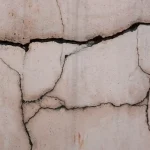
Look at the cracks. A diagonal crack running away from a corner often means that corner moved more than the rest. A crack parallel to an edge can mean the edge lost support first. If the slab is separated from a wall, step, or adjacent slab by a wider gap on one side, that is also a clue.
Check the surrounding hardscape. If the adjoining driveway panel, walkway, or patio section is still level while one slab panel dropped, the problem is local. If several connected slabs are following the same slope, the cause may be broader drainage or fill movement across the site.
If you want a professional to diagnose it, the question to ask is not just “What is wrong with the concrete?” Ask what changed in the subgrade, drainage, or load path. That framing is more useful, and it matches how concrete slab settlement diagnosis is usually approached.
When the standard explanation does not fit
Sometimes the usual “water plus weak soil” answer is incomplete. That does not make the pattern mysterious; it means the site has an extra factor.
A slab next to a roof downspout or low gutter outlet: concentrated runoff can undercut the edge — redirect the discharge away from the slab and verify where water lands after a hard rain.
A slab over recent backfill, a utility trench, or a patched area: uneven compaction can create a weak strip — the fix is not to guess at the surface; the subgrade may need evaluation.
A slab beside a mature tree or large shrubs: roots can dry soil unevenly and create localized shrinkage — the edge may move seasonally, so observe whether the low side changes after wet and dry periods.
A garage or driveway slab carrying heavy vehicles on one lane: repeated wheel loads can exaggerate a weak edge — if the low side matches the wheel path, load imbalance is part of the story.
A slab with a recent plumbing leak or persistent damp spot: saturated soil can lose strength quickly — the consequence is often continued movement until the moisture source is identified and corrected.
A slab with visible voids under the edge or a hollow sound when tapped: the support may have been lost already — consult a qualified professional if that is the case, because this is a sign to stop treating it as a simple surface issue.
These are the cases where a basic visual read may miss the real cause. The standard explanation still points you in the right direction, but the source of movement may be hidden below grade.
The mistakes people make, and what they cost
The most common mistake is blaming the concrete mix. A 100 mm or 125 mm slab can look dramatic when it drops, but the concrete itself is usually not what settled. The cost of that mistake is time spent chasing the wrong fix while the subgrade keeps moving.
Another mistake is sealing the symptom and ignoring drainage. Caulking a joint or patching a crack does not stop water runoff from reaching the edge. If water is the driver, the low side can keep sinking after the patch hardens.
A third error is assuming a level-looking surface means the problem is gone. Small movement at one corner can still change drainage and load transfer. If the edge is still unsupported, the settlement can continue below the visible line.
Some people add soil at the perimeter without correcting the cause. That may hide the gap for a while, but loose fill can settle again if it is not properly compacted. The better alternative is to identify why the support was lost in the first place.
A final mistake is treating every crack as a sign of immediate structural danger; consult a qualified professional if you are unsure. Not every settled slab is an emergency, but not every settled slab is harmless either. The correct alternative is to map the pattern: where the low point is, how far it extends, and whether drainage, trees, or leaks are present.
What a careful diagnosis actually looks at
A good diagnosis starts with geometry, not guesses. Measure where the slab is low relative to nearby grade, where water travels in rain, and where the visible gap or crack begins. A 1 m level, laser level, or even a string line can show whether the problem is localized or spread across a panel.
Then look at support clues. Is the edge tight against soil, or is there a void? Is the adjacent ground firm, soft, or eroded? Is the soil type heavy clay, loose fill, or a mix? Those details matter because settlement behavior changes with soil type and moisture.
The next question is whether the movement is active. A slab that has been stable for years and then drops after a storm, plumbing leak, or grading change points to an ongoing trigger. A slab that settled long ago and then stopped may simply reflect an old construction issue.
The honest limitation here is that a visual inspection can identify the pattern, but it cannot always prove the underground cause. In uncertain cases, a qualified concrete contractor, geotechnical engineer, or foundation professional may need to assess the site. That is especially true if the slab is near a structure, a utility line, or an area where further movement could create a trip hazard or water-entry problem.
What the pattern means for the next decision
A slab that sinks more on one side usually means the support under that side has changed, not that the whole slab is doomed. Differential settlement, edge settlement, and slab corner drop all point to uneven conditions in the subgrade, drainage, or loading.
The practical takeaway is simple: follow the pattern. If the low side lines up with runoff, investigate water first. If it lines up with a trench, fill area, or unsupported edge, think about bearing and compaction. If it lines up with a leak, tree roots, or heavy repeated loading, focus on the site condition that is still acting on that side.
That is the most useful way to read the slab before anyone talks about repair. It keeps the diagnosis on the cause, not just the symptom.
Why is one corner of my slab lower?
One corner is lower when that corner has lost support faster than the rest of the slab. Water runoff, loose fill, a nearby trench, or an unsupported perimeter can all do that. Corner settlement is common because corners carry less continuous support, so a small soil change shows up there first.
What causes one side of concrete to settle faster?
One side settles faster when the soil beneath it weakens, erodes, or compacts more than the other side. The usual drivers are drainage toward that edge, poor subgrade preparation, a hidden void, or repeated loading on one side. Trees, plumbing leaks, and backfill settlement can make the difference more pronounced.
Can uneven settlement get worse?
Yes, if the cause is still active. Water intrusion, ongoing erosion, saturated subgrade, or repeated heavy loading can keep the weak side moving. If the trigger stops and the soil stabilizes, movement may slow. A changing pattern after rain, plumbing issues, or seasonal dry periods usually means the condition deserves prompt professional review.
Drafted with AI; not yet reviewed by a person.