What New York Weather Conditions Make Concrete Settlement Worse?

Last updated: November 05, 2026
Key Takeaways
- Repeated freeze-thaw, saturated soil, and long dry spells are the main weather triggers.
- Weather changes subgrade moisture, volume, and strength in weeks, not years.
- Timing matters most: worsening after thaw, rain, or drought points weather into the diagnosis.
- Don’t blame every crack on winter without checking other causes.
Concrete settlement in New York gets worse when weather pushes water into the soil, then pulls it back out, especially through freeze-thaw cycles, heavy rain, snow melt, and drought. Those swings change how the ground supports a concrete slab, which makes settlement diagnosis harder and the damage more likely to keep moving. For readers asking what New York weather conditions make concrete settlement worse, the short answer is that moisture swings under the slab are the main driver.
This article gives general information for New York property owners and managers. New York rules and property issues vary by location and by contract, so a qualified lawyer should be consulted for any dispute about responsibility, notice, or repair obligations.
What this guide covers, and what it assumes you already know
This guide applies to New York homeowners, buyers, and property managers trying to understand how weather-related concrete settlement fits into a slab problem they already see: a cracked driveway, patio, garage floor, or basement slab. It assumes you already know that a concrete slab can move when the ground beneath it changes. It does not try to answer why a slab is sinking, whether lifting is needed, or whether a particular crack means structural failure; those are separate questions.
The weather patterns that matter most here are freeze-thaw cycles, rain saturation, snow melt runoff, drought shrinkage, and soil expansion. Those are not abstract terms. They change moisture in the subgrade, which is the soil layer directly under the slab, and that moisture change changes support.
A useful way to think about the problem is simple: a slab is only as steady as the soil under it. If the soil is soft from repeated wetting, shrinks after a dry stretch, or loses support after water drains unevenly, the slab can settle more in one area than another. That uneven movement is what makes diagnosis tricky. A crack that appeared after a January thaw may mean something different from the same crack after a summer dry spell.
This is also why the same weather can affect different properties differently. Clay-rich soil moves more with moisture change than dense granular fill. A slab with poor drainage reacts faster than one on well-compacted base. A driveway at the bottom of a slope sees different runoff than a garage slab on a higher lot.
For New York readers, the practical question is not just “Did weather contribute?” It is “Which weather pattern is most likely to have made the settlement worse, and why now?” For more on related slab issues, see the related hub on site-specific slab lifting scenarios in New York and the New York concrete repair overview.
Which New York weather conditions make concrete settlement worse?
The biggest culprits are repeated freeze-thaw cycles, saturated ground from rain or snow melt, and long dry periods that shrink soil under the slab. Each one changes how evenly the slab is supported, and each one is common somewhere in New York, from coastal areas to the Hudson Valley to upstate freeze-prone sites.
Freeze-thaw cycles make settlement worse because water in soil expands when it freezes and contracts when it thaws. That repeated movement loosens soil structure and can create small voids under a concrete slab. When the slab no longer sits on firm, uniform support, it can settle at the weaker edge or corner. The effect is strongest where the ground repeatedly crosses 32°F, because that is where the water in the soil changes state. The U.S. Geological Survey explains how freeze-thaw and moisture change can alter ground conditions, and the American Concrete Institute also discusses slab support and base preparation.
Rain matters when it is heavy enough to saturate the subgrade or when it pools near the slab. Saturated soil loses bearing strength, which means it cannot support weight as well. If roof runoff, downspouts, grading, or surface drainage keep sending water to one side of a slab, that side can soften more than the rest. The result is often differential settlement, meaning one part of the slab moves more than another.
Snow melt is a special version of the same problem, but the timing matters. Meltwater often arrives after the ground has been frozen or partially frozen, so it can run across the surface, gather at edges, and seep into joints and cracks as the soil thaws. In March or early April, that freeze-then-melt pattern can be rough on slabs because the ground is already stressed. Meltwater can also overwhelm drainage that handles ordinary rain but not a sudden thaw.
Drought causes a different kind of trouble. Dry soil, especially clay, can shrink and pull away from the slab edge. That shrinkage can leave gaps or reduce contact between the slab and its base. If the soil later wets up again, it may not return to the same shape or density. The slab can then settle into those changed conditions.
Soil type changes the whole picture. Clay expands and shrinks more than sand or gravel, so weather swings show up faster and more clearly. Loose fill, poorly compacted backfill, and organic soils are also more vulnerable to moisture change. New York has enough regional variation that a long dry spell in one area and a wet spring in another may cause different failure patterns on similar-looking slabs.
If the goal is to connect weather to diagnosis, one helpful source is the U.S. Geological Survey’s overview of expansive soils and moisture change, and another is the American Concrete Institute’s guidance on slab support and base preparation. Those organizations explain why moisture swings matter even when the concrete itself is sound. For New York-specific drainage and grading concerns, see the foundation drainage guide and the basement waterproofing overview.
How do weather swings change the ground under a slab?
Weather swings change the ground by altering moisture, volume, and strength in the subgrade, often within a few weeks, not years. That is why a slab can look stable in October and show movement by spring.
The chain usually starts with water. Rain, snow melt, or groundwater infiltration enters the soil through the surface, edges, cracks, or poorly drained spots. If the soil is fine-grained, especially clay, it holds that water and swells. If it is coarse and loose, water can wash fines out or soften a weak base. Either way, the support under the slab changes.
When temperatures drop below freezing, water in the soil can freeze and expand. Even shallow freezing can disturb the top layer under a slab, especially at edges and corners where heat loss is greater. When the thaw comes, the soil may not rebound evenly. Repeated cycles can create a patchwork of dense, soft, and empty zones under the same slab.
Drought works in the opposite direction. As soil dries, it shrinks and can crack. Those cracks can open pathways for the next rain or thaw to move water quickly into one area instead of spreading it evenly. That uneven wetting is one reason drought and later rain can be a bad combination for settlement. The dry period creates gaps; the wet period softens the edges of those gaps. The New York State Department of Environmental Conservation notes that local soil and drainage conditions can change quickly with weather.
A slab responds to support loss in a limited set of ways: it can settle downward, crack, or become visibly uneven at joints and transitions. What weather does is make those changes more likely or more active. It does not automatically mean the slab is failing for weather reasons alone. Load, construction quality, and drainage still matter. But if the movement followed a wet spring, a harsh winter, or a long dry spell, weather deserves a closer look.
For a broader New York-specific overview of slab-lifting scenarios, see the related hub on site-specific slab lifting scenarios in New York. For examples of inspection issues after storms, see the New York crack diagnosis page.
How do I connect the weather to the slab damage I’m seeing?
The strongest clue is timing: if the damage became worse after a thaw, a long rain, or a dry spell, the weather pattern may be part of the diagnosis. That does not prove it caused the settlement, but it tells you where to look next.
Start with the slab itself. Measure any height difference with a 4-foot level or a laser level if one is available. A small slope can be normal in exterior slabs for drainage, but a change in slope, a new low spot, or a gap at one edge is more suggestive of movement than a uniform crack. Look for movement at control joints, expansion joints, and at places where the slab meets a foundation, step, or garage threshold.
Then compare the damage with weather history. Did the crack widen after a week of freeze-thaw conditions? Did the slab edge near a downspout get softer after a heavy rain? Did a patio settle after a dry summer and then a wet fall? Those patterns matter because they point to moisture movement in the soil rather than a one-time impact.
It also helps to note drainage details. A downspout that dumps water within 3 to 6 feet of a slab can concentrate wetting near one side. Negative grading, where the soil slopes toward the slab, can do the same. Snow piles placed against a slab can melt slowly and saturate the edge for days. Those are not subtle effects; they are common ways weather becomes a localized ground problem.
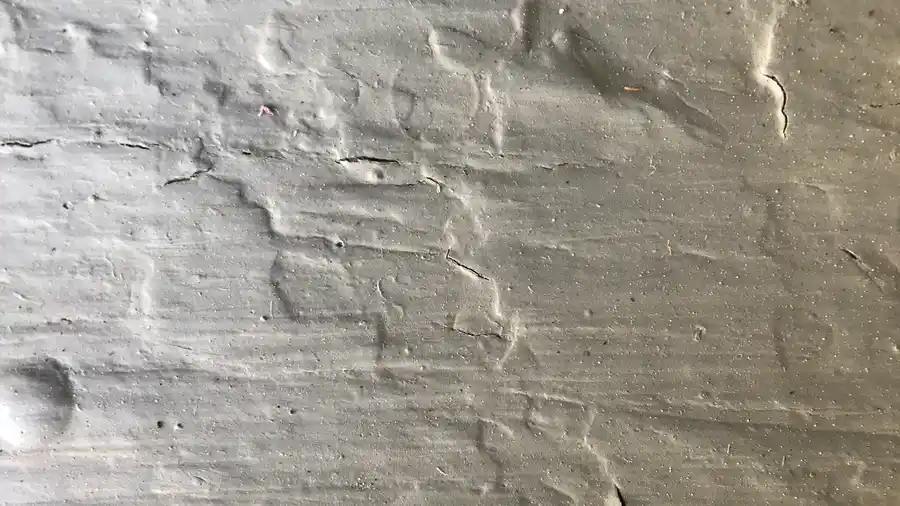
Do not overread one crack. Hairline surface cracking in concrete can come from shrinkage during curing, while settlement usually shows up as displacement, uneven edges, or widening tied to a support problem. A crack by itself is not enough. The point is to match pattern, timing, and location to a weather event that changes soil moisture or temperature.
If the slab movement is tied to a legal dispute over repair responsibility, warranty language, or a buyer-seller issue, that is where New York property and contract rules start to matter. Because those rules vary, a qualified lawyer should handle the jurisdiction-specific questions.
Common mistakes that make the diagnosis worse
The first mistake is blaming every crack on winter. Freeze-thaw cycles can worsen settlement, but they are not the only cause. The consequence is a bad diagnosis and the wrong repair. The better alternative is to compare the damage with rain, drainage, and drought history before drawing a conclusion.
The second mistake is ignoring drainage because the slab is “only” exterior concrete. A driveway or patio that sheds water poorly can saturate the subgrade just as effectively as a roof leak. The consequence is repeated wetting at the same edge. The better alternative is to trace where water goes during a storm and after snow melt.
The third mistake is treating drought as harmless because the ground looks dry. Dry soil can shrink, crack, and then re-wet unevenly. If the problem keeps changing, consult a qualified professional to check for voids, edge separation, and grade changes. The consequence is hidden support loss under the slab. The better alternative is to look for voids, edge separation, and changes in grade after a dry season.
The fourth mistake is assuming snow melt is the same as ordinary rain. Meltwater often arrives after freezing temperatures, and the ground may thaw unevenly under it. The consequence is concentrated runoff and softening at slab edges. The better alternative is to inspect where meltwater pools and whether it is entering joints or low spots.
The fifth mistake is using a single measurement and calling it the whole story. A 1/4-inch dip in one corner means little unless you know whether the rest of the slab is level, whether the crack is active, and whether the movement matches a weather event. The better alternative is to measure multiple points over time, ideally after a storm and again after a dry period.
The sixth mistake is confusing soil expansion with heaving. Expansive soil swells when wet, but the weather-related settlement question here is about worsening support loss under the slab, not about every vertical movement. The consequence is mixing up problems and missing the real driver. The better alternative is to separate soil wetting, soil drying, and slab response into distinct observations.
When weather alone is not the full explanation
Weather alone is not enough when the slab sits on poor fill, old disturbed soil, or a base that was never compacted well. In those cases, weather may trigger the movement, but the underlying construction condition is doing the real work.
One edge case is a slab placed over recent backfill. Even a modest rain of 1 inch can expose weak compaction by softening fill that was already marginal. The weather did not create the problem from nothing; it revealed it.
Another edge case is a slab adjacent to a tree or large shrub. Roots change drainage and soil moisture over a broad area, sometimes several feet beyond the trunk. Drought and rain then act on uneven soil conditions created by the roots. The weather still matters, but the planting pattern is part of the diagnosis.
A third edge case is a slab on a slope. Runoff accelerates downhill, so water may never soak the whole slab area evenly. That can produce one-sided settlement after heavy rain or snow melt. The same weather event will not affect a flat site the same way.
A fourth edge case is a slab with a radiant system or another heat source underneath or nearby. Heat can change freeze-thaw behavior and keep one area wetter or drier than another. That makes the weather pattern more complex, not less.
A fifth edge case is seasonal movement that appears and then partially fades. That can happen when frozen ground, thawed ground, and soil moisture all change within a few weeks. The slab may look worse in March and less uneven by June, which makes diagnosis harder. A temporary improvement does not necessarily mean the underlying support issue is gone.
The practical takeaway is that weather can make settlement worse, but it is not always the only factor. Soil, drainage, and construction details decide how hard the weather hits.
What should you do first if you think weather is making it worse?
The first step is to document the slab and the weather pattern together, not separately. Take dated photos, measure the same points with a level, and note the last major rain, thaw, or dry spell. That gives you a clearer picture than memory alone.
Then check the easy moisture sources: downspouts, grading, sprinklers, gutter discharge, and places where snow piles against the slab. A downspout extension that moves water 6 to 10 feet away can change the wetting pattern dramatically, while a clogged gutter can undo that benefit fast. You are not fixing the slab here; you are testing whether water concentration is part of the problem.
Next, compare the movement over at least two weather cycles. One wet period and one dry period are often enough to show whether the slab changes with moisture. If the movement is stable, the cause may be older and less weather-dependent. If it changes after storm events, weather is a stronger suspect.
Do not rush to a repair choice before the pattern is clear. A slab that settles because the soil is wet needs a different diagnosis than one that moves because the soil shrank in drought and opened voids. The same visible symptom can point to different ground behavior.
For New York readers, the key is not to treat weather as a vague background factor. Freeze-thaw cycles, rain, snow melt, and drought all leave different fingerprints. If you can match the damage to one of those fingerprints, the diagnosis becomes far more reliable. For more detail on slab movement patterns, see the settlement inspection checklist.
Does heavy rain cause slabs to sink?
Heavy rain can contribute to slab settlement, but it usually works by softening or saturating the soil under and beside the slab rather than by pushing the concrete down directly. In New York, the same storm can affect different properties differently because grading, runoff, and soil type vary so much. A 1-inch rain may be enough to reveal a weak base, while a longer wet period may be needed to trigger visible movement on a better-prepared slab.
Drafted with AI; not yet reviewed by a person.