
Last updated: November 19, 2026
Quick Answer: Yes—a settling slab can damage plumbing and utility lines, and the first failures often show up at slab penetrations, rigid connections, and shallow runs. In homes built on slab foundations, the damage can start with a small offset or crack and then worsen over time. If you are asking, “Can a Settling Slab Damage Plumbing or Utility Lines?”, the practical answer is yes, especially when movement is ongoing.
Yes, a settling slab can damage plumbing and utility lines, especially where pipes pass through the concrete slab or run just below it. The risk is highest at rigid connections, shallow water pipes, drain lines with little slope, and utility penetrations that cannot move with the slab.
If a slab is dropping unevenly, the concrete does not just “sink” in place. It can bend, pinch, or pull on a pipe, fitting, or conduit by a small amount at first and then by more as movement continues. That is why this question matters: the damage often starts as stress, not a dramatic break.
Key takeaways
- A settling slab can crack a pipe long before anyone sees water on the floor.
- Water lines are vulnerable to tension and offset; drain lines are vulnerable to slope changes and joint separation.
- The most exposed spots are slab penetrations, turn points, and places where rigid plumbing meets moving concrete.
- A slow leak under the slab can waste water and erode soil for months before the floor shows a stain.
- Utility lines are not all affected the same way; gas, electrical, and communication conduits have different failure modes.
- If the slab movement is still active, repairs that ignore the movement often fail again.
Where a settling slab puts the most stress on plumbing
A settling slab damages plumbing when the concrete moves more than the pipe can tolerate. The danger is not the same everywhere under the floor. A pipe running parallel to the slab may survive a little movement, while a pipe crossing a crack or passing through a sleeve may take the full bend in one spot.
The most exposed locations are usually utility penetration points, short rigid runs, and transitions from buried pipe to fixed fixtures. A 90-degree elbow at a slab edge can act like a hinge under load. A coupling can separate by a few millimeters and still start a leak. That small gap matters because pressure in a supply line keeps feeding the opening.
Plumbing inside a slab is often the hardest hit because it cannot “float” with the floor. Copper, PVC, ABS, and cast iron each fail differently, but they all dislike repeated movement. Copper can work-harden and crack. Plastic drain pipe can shear at a joint. Cast iron can fracture at a hub or break from misalignment.
A useful way to think about the problem is this: the slab is not crushing the pipe like a truck tire. It is changing the pipe’s geometry. A line that was straight yesterday may be forced into a shallow bow today. That bow becomes a stress point, and stress becomes a leak or blockage later.
This is the kind of issue that belongs in a broader slab safety and urgency review, because the plumbing damage is often a symptom of ongoing movement, not a one-time event.
Can a settling slab damage plumbing line by line?
Yes, and the failure mode depends on the type of line. A water pipe usually fails by leakage under pressure, while a drain line usually fails by loss of slope, cracking, or joint separation. Utility lines in sleeves or conduits may not leak water, but they can still be damaged enough to stop working properly.
Water supply lines
Water supply lines are under constant pressure, so even a hairline crack can become a visible leak. A copper line under a slab may crack at a soldered joint or at a bend near a wall penetration. PEX is more flexible than copper, but it is not immune when it is trapped by concrete or pinched at a transition point. If the slab settlement pulls the pipe sideways, the result can be a slow leak first and a larger break later.
Drain lines
Drain lines do not carry pressure, but they depend on a correct slope. Most gravity drains need enough fall to move waste away without standing water. When a slab settles, a drain line can belly, dip, or reverse its grade over a short stretch. That creates slow drains, recurring clogs, or sewage backup. A cracked drain pipe may not leak much at first because it is not pressurized, which makes the damage easier to miss.
Utility conduits and non-plumbing lines
Utility lines include more than water and waste. Electrical conduit, gas piping, telecom lines, and irrigation tubing can all be affected if they pass through or under a moving slab. Electrical conduit may buckle or pull loose at a junction box. Gas piping can stress a fitting if the structure moves enough, which is a serious safety issue and needs prompt attention by the proper licensed trade. For gas service and utility safety basics, see the PHMSA gas safety page.
The short version is simple: a slab can damage any line that is fixed on both ends and forced to follow the concrete as it moves. That rule applies whether the line is carrying water, waste, gas, or cable.
What warning signs point to slab movement affecting plumbing?
A changing water bill, a new crack near a penetration point, or repeated drain trouble can all point to slab movement affecting plumbing. The clues are often indirect because the pipe may fail under the floor before it leaks where you can see it.
Watch for wet carpet, warm spots on a floor over a hot water line, or a musty odor near a wall with plumbing. Those signs can show up before any visible puddle. A supply leak under a slab may also cause one section of flooring to feel damp or slightly soft. A drain issue may show up as gurgling, slow flushes, or a sewage smell after heavy use.
The shape of the floor matters too. If a door starts rubbing, tile grout opens along one path, or a baseboard gap grows near a bathroom, the slab may be moving enough to strain a pipe. At a penetration point, look for a crack running outward from the pipe location. That crack can be a clue that the pipe is being pulled or bent.
A simple check sequence helps narrow it down:
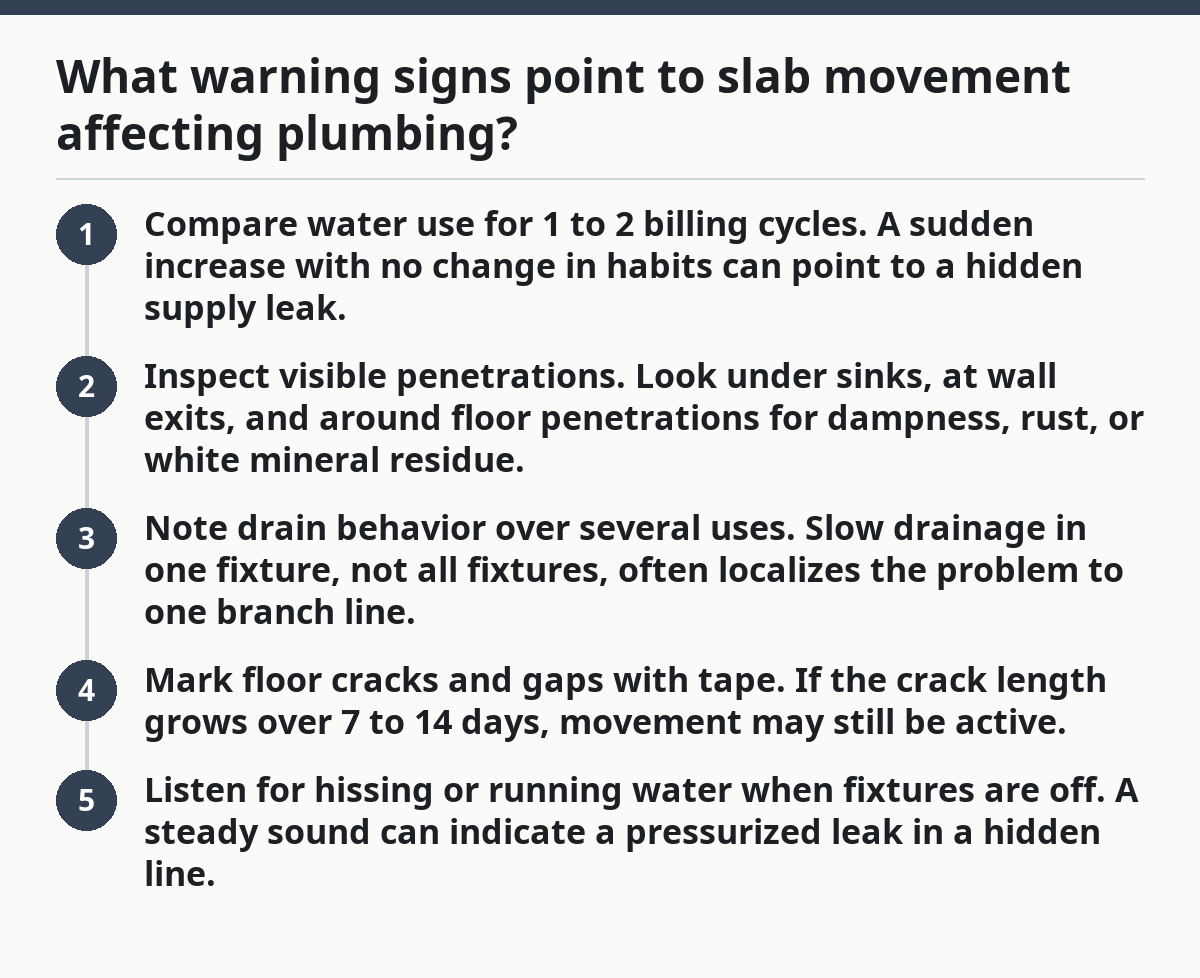
- Compare water use for 1 to 2 billing cycles. A sudden increase with no change in habits can point to a hidden supply leak.
- Inspect visible penetrations. Look under sinks, at wall exits, and around floor penetrations for dampness, rust, or white mineral residue.
- Note drain behavior over several uses. Slow drainage in one fixture, not all fixtures, often localizes the problem to one branch line.
- Mark floor cracks and gaps with tape. If the crack length grows over 7 to 14 days, movement may still be active.
- Listen for hissing or running water when fixtures are off. A steady sound can indicate a pressurized leak in a hidden line.
That sequence does not replace a plumber’s diagnosis, but it helps separate slab-related plumbing trouble from a fixture problem or a simple clog. For leak-tracing basics, the EPA water leak guidance is a useful starting point.
Which utility penetration points are most vulnerable?
Utility penetration points are the places where a pipe or conduit crosses the slab, and those are the spots most likely to fail first. The slab may move only a small amount, but the stress concentrates where the utility line is restrained.
The classic weak points are:
- Pipe sleeves through the slab, especially if the pipe no longer sits centered in the sleeve
- Rigid fittings right at the slab edge
- Joints located within a few inches of a crack
- Lines that turn 90 degrees immediately after exiting the slab
- Penetrations patched tightly with mortar or grout, which removes any room for movement
A sleeve is supposed to let the pipe move a little without grinding against concrete. If the sleeve is too tight, filled solid, or damaged, the pipe loses that buffer. The same problem shows up when a line was installed with minimal clearance and later settlement steals the little movement allowance it had.
Drain lines are especially sensitive at cleanouts and junctions. If a cleanout cap sits slightly off plumb, it can hint that the line below has shifted. A water line may still look normal at the surface while the joint below is taking load.
This is where a generic “slab crack” article often misses the real issue. The crack itself may not be the problem. The problem is what the crack does to the line crossing it. A 1/8-inch offset at a penetration can be enough to start a leak in a rigid pipe, even if the floor damage looks minor.
How to judge the likely damage before opening the slab
A settling slab can damage plumbing without a full break, so the first job is to judge whether the line is stressed, leaking, or still holding. That decision keeps the repair focused. Opening the wrong spot can add cost and create a second problem.
Start with the type of line. A supply line under pressure is more urgent than a drain line with a slow slope issue. Then map where the line runs in relation to visible movement. A crack that crosses the pipe path is more suspicious than a crack that runs far away from it. A utility line crossing a settlement zone at an angle is more vulnerable than one that runs parallel to the movement.
A plumber or leak-detection technician may use acoustic listening, pressure testing, or a camera for drain lines. Those tools can identify a leak or deformation without guessing at the slab. A pressure test can show whether a water line is losing pressure. A drain camera can show a belly, offset joint, or crushed section. Those methods matter because a slab repair alone does not fix a pipe that has already failed.
There is one honest limit here: if the slab is still settling, a plumbing repair can be temporary. Fixing a split line without stabilizing the movement may buy time, but it does not remove the stress source. That is why line repair and slab movement need to be treated as connected problems, not separate ones. If the movement is active or the pipe is gas-bearing, consult a licensed plumber, leak-detection technician, or structural professional before choosing a repair path. The American Society of Home Inspectors and similar trade groups recommend professional evaluation when structural movement and concealed plumbing damage overlap.
What the right response looks like when plumbing is involved
The right response is to locate the affected line, stop further water loss or gas risk, and decide whether the utility line can be repaired without disturbing the moving slab. That sequence is safer than patching symptoms one by one.
A practical order is:
- Shut off the affected service if needed. For a suspected supply leak, close the nearest valve or the main shutoff. The result should be a stop in active water flow.
- Confirm the line type. Identify whether the issue is on a water pipe, drain line, gas line, or other utility line. The next step depends on pressure, contents, and access.
- Map the damaged zone. Mark visible cracks, wet spots, and utility exits with painter’s tape or chalk. This makes the movement pattern easier to read.
- Use a proper diagnostic method. Pressure testing, camera inspection, or leak tracing can show whether the line is cracked, offset, or merely stressed.
- Repair the line and the movement source in the right order. If the slab is still moving, the pipe repair may need a flexible transition, rerouting, or a protected chase rather than a hard reset into concrete.
This is not a DIY job when gas piping, main water service, or electrical conduit is involved. A plumber or the appropriate licensed utility contractor should handle those repairs, because the failure can be hidden and the consequences are not minor. If the damage is tied to a structural settlement problem, the fix often has to be coordinated rather than improvised. For foundation movement and repair planning, see foundation repair methods and when to call a structural engineer.
What this answer means in plain English
A settling slab can absolutely damage plumbing, and it can do so before the floor looks severe. The pipes most at risk are the ones trapped at slab penetrations, forced through tight bends, or tied into fixed fixtures with no room to move. Water lines tend to leak under pressure. Drain lines tend to lose slope, crack, or separate. Utility lines can fail in different ways depending on what they carry.
The part many readers miss is that the slab does not need to collapse to cause trouble. Small movement over weeks or months is enough to strain a pipe, especially at a joint or transition. That is why visible floor damage and plumbing damage do not always arrive together.
If the line is leaking, backing up, or tied to gas or electrical service, the safer assumption is that the slab movement matters until proven otherwise.
Drafted with AI; not yet reviewed by a person.