Last updated: November 20, 2026
Key Takeaways
- Fix the cause of movement before choosing a repair.
- Match the lift method to the slab condition and future movement risk.
- Mudjacking uses cement slurry to fill voids and lift settled concrete.
- Polyurethane foam lifting uses expanding foam for fast, small-hole slab repair.
Quick Answer
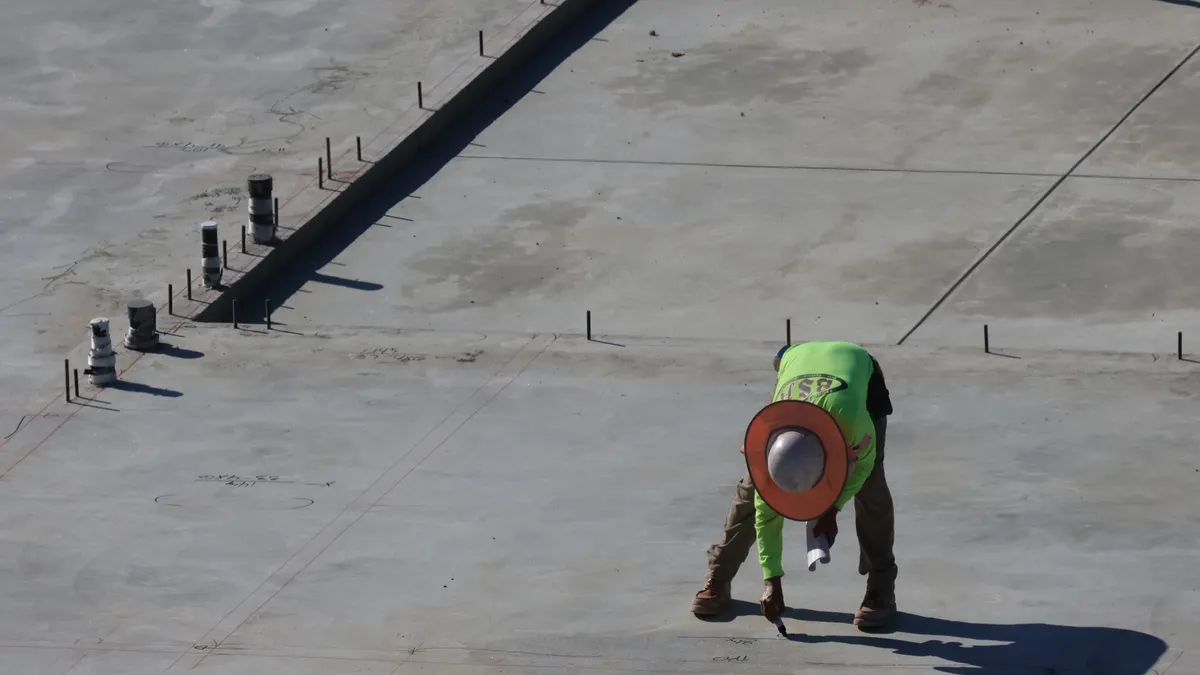
For slab lifting methods and repair decisions, the first step is to measure the drop. A 1/4-inch offset may be repairable with lifting, while a 2-inch corner drop often needs more than cosmetic patching.
Slab lifting is the right fix when concrete has settled, but the right method depends on why it moved, how much it moved, and whether the slab is still structurally sound. In the topic of Slab lifting methods and repair decisions — The Complete Guide, the real decision is not “lift or replace” but “lift, stabilize, seal, or tear out.”
What you need to know first before any repair
The right repair starts with the cause of the movement, not the visible crack. If the slab is only 1/4 inch low at a doorway, that may be a simple lift-and-fill job; if one corner has dropped 2 inches because the base washed out, the repair needs more than cosmetic patching.
The practical sequence is simple:
-
Measure the movement. Use a 4-foot level, a laser level, or a straightedge.
Check: how far the slab dropped, whether the settlement is uniform, and whether adjoining slabs moved together.
Do not: guess from the crack alone. -
Look at the crack pattern. Hairline shrinkage cracks are not the same as a faulted joint or a slab that has broken into separate pieces.
Check: whether the crack is vertical displacement, not just surface cracking.
Do not: assume every crack means the slab has failed. -
Find the cause of settlement. Water from downspouts, poor compaction, tree roots, voids, and plumbing leaks are the usual suspects.
Check: drainage slope, gutter discharge, soft soil, and repeated wetting.
Do not: lift over an active leak or ongoing washout. -
Decide whether the slab is a candidate for lifting. Monolithic slabs with intact edges often are; badly broken, thin, or undersupported slabs often are not.
Check: slab thickness, edge condition, and whether reinforcement is exposed or broken.
Do not: pay for lifting if the concrete will just keep fracturing. -
Choose the repair method. Mudjacking, polyurethane foam lifting, or full replacement each has a different use case.
Check: access, load needs, finish tolerance, and budget.
Do not: choose the lowest price if it will not stabilize the base. -
Fix the cause after the lift. Re-route water, repair leaks, and backfill voids.
Check: whether the slab stays level after the first heavy rain.
Do not: treat lifting as a permanent cure if drainage is still wrong.
A useful rule of thumb: if the slab has settled but is otherwise intact, lifting is often worth considering. If the slab is badly cracked, rocking, or crumbling, replacement may be the better long-term call.
Which slab lifting method actually fits the problem?
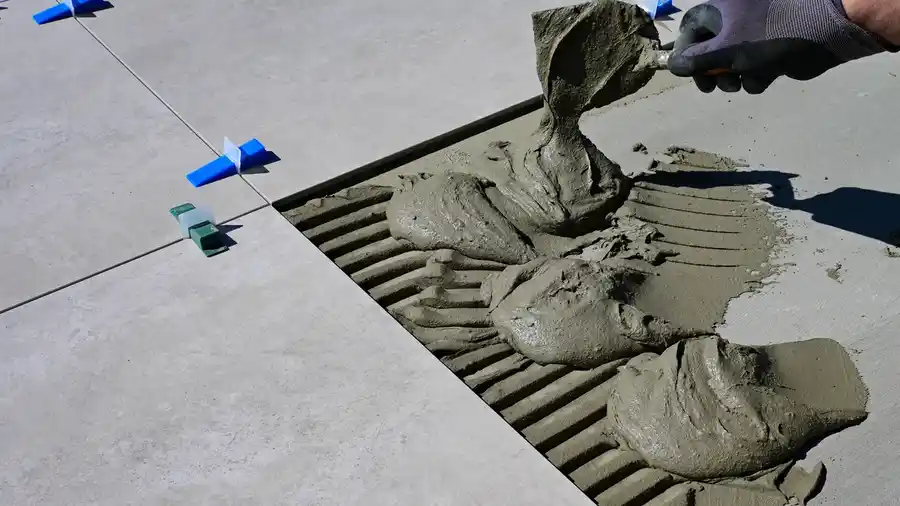
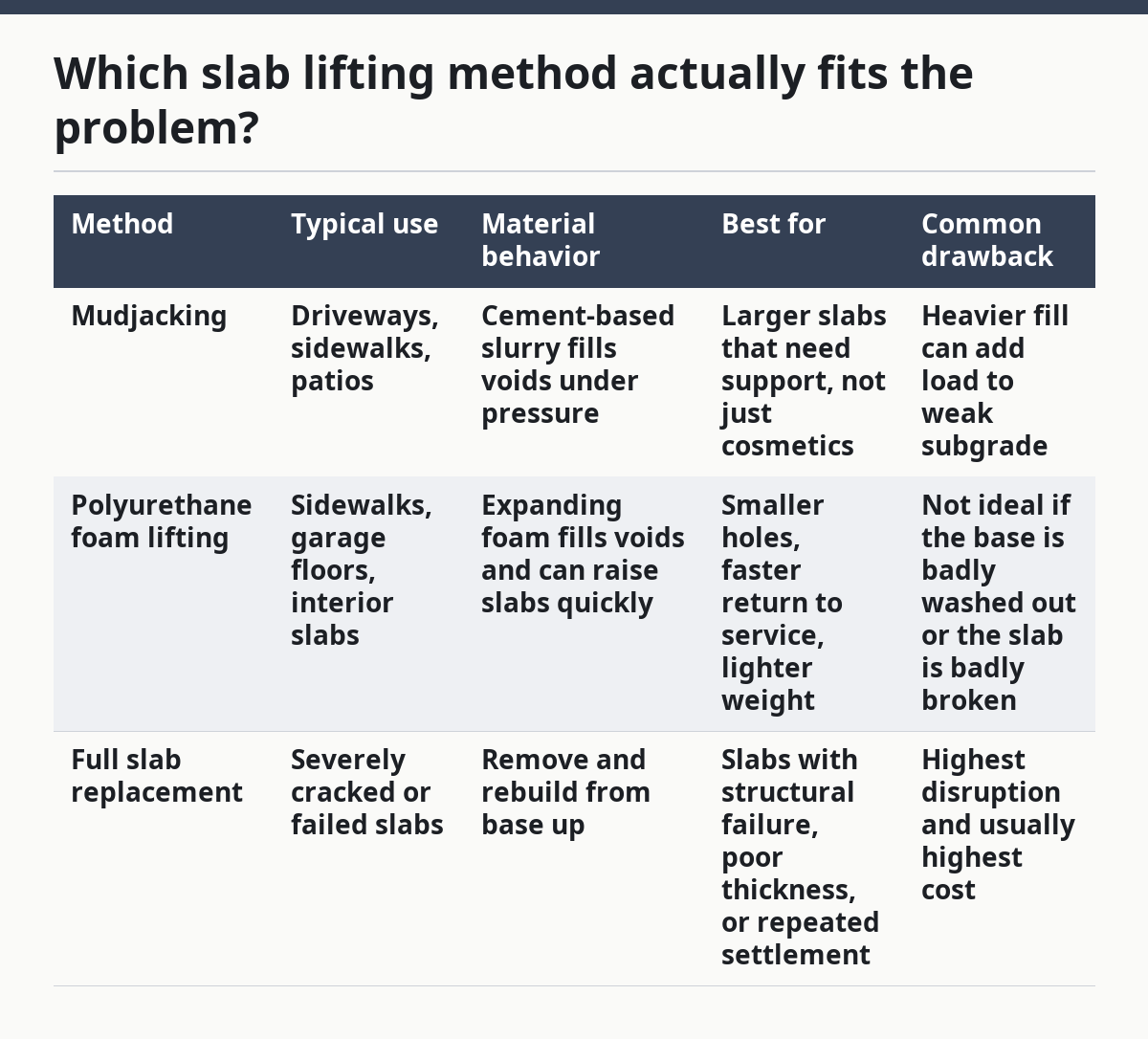
The best slab lifting method matches the slab, the void, and the tolerance for future movement. Mudjacking is usually the older, heavier option; polyurethane foam is lighter and faster; replacement is the fallback when the slab is too damaged to save.
Here is the basic comparison:
| Method | Typical use | Material behavior | Best for | Common drawback |
|---|---|---|---|---|
| Mudjacking | Driveways, sidewalks, patios | Cement-based slurry fills voids under pressure | Larger slabs that need support, not just cosmetics | Heavier fill can add load to weak subgrade |
| Polyurethane foam lifting | Sidewalks, garage floors, interior slabs | Expanding foam fills voids and can raise slabs quickly | Smaller holes, faster return to service, lighter weight | Not ideal if the base is badly washed out or the slab is badly broken |
| Full slab replacement | Severely cracked or failed slabs | Remove and rebuild from base up | Slabs with structural failure, poor thickness, or repeated settlement | Highest disruption and usually highest cost |
The key visual difference is what happens at the crack and the edge. A good lift brings the slab back into plane so the joint or crack no longer catches a wheel or trips a foot. A bad lift leaves a visible lip, a hollow-sounding section, or a crack that widens because the base was never stabilized.
The first question to ask is not “Which method is newest?” It is “What is under the slab right now?”
-
Mudjacking is often chosen when the slab has broad settlement and there is enough room to drill larger injection holes.
Check: whether the slab needs heavy support and whether the area can tolerate larger patch marks.
Do not: use it where the soil is so weak that added weight is part of the problem. -
Polyurethane foam lifting is often chosen when speed matters, such as a garage floor, entry walk, or commercial sidewalk.
Check: whether the slab needs a lighter fill, quick cure time, and smaller drill holes; consult a professional before choosing.
Do not: expect foam to solve active erosion or major voiding by itself. -
Replacement is the right answer when the slab is cracked through, heaved by roots, broken into multiple moving pieces, or too thin for reliable repair.
Check: whether the repair would merely disguise a structural problem.
Do not: keep paying to jack up a slab that has already failed at the base and at the concrete itself.
A simple test: if the slab can be lifted and then stays supported, lifting makes sense. If the concrete keeps flexing after the void is filled, the slab may be telling you to replace it.
How mudjacking works without the guesswork
Mudjacking pumps a cement-based slurry under the slab to fill voids and raise it back toward level. It is the heavier, older method, and it works best when the concrete is intact and the problem is a void or soft support rather than a shattered slab.
The process usually looks like this:
-
Map the settled area. Mark the low points and measure the height difference with a level or laser.
Check: where the slab is low relative to adjacent concrete.
Do not: drill before you know the lift pattern. -
Drill injection holes. Holes are usually spaced across the settled section, often 1.5 to 2 inches in diameter for mudjacking.
Check: hole placement over the area that needs support, not just at the visible crack.
Do not: place holes too close to a weak edge. -
Pump the slurry. The mix is forced beneath the slab until it starts to rise.
Check: whether the slab responds evenly and whether the pressure feels controlled.
Do not: overpump and create a hump. -
Watch the slab edge and joints. The key here is the joint line — notice how it closes gradually as the slab rises. This is what separates a controlled lift from a slab that fractures under pressure.
Check: alignment with neighboring concrete.
Do not: chase perfect height if the adjacent slab is already sloped for drainage. -
Patch the holes. The openings are sealed after the lift is complete.
Check: patch color and adhesion.
Do not: leave unsealed holes that admit water. -
Verify drainage. Water should still run away from the structure.
Check: after the patch cures, inspect whether puddles form at the same low spot.
Do not: create a flat area where water now sits against the building.
Mudjacking is often appropriate for sidewalks, porch slabs, drive approaches, and patios where the goal is support and recovery of usable elevation. It is less attractive when the slab is thin, highly decorative, or sensitive to additional load.
How polyurethane foam lifting is different
Polyurethane foam lifting uses expanding foam to raise and stabilize a slab with small injection holes and fast cure times. It is often the cleaner-looking option, but it is not magic; it still depends on a competent base and a slab that can be saved. Consult a professional if the slab has active washout, because a site problem can overwhelm any lift method.
The usual workflow is straightforward:
-
Identify the settled zone. Find the exact low line, especially where the slab meets a garage door, threshold, or adjoining panel.
Check: the amount of lift needed, often in fractions of an inch up to a few inches.
Do not: assume a foam lift can correct a badly shattered slab. -
Drill small ports. The holes are typically much smaller than mudjacking holes.
Check: port spacing and slab thickness.
Do not: drill through a slab edge that is already weak. -
Inject foam in stages. The foam expands, fills voids, and lifts the slab gradually.
Check: whether the lift is even and whether the slab begins to respond before a hard spot develops.
Do not: inject too quickly and force a corner upward. -
Observe the joint and crack edges. The important visual cue is whether the crack line closes without new stair-stepping.
Check: that the slab rises as one piece, not as a hinge.
Do not: keep injecting if the concrete starts to flex. -
Trim and seal. Excess material is removed, and the ports are filled.
Check: that the finished surface is flush and safe for foot traffic.
Do not: leave a proud plug that creates a trip point. -
Return to service after cure. Foam often cures quickly, which is useful for driveways and commercial entries.
Check: manufacturer cure guidance for the specific product used.
Do not: drive on it before the material has set.
Foam lifting is a strong choice when the slab is intact, the goal is speed, and the access holes need to stay small. It is a weaker choice when the soil has been washed away in a wide void or when repeated water intrusion will keep undermining the base.
When lifting is the right repair — and when replacement wins
Lifting is the right repair when the slab is structurally usable and the issue is loss of support, not loss of integrity. Replacement wins when the concrete itself has failed, the base is unstable, or the slab has already crossed the line from settlement to breakup.
Here is a practical decision guide:
| Condition | Lifting usually makes sense | Replacement usually makes more sense |
|---|---|---|
| Crack type | Hairline or moderate crack with one side low | Wide, multiple, or moving cracks through the slab |
| Surface condition | Mostly intact surface, no major crumbling | Spalling, broken corners, exposed reinforcement |
| Settlement | One area settled from a void or soft soil | Repeated settlement from ongoing drainage failure |
| Slab size and use | Sidewalk, patio, garage slab, driveway panel | Heavily loaded slab with structural distress |
| Goal | Restore trip safety and support | Fix a slab that has failed at the base and in the concrete |
The key visual clue is whether the slab behaves like one piece. A slab with a clean settlement line often lifts well. A slab that rocks, crumbles, or has a jagged vertical break may be telling you it is no longer a single repairable unit.
A good repair decision also respects the ground beneath the slab:
-
If water is the cause, fix water first.
Check: downspouts, grading, irrigation overspray, or plumbing leaks.
Do not: lift into wet, pumping soil and expect the slab to stay put. -
If the slab is too damaged, stop trying to save it.
Check: whether crack repair would be purely cosmetic.
Do not: spend on lifting if replacement is the only durable outcome. -
If the slab is salvageable but the finish matters, match the method to the use.
Check: visible surface, traffic load, and repair tolerance.
Do not: over-engineer a small cosmetic issue or under-engineer a structural one.
Replacement is more disruptive, but sometimes that is the honest answer. A slab that has failed repeatedly usually costs more in repeated lifts than in one properly built replacement.
What a good lift should look like after the repair
A good lift looks boring: the surface is even, the trip edge is gone, and the slab no longer sounds hollow in the problem area. The repair should restore function without drawing attention to itself.
The finish check is visual and practical:
- The lifted slab should sit close to the elevation of adjacent concrete, with no abrupt lip that catches a shoe or tire.
- Crack lines may remain visible, but they should no longer show a step between sides.
- Drainage should still move away from the structure. A flat spot that ponds water is a failed outcome, even if the slab is level.
- Patch marks should be flush, not proud of the surface.
- The slab should feel solid under foot, not springy or hollow.
| Check point | Good result | Poor result |
|---|---|---|
| Edge alignment | Transition feels smooth to foot and wheel | Sharp lip remains |
| Drainage | Water runs away or across as designed | Water pools near door or foundation |
| Surface sound | Solid response when tapped | Hollow response suggests remaining voids |
| Crack behavior | Crack remains but is no longer offset | Crack opens further after lift |
| Patch finish | Holes sealed flush | Patches stand proud or crumble |
The first 24 hours matter, but the next heavy rain matters more. If the slab settles again after a storm or after seasonal soil movement, the cause was not corrected. That means the repair decision needs to be revisited instead of repeated blindly.
A lift is successful when it solves the problem you actually had. If the problem was a trip hazard, the fix should remove the step. If the problem was drainage, the fix must preserve slope. If the problem was base failure, the fix must restore support, not just surface height.
How to choose a contractor without getting the wrong repair
The right contractor will explain the cause, the method, and the limits before talking price. If the first pitch is just “We can lift it today,” that is not enough for a slab with settlement, drainage issues, or repeated movement.
Ask these questions:
-
What caused the slab to settle?
Check: whether the answer mentions drainage, washout, or soil voids.
Do not: accept a vague answer about “normal settling.” -
Which method are you recommending, and why?
Check: whether the method matches the slab’s condition and use.
Do not: let a one-method shop push the same fix for every slab. -
Will the lift affect drainage?
Check: whether the contractor measures slope, not just height.
Do not: create a new ponding problem at a doorway or garage apron. -
What happens if the slab cracks more during lifting?
Check: whether the risk is discussed honestly.
Do not: assume concrete can be moved like a tabletop. -
What warranty or follow-up is included?
Check: whether there is a clear written term and what it covers.
Do not: rely on verbal promises alone.
A good contractor will also point out when lifting is the wrong fix. That honesty matters more than a polished sales pitch. If the slab is too broken, too thin, or too unstable, the best recommendation may be replacement, not repair.
One useful standard to keep in mind is that concrete work should follow the logic of the slab itself, not the convenience of the crew. When a repair matches the failure mode, the result lasts longer and looks cleaner.
What should I do if my slab is cracked and uneven?
The first move is to measure the drop and find out whether the slab is still structurally sound. A crack with a 1/4-inch to 1/2-inch offset may be a lift candidate, but a slab that is crumbling, rocking, or broken into several moving pieces usually needs more than lifting.
Is polyurethane foam better than mudjacking?
Polyurethane foam is better when you want smaller drill holes, faster cure time, and a lighter material under the slab. Mudjacking can be a better fit when the slab needs broader support and the site can tolerate larger injection holes. The right choice depends on the slab, not the trend.
Can every settled slab be lifted?
No, not every settled slab should be lifted. Lifting works best when the slab is mostly intact and the problem is lost support underneath. If the concrete has failed, the base is actively washing out, or the slab is too damaged to move as one piece, replacement is usually the wiser repair.
How do I know if the problem is drainage or just age?
Because drainage problems usually show a pattern, look for repeated settlement near downspouts, low spots that get worse after rain, or soft soil near the edge of the slab. Age alone does not usually create one clean sunken area. If the movement follows water, the water issue needs to be fixed before or alongside the repair.
Drafted with AI; not yet reviewed by a person.