
How to Tell If a Concrete Slab Needs Foam, Mudjacking, or Neither

Last updated: November 19, 2026
Quick Answer: To tell whether a concrete slab needs foam, mudjacking, or neither, look for settlement, support loss, and active movement; if the slab is only slightly uneven and still stable, it may need neither repair. This guide explains how to tell if a concrete slab needs foam, mudjacking, or neither, using the slab’s condition, not the repair material, as the starting point. If the slab has settled because of voids or weak support, it usually needs lifting; if the movement is minor, stable, and mostly cosmetic, it may need neither foam nor mudjacking. The real job is to tell whether the concrete has dropped, whether the drop is still active, and whether the fix should be polyurethane foam injection, mudjacking, or a different repair altogether.
Start with the slab, not the repair method
The right decision comes from what the slab is doing, not from which material sounds better. A concrete slab with 1/4 inch of uniform settlement and no ongoing movement is a very different problem from a slab with a 1 inch corner drop, a widening crack, and soft soil at the edge.
Begin with three observations:
- Check the shape of the movement. Look for one end lower than the other, a center dip, or a corner that has dropped away from the rest of the slab. A straightedge, level, or string line helps here. If the low area is localized, lifting may be appropriate. If the whole slab is racked, cracked through, or broken into many pieces, lifting may not solve the real problem.
- Look for signs of voids under the slab. Hollow sound, rocking at the edge, or a gap at the base of the slab often means there is empty space below. That points toward a lifting method rather than simple patching.
- Decide whether the movement is structural or cosmetic. Hairline cracks that stay narrow are often consistent with settlement. Cracks that widen, offset vertically, or continue to spread suggest more than surface-level settlement. If the slab has heaved instead of settled, foam or mudjacking may not be the right fix.
If the slab is only slightly uneven and still drains correctly, a contractor may recommend leaving it alone and monitoring it. That is often the smarter choice than filling holes in search of a correction that adds cost without solving a real problem.
How do I know if a concrete slab needs lifting?
A concrete slab needs lifting when the slab has dropped enough to create a functional problem, and the support below it has failed in a way that lifting can address. That is the clearest answer, but the details matter because not every low slab should be raised.
Use this order:
- Measure the low spot. Place a long level or straight board across the slab and measure the gap at the low point. Small variations can be normal. A visible low area that creates a trip edge, directs water toward the house, or makes a door bind is a practical sign that lifting should be considered.
- Inspect the joints and edges. Edge settlement is common where water washes soil away, especially along driveways, walks, and slab edges near downspouts. If the edge has dropped while the interior stays intact, lifting is more likely to help than replacement.
- Check for movement at transitions. A slab that has dropped beside a garage floor, porch step, or adjacent slab can often be lifted if the surrounding concrete is sound. If the transition is badly broken, lifting may only expose the next failure.
- Test for void-related clues. A drumlike hollow sound, a soft shoulder at the edge, or a section that flexes under load suggests support loss beneath the concrete. That is the kind of condition foam or mudjacking is meant to address.
- Watch for repeat settlement. If a repaired area keeps dropping, the cause may be ongoing water intrusion, poor compaction, or expansive soil. In that case, the lift alone may not hold.
A slab that is out of level but stable, drains well, and does not create a use problem is a gray area. In that case, lifting may be optional rather than necessary. The right answer depends on whether the movement affects safety, drainage, or the next repair.
For a broader overview of concrete slab lifting methods and applications, the hub page can sit alongside this guide.
How to tell if a concrete slab needs foam, mudjacking, or neither
Foam is usually the better choice for small voids, cleaner access, and precise lifting; mudjacking is often considered when larger fills are needed and the slab is thick enough to tolerate a bulkier lift; neither is right when the slab is broken, the soil keeps moving, or the issue is not settlement at all.
Use the following filter before you call contractors:
- Look at slab thickness and condition. Thin, cracked, or deteriorated concrete can be risky to lift aggressively. If the slab is badly fractured, replacing sections may make more sense than trying to restore level.
- Check access to the work area. Polyurethane foam injection uses smaller drill holes and lighter equipment, which can matter in tight spaces, along finished landscaping, or near delicate surfaces. Mudjacking uses larger holes and heavier slurry equipment, so access can be more demanding.
- Judge the amount of void and settlement. If the slab has only a modest drop but clear support loss, foam can be a practical fit because it can be placed with more precision. If the void is broad and the slab is sound enough to handle it, some contractors may consider mudjacking.
- Separate settlement from other problems. Cracks caused by shrinkage, freeze-thaw damage, poor finishing, or structural failure are not automatically solved by lifting. A lift can level a slab and still leave the same underlying defect in place.
- Ask whether the ground is still changing. If water keeps entering the same area, or if the subgrade is unstable, any lift may be temporary. That is the clearest “neither” case: fix drainage, grading, or soil conditions first.
A generic article often treats foam as always better because it is newer and cleaner-looking. That misses the real question. The right method depends on the slab, the access, and whether the soil below is stable enough for any lift to last. According to the U.S. Department of Energy’s water management guidance, controlling drainage and runoff is part of preventing repeated foundation and slab problems, which is why site conditions matter before any lift is chosen.
What hairline cracks, offsets, and edge drops are telling you
Hairline cracks without offset often point to settlement or shrinkage, while vertical displacement, widening joints, and corner drop point toward movement that may justify lifting or replacement. The crack itself is not the whole story; the way it behaves is what matters.
Here is how to read the common signs:
- Hairline crack with no offset: Often cosmetic or minor settlement. If the slab is otherwise stable and level enough, neither foam nor mudjacking may be needed.
- Hairline crack that has one side higher than the other: That offset means the slab has moved unevenly. Lifting may help if the slab is still in one piece and the support loss is localized.
- Wide crack that keeps opening: That suggests active movement. Lifting may be only a short-term correction unless the cause is addressed.
- Corner drop at an outside edge: This often points to voids from erosion, downspout runoff, or soil washout. Edge lifting can work if the slab edge is intact, but very thin edges can break during the process.
- Pattern of multiple cracks across the slab: That is the point where neither method may be the right first move. The slab may be too fractured to lift cleanly.
A useful rule: if you can place a straightedge across the slab and the defect is mostly about elevation, lifting is on the table. If the concrete itself is failing, lifting is only part of the answer.
The edge matter is especially important. Lifting a slab corner that has lost support can work well when the concrete is thick and the break is clean. It can fail when the edge is crumbled, the slab has spalled badly, or the low area extends farther than the visible crack.
Access conditions can decide the method before the soil does
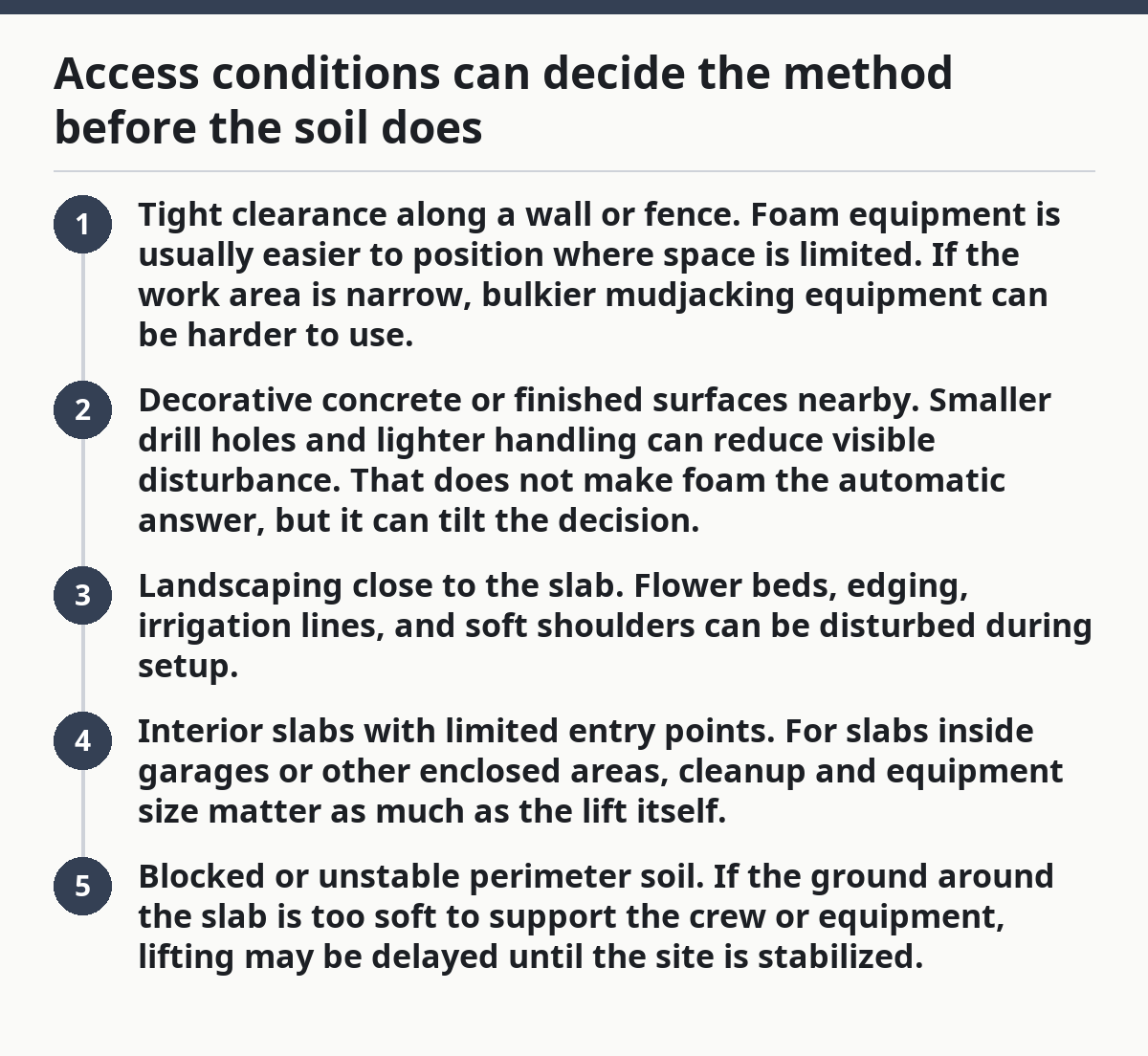
Access conditions can rule out one repair method even when the slab itself is a candidate for lifting. The crew has to reach the slab, drill, inject, and monitor the rise without damaging the area around it.
Pay attention to these access limits:
- Tight clearance along a wall or fence. Foam equipment is usually easier to position where space is limited. If the work area is narrow, bulkier mudjacking equipment can be harder to use.
- Decorative concrete or finished surfaces nearby. Smaller drill holes and lighter handling can reduce visible disturbance. That does not make foam the automatic answer, but it can tilt the decision.
- Landscaping close to the slab. Flower beds, edging, irrigation lines, and soft shoulders can be disturbed during setup.
- Interior slabs with limited entry points. For slabs inside garages or other enclosed areas, cleanup and equipment size matter as much as the lift itself.
- Blocked or unstable perimeter soil. If the ground around the slab is too soft to support the crew or equipment, lifting may be delayed until the site is stabilized.
Access problems do not always change the final repair, but they change the cost and the time. A simple lift that might take part of a day can take longer if the crew has to protect surfaces, move equipment carefully, or work around utilities and finished landscaping.
If you are comparing contractors, ask what access they need, how many drill points they expect, and whether the slab edge is thick enough for the method they propose. Those questions can tell you more than a sales pitch about “the best fix.”
When neither foam nor mudjacking is the right call
Neither method is the right call when the slab is too broken, the soil problem is still active, or the movement is not a settlement problem in the first place. That is the most expensive mistake to miss, because a lift can look successful for a while and still leave the site failing.
Skip lifting or pause before approving it if you see any of these:
- Severe breakup or crumbling concrete. If the slab is shattered, patching or partial lifting may waste money. Replacement is often the more honest repair.
- Heaving instead of settlement. If part of the slab is rising because of expansive soil, frost, or root pressure, pushing it higher is the wrong move.
- Ongoing water problems. A downspout dumping at the slab edge, poor grading, or chronic saturation can keep creating voids. Fix drainage first.
- Large structural movement. If the slab is part of a structure and the movement affects walls, doors, or framing, the issue may go beyond slab lifting.
- Cosmetic-only concerns. A slab that is a little off level but still functional may not justify the cost or disruption.
This is the main limitation of any lift. It corrects elevation and support loss, but it does not cure bad drainage, unstable soil, or a slab that has reached the end of its useful life. In practice, the Federal Highway Administration notes that repair decisions should account for condition, cause, and expected service life, not just visible distress.
A contractor who pushes a lift without asking about water, edge condition, and crack pattern is skipping the diagnosis. That is the wrong fit for this job.
What to ask before you compare contractors
Ask for a diagnosis of the slab, not just a quote for foam or mudjacking. The best contractor conversation is about cause, access, and expected result, because those three things determine whether the repair will last.
Use these questions:
- What makes you think this is settlement and not cracking, heave, or drainage failure? A good answer should mention voids, soil support, or drainage clues.
- Would you lift the whole slab or only the low section? That tells you whether the contractor is looking at the shape of the movement.
- How many drill holes and access points do you expect? Fewer holes can mean less disturbance, but the real point is whether the method fits the slab.
- What would make you say “neither”? That question separates a salesperson from a diagnostician.
- What will the slab look like immediately after the lift? A realistic answer should mention that some cosmetic issues, like cracks or prior patch marks, may remain visible.
A careful evaluation often starts with the low spot, the crack pattern, and the edge conditions. If the answer is vague, the diagnosis is probably vague too.
For the contractor conversation, ask about timing as well. Some repairs can be done in a short visit; others need prep, cleanup, or follow-up if drainage work is part of the plan. A realistic scope matters more than a quick promise.
Key takeaways
- A slab usually needs lifting when it has settled, lost support, and the problem affects use, drainage, or safety.
- Foam tends to fit tighter access and more precise lifting; mudjacking may suit broader fills when the slab is sound enough for it.
- Hairline cracks alone do not prove a lift is needed; vertical offset and active movement matter more.
- If the slab is badly broken, heaving, or still being undermined by water, neither lift method is the right first fix.
- The next step is a diagnosis of cause, not a quote based only on square footage.
How do I know if a slab needs lifting?
A slab needs lifting when the low area is caused by settlement and the drop creates a real problem, such as a trip edge, drainage issue, or stuck transition. If the slab is only slightly out of level and still stable, it may not need any repair yet. A straightedge, level, and crack check usually tell the story.
When is repair not worth it?
Repair is often not worth it when the slab is badly broken, the soil keeps moving, or the movement is really heave rather than settlement. In those cases, lifting can be temporary or cosmetic. Replacement, drainage correction, or a broader structural fix may be the more practical choice.
Can a slab be level enough without lifting?
Yes, a slab can be uneven and still function well enough to leave alone. If the slope does not create a trip hazard, water problem, or equipment issue, doing nothing can be the smartest option. The goal is not perfect level; it is a stable slab that works as intended.
Drafted with AI; not yet reviewed by a person.