Last updated: November 20, 2026
Quick Answer: New York freeze-thaw cycles move concrete slabs when water under and around the slab freezes, expands, and changes the soil support. In many cases, the slab rises, tilts, or opens gaps after repeated cycles through winter and early spring.
Key Takeaways
- Freeze-thaw shifts a slab by changing the soil beneath it, not by breaking the concrete first.
- Water under the slab matters because even small support changes can move concrete unevenly.
- Frost heave lifts slabs when freezing water in soil forms ice lenses.
- New York weather repeats the problem because winter and shoulder seasons often cross 32°F again and again.
New York freeze-thaw cycles make concrete slabs move because water gets into the ground under and around the slab, freezes, expands, and pushes the soil upward or outward. This is the topic of Why Do New York Freeze-Thaw Cycles Make Concrete Slabs Move? When that happens repeatedly through winter and early spring, the slab can rise, tilt, or open gaps where the support used to be solid.
What freeze-thaw cycles do to a concrete slab in New York
Freeze-thaw cycles move a slab by changing the soil beneath it, not by “breaking” the concrete first. In New York, the problem usually starts when soil moisture collects under a driveway, patio, sidewalk, garage floor, or front step. As temperatures drop below 32°F and then rise above it again, that trapped water turns to ice and back to liquid, often several times in the same week.
That matters because ice takes up more space than liquid water. In a fine-grained soil, that expansion can lift the ground in pockets. In a looser soil, the repeated freeze and thaw can wash out fines, leave small voids, and weaken support. A concrete slab is heavy, but it is brittle and spans only so much. If one corner rises 1/2 inch and another corner stays put, the slab starts to move in a way you can see: a lip at a joint, a crack, a sloped section, or a slab that rocks when stepped on.
New York weather makes this worse because winter rarely stays locked at one temperature. The common pattern is freeze, thaw, rain or meltwater, then another freeze. That cycle keeps feeding moisture into the ground and then locking it there again. The result is seasonal movement that can show up in a single winter, then become more obvious after the next one.
For a broader look at site-specific slab lifting scenarios in New York, the hub page is the right next stop.
Why does water under the slab matter so much?
Water under the slab matters because concrete does not move evenly when the support below it changes by just a small amount. A slab does not need a dramatic event to shift. A 1/4-inch change in support across part of the base can create a visible trip edge, and a driveway apron can feel off long before a homeowner calls it a structural issue.
The usual chain is simple. First, water gets in through joints, cracks, downspouts, poor grading, or snowmelt that sits near the slab edge. Next, the soil underneath reaches a moisture level where freezing can create pressure or where thawing leaves the ground soft and unsettled. Then the slab responds to that uneven support.
This is why a slab can seem fine through late fall and then start changing after the first hard freeze or the first warm spell. The concrete itself may not be the weak point. The base under it is. If the subgrade loses density, or if a void opens after thawing, the slab may drop slightly into that space later, or it may remain perched on the higher spots and crack at the low ones.
The practical takeaway is that drainage and water intrusion are not side issues here. They are the fuel for the freeze-thaw cycle. A slab over dry, well-drained, compacted material is far less likely to move than one sitting over a damp edge, clay-rich fill, or a spot that catches roof runoff every thaw.
How frost heave actually pushes slabs around
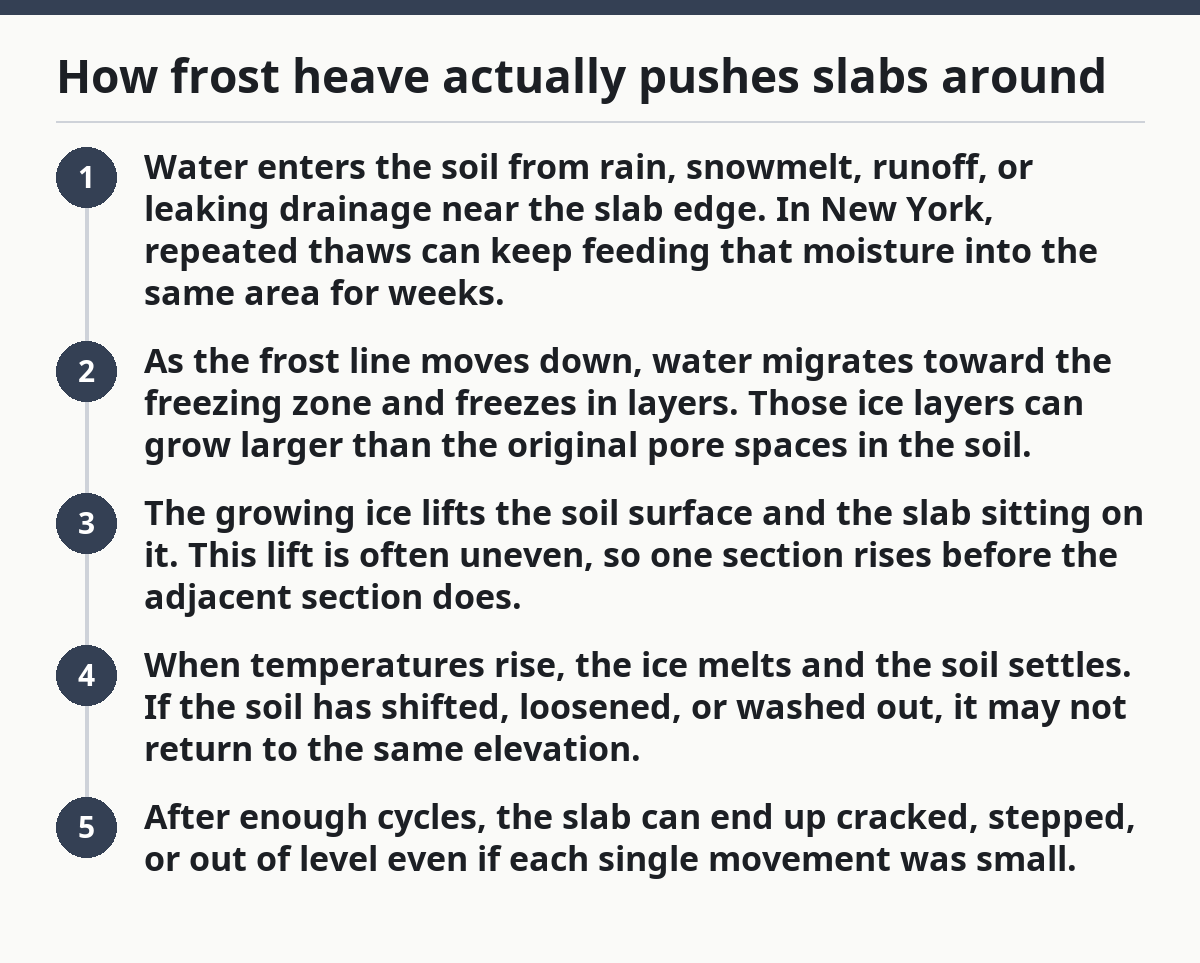
Frost heave pushes slabs around when freezing water in the soil forms ice lenses that grow and lift the ground. This is the mechanism most people mean when they talk about freeze-thaw damage, and it is different from simple “expansion.” The soil has to be wet enough, cold enough, and fine-grained enough for ice to develop in a way that can exert upward force.
Here is the basic sequence:
- Water enters the soil from rain, snowmelt, runoff, or leaking drainage near the slab edge. In New York, repeated thaws can keep feeding that moisture into the same area for weeks.
- As the frost line moves down, water migrates toward the freezing zone and freezes in layers. Those ice layers can grow larger than the original pore spaces in the soil.
- The growing ice lifts the soil surface and the slab sitting on it. This lift is often uneven, so one section rises before the adjacent section does.
- When temperatures rise, the ice melts and the soil settles. If the soil has shifted, loosened, or washed out, it may not return to the same elevation.
- After enough cycles, the slab can end up cracked, stepped, or out of level even if each single movement was small.
This is one reason frost heave is so frustrating. It can be seasonal and subtle at first, then become permanent if the soil structure changes. Clay and silty soils are more likely to hold the kind of moisture that feeds this process than clean, free-draining gravel. A slab over a well-graded base with proper drainage still can move, but the risk is lower and the movement is usually less severe.
A common mistake is blaming the concrete mix alone. Concrete strength matters, but a strong slab can still move if the ground under it freezes unevenly. Another mistake is thinking the movement will stop as soon as spring arrives. If voids have formed, the thaw can leave the slab unsupported until something fills that gap.
How New York weather makes the problem repeat all season
New York weather makes the problem repeat because winter and shoulder-season weather often swing around the freezing point rather than staying solidly below it. That means the ground under a slab can go through multiple freeze-thaw cycles in a single month, especially in late fall, midwinter thaws, and early spring warmups.
The pattern is what hurts the slab. A wet December can saturate the soil. A cold snap freezes it. A mild stretch melts surface water and sends it deeper. Then the next cold snap locks that water in again. If snow piles against the slab or melts off a roofline onto one side, the moisture load is uneven from the start. That gives you uneven heave, uneven thaw, and uneven support.
This is also why two slabs on the same property can behave differently. A north-facing sidewalk strip that stays shaded may freeze more consistently than a south-facing patio. A garage floor with a gutter discharge nearby may get more water than a front walk with good grading. Even the same slab can move more at one corner because one side sees more sun, runoff, or wind-driven snowmelt.
The season matters too. Early winter may not do much if the ground is still warm and relatively dry. Late winter often does more damage because the soil has already been soaked, frozen, thawed, and refrozen several times. That repetition is the real stressor.
What a contractor should check before talking repair
A contractor should check the drainage, the soil condition, the slab edges, and whether the movement is active or historic before any repair is priced. A fast guess is not enough, because two slabs that look similar can need very different fixes. One may need void filling under a section. Another may need water control before any lifting work makes sense.
A practical inspection usually starts with these questions:
- Where does roof runoff go?
- Does the slab slope toward the house or toward a low spot?
- Are there open joints, cracks, or gaps at the edge?
- Is there evidence of washout, soft base material, or a hollow sound when tapped?
- Is the movement seasonal, or has it stayed displaced through summer?
The answer changes the job. If a slab is only slightly out of level because of a void, a repair may be straightforward. If water keeps entering the same edge every thaw, fixing the symptom without fixing drainage can mean paying twice. That is the trade-off homeowners miss most often.
What a bad job looks like is also fairly clear. The slab is lifted without addressing the water source. The crack line is hidden but not stabilized. The surface ends up level for a month, then the same corner moves again after the next freeze-thaw cycle. If the contractor never mentions drainage or soil moisture, that is a warning sign.
For price, the honest answer is that cost depends on slab size, access, how much movement there is, and whether the repair includes drainage corrections or only lifting. Small, accessible work costs less than a full approach that includes base remediation. A site visit is often the most reliable way to narrow it down.
When this is not just a freeze-thaw issue
This is not just a freeze-thaw issue when the slab keeps moving in warm weather, the crack pattern widens steadily, or the entire area drops without seasonal recovery. In those cases, freeze-thaw may be part of the story, but it is not the whole story.
Some signs point to a different problem or a combination of problems:
- Water is pooling near the slab after every storm because grading is wrong.
- A downspout is dumping onto the same area week after week.
- The soil stays soft long after the thaw.
- The slab is breaking at control joints with no obvious uplift pattern.
- The movement is broad and uniform instead of localized.
That is why a repair plan should separate movement caused by seasonal frost heave from movement caused by ongoing water intrusion or base failure. Fixing only the concrete surface is usually the wrong order. The slab is reacting to the support below it, so the support has to be addressed first.
This is also the point where a homeowner should stop looking for a cosmetic patch. If the slab is serving as a walking surface, driveway, or step, movement can create a trip edge or a drainage issue fast. A contractor who understands New York freeze-thaw conditions should be able to explain what part of the problem is seasonal and what part is structural support.
What to ask before you hire someone
Ask whether the repair plan addresses moisture, base support, and seasonal movement, not just the visible crack. That question separates a real fix from a surface patch in under a minute.
A good contractor should be able to answer plainly:
- How much of the movement looks like frost heave versus voiding?
- Is the soil likely holding water at the slab edge?
- Will the repair include lifting, void filling, drainage correction, or all three?
- What happens if the slab moves again after the next freeze-thaw season?
- Is there a limit to how far this slab can be brought back safely?
Sometimes the best answer is not the biggest repair. Sometimes a small section can be stabilized and left alone. Sometimes the right move is to correct runoff and monitor the slab through one winter before committing to a larger fix. That is honest work, and it is cheaper than repeating the same repair after the next thaw.
A bad answer sounds confident but vague: “The winter did it” or “We can just bring it back up.” Those lines skip the mechanism. In New York, the mechanism is often moisture plus freeze-thaw plus support loss. If a contractor cannot explain all three, the fix is not well thought out.
How does freezing affect concrete settlement?
Freezing can worsen settlement because thawing leaves the soil softer and less supportive than it was before. The slab may then drop into a small void or compacted area as loads return in spring. In other words, freeze-thaw can turn a minor support problem into a visible low spot.
Why do slabs move more in winter?
Slabs move more in winter because the ground is cycling between frozen and thawed states, and each change alters the soil’s volume and strength. Water expands when it freezes, then melts and drains or redistributes when temperatures rise. In New York, that repeated swing can happen several times in one month.
Can freeze-thaw damage lifted concrete again?
Yes, freeze-thaw can damage a lifted slab again if the water source and soil conditions are still present. A repaired slab over the same wet, frost-prone base can move the next season just as the first one did. The repair lasts longer when drainage and subsurface support are corrected at the same time.
Drafted with AI; not yet reviewed by a person.