New York slab conditions and weather factors — The Complete Guide

Last updated: November 20, 2026
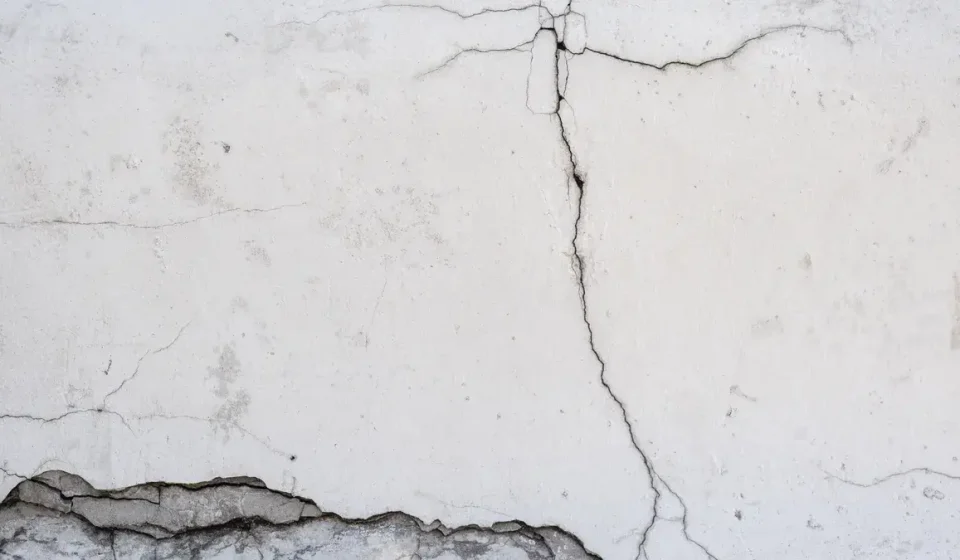
Quick Answer: In New York, two forces usually do the real damage: one hard freeze-thaw season and one drainage failure can be enough to trigger visible trouble. New York slab conditions and weather factors depend on the slab’s own condition and the weather it has to survive. Once concrete is exposed to freeze-thaw cycles, road salt, heavy rain, or poor drainage, it can crack, settle, spall, or heave much faster than a slab in a milder, drier setting.
Key Takeaways
- A slab in New York lives or dies by drainage, freeze-thaw exposure, and salt contact.
- The biggest weather risks are winter freezing, spring thaw, driving rain, and repeated wet-dry cycles.
- Outdoors, winter details matter: slope, jointing, subbase, and de-icing chemicals all change the risk.
- Indoors, moisture still matters; ground vapor and water intrusion can still damage it.
- The right fix depends on the symptom: cracking, scaling, heaving, sinking, or surface dusting do not point to the same solution.
- Some slabs are not worth patching with a cosmetic repair if the base has failed or the slab keeps moving.
Trying to figure out why a New York slab is failing? Weather usually doesn’t act alone. It works on a slab that already has weak drainage, a thin base, bad joints, or a poor mix — and that is the real story behind most slab damage in New York. For a broader regional overview, see New York concrete repair and foundation issues.
What New York weather does to a slab first
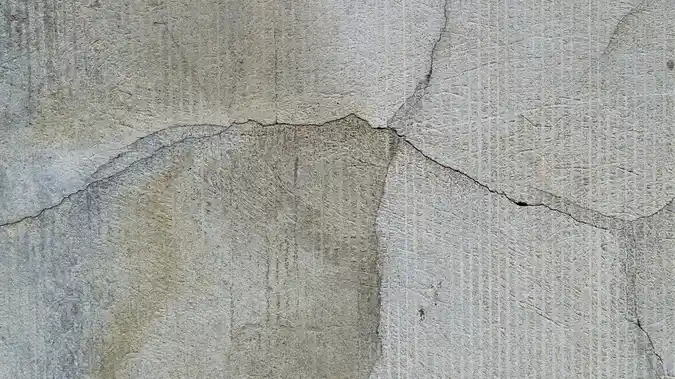
Freeze-up is the first hit. When water gets into cracks, joints, or the soil under the slab and then freezes, it expands and pushes the concrete upward or outward. That is why the same slab can look fine in October and then start acting up after a January cold snap. According to the National Weather Service, freeze-thaw damage becomes more likely when temperatures swing around the freezing point, which is common in New York winters. See National Weather Service.
Winter is the obvious threat if the slab is outdoors. But spring can be worse. Snowmelt and rain soak the base under the slab, then a cold night locks that water in place. That freeze-thaw cycle turns small surface flaws into structural headaches.
Salt matters too. On driveways, sidewalks, stoops, and steps, chloride de-icers can accelerate scaling on weak concrete surfaces. The surface starts flaking, then gets rough, then loses more material every season. A slab with a hard, dense finish handles this better than one with a weak top layer, but no slab likes repeated salt exposure. The Portland Cement Association notes that de-icing salts can increase scaling risk on vulnerable concrete surfaces. See Portland Cement Association.
Heavy rainfall periods hit New York slabs as well, especially in coastal and urban areas where water has fewer places to go. If the slab doesn’t drain away from the structure, water tends to sit at joints and edges. That raises the moisture load even when the weather does not look extreme. For storm and rain context, see drainage solutions.
Here is the practical rule: if the slab is cracking mainly after winter, focus on freeze-thaw and drainage. If it is crumbling at the surface, focus on salt exposure and finishing quality. If it is dropping or rising unevenly, focus on the subgrade, not just the concrete. Quick check: if the damage changes with the season, weather is probably part of the problem; if it changes with foot traffic or settling, the base may be the bigger issue.
The 3 conditions that change everything
Three things change the answer fast: where the slab sits, what the soil is doing, and how water moves around it. Miss one of those, and the repair plan is usually off. The slab repair decision should start there, not with a patch kit.
A slab on grade in upstate New York faces a different set of conditions than a Manhattan cellar slab or a coastal Long Island patio. Upstate slabs are usually more exposed to deep freezing and snowmelt. Coastal slabs can see less severe freeze depth but more salt, more wind-driven rain, and more wet-dry cycling. Basement slabs may stay out of direct weather, but groundwater and vapor can still cause dampness, efflorescence, or floor-covering failure. For basement-specific details, see basement waterproofing.
Soil comes next. Clay-rich soil holds water and expands when wet; that can lift a slab. Sandy soil drains faster but can wash out or settle if it was not compacted well. Fill dirt is often the weak link. If a slab was poured over loose or disturbed fill, weather simply exposes the flaw faster.
Water movement is the third factor, and people underestimate it constantly. A roof downspout dumping next to the slab can do more damage than a snowstorm. So can a negative slope that sends water back toward the building. The weather may be the trigger, but bad grading is what lets the trigger keep firing. See also grading and drainage.
If you are assessing a slab, use this order: first check drainage, then joints and cracks, then the base, then the mix and finish. That sequence matters because a perfect patch on a bad base fails again. A slab that lacks slope or proper runoff can still fail even if it was built with decent concrete. The EPA also emphasizes managing stormwater before it reaches structures. See EPA green infrastructure guidance.
Benchmarks help. A typical exterior slab should shed water away from the structure; if water sits after a normal rain, the geometry is already telling you something is wrong. For frost-prone sites, local code and design practice often focus on subbase preparation, depth, and reinforcement decisions rather than cosmetic surface fixes. For exact design and repair choices, a local licensed contractor or structural engineer is the right call when the movement looks structural. Quick check: if the slab moves with water and temperature, you are dealing with site conditions first, concrete quality second.
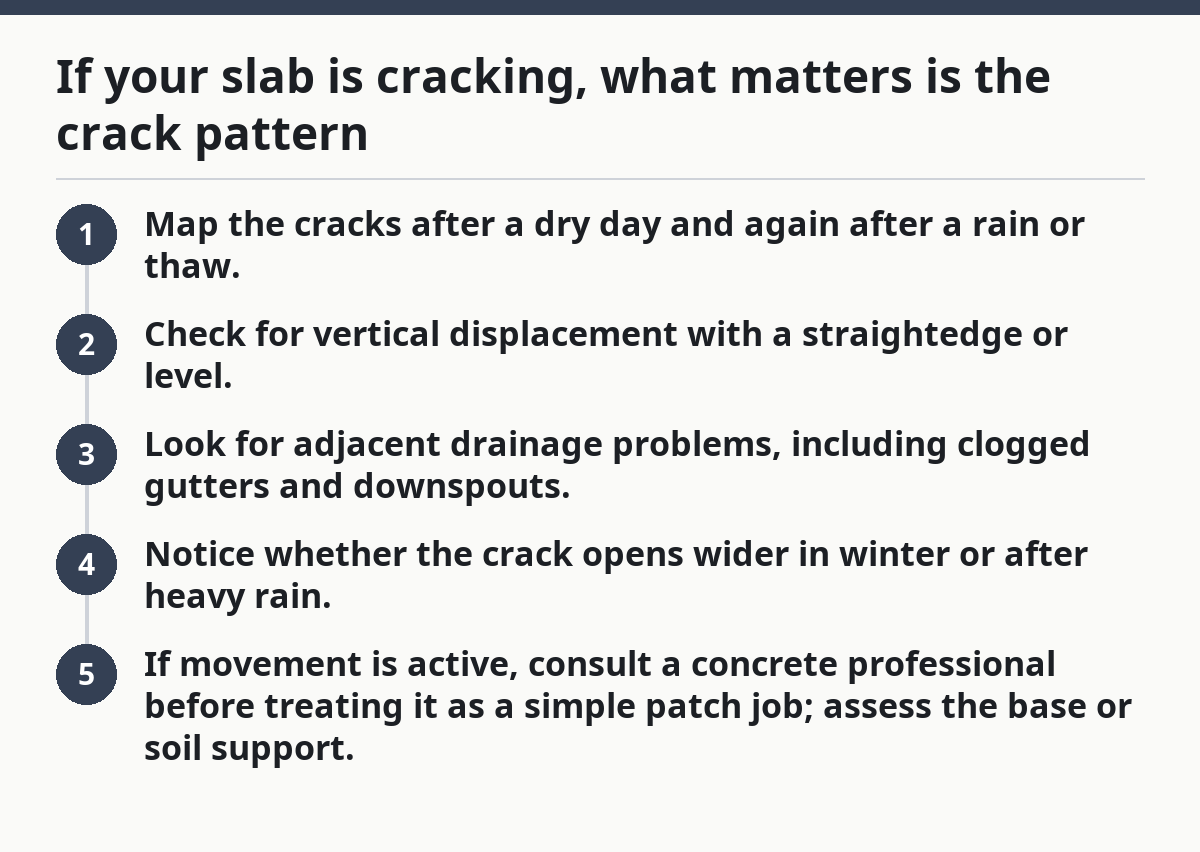
If your slab is cracking, what matters is the crack pattern
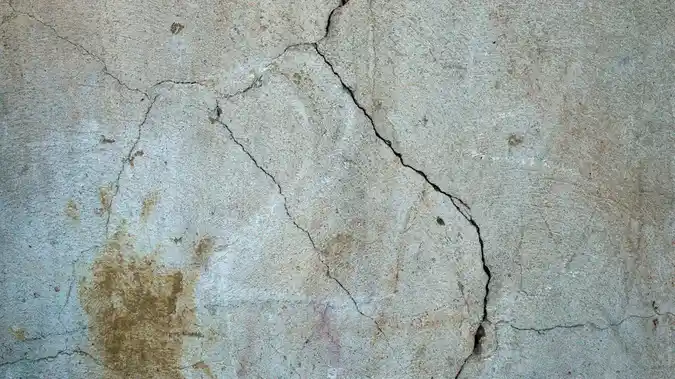
Crack pattern tells you more than crack length, and many generic guides miss that. Hairline and random? You may be looking at normal shrinkage or minor movement. Wide, offset, or worsening each season? That points somewhere else.
Shrinkage cracks often show up early in a slab’s life. They are common, and not every one means failure. But once those cracks line up with where water collects, the weather works through them year after year. In New York, that usually means freeze-thaw stress will enlarge them. Ugly little fault lines, in other words.
One-sided cracks or a noticeable lip between sections usually mean movement. Frost heave, settling, or washout under the slab could all be in play. No sealant fixes that by itself. A crack filler can help keep water out for a while, but it will not correct the underlying motion.
Here is the decision path that makes sense for a homeowner or property manager:
- Map the cracks after a dry day and again after a rain or thaw.
- Check for vertical displacement with a straightedge or level.
- Look for adjacent drainage problems, including clogged gutters and downspouts.
- Notice whether the crack opens wider in winter or after heavy rain.
- If movement is active, consult a concrete professional before treating it as a simple patch job; assess the base or soil support.
The repair path depends on the diagnosis. For non-moving cracks, a polyurethane or epoxy repair may be appropriate depending on whether flexibility or strength matters more. For moving cracks, you need to solve the movement first. That might mean slab leveling, subgrade correction, or drainage work. Re-caulking the same crack every season is a sign the real issue is still untouched. For crack repair options, see crack repair.
This is where a lot of low-effort advice goes sideways: it treats every crack as the same. In New York, a crack on a driveway edge exposed to plow salt is not the same as a basement slab crack with no traffic and a wet vapor source beneath it. Quick check: if the crack has height difference, changing width, or water entry, it is not just a surface defect.
If your slab is sinking or lifting, the weather is probably working through the ground
A sinking slab usually means the support under it has failed, and a lifting slab usually means frost or water has changed the soil volume. If the concrete itself is still intact but the slab is no longer level, the weather factor is often happening below the surface.
Settlement is common where the base was never compacted well or where water has washed fines out of the subgrade. That can happen after repeated storms, broken drainage, or long-term runoff concentration. In some cases, the slab was poured over fill that looked firm at first but kept consolidating over time.
Frost heave is different. Water in the soil freezes and expands, pushing the slab upward. When it thaws, the slab may drop back unevenly or not return to the same position. That cycle can create a staircase effect at joints and edges.
Age matters, but support matters more. A 10-year-old slab on bad drainage can fail sooner than a 30-year-old slab on a properly prepared base.
Use this sequence if the slab is out of level:
- Measure the slope and note where water pools after rain.
- Check whether the problem is isolated to one corner, one edge, or a broad area.
- Inspect nearby downspouts, sprinklers, window wells, and grading.
- Look for voids, soft spots, or soil erosion at slab edges.
- Choose the repair based on movement type: mudjacking or polyurethane lifting for settled slabs, drainage correction for water-driven movement, and engineering review if the displacement suggests structural risk.
Polyurethane foam injection and mudjacking can both be useful, but neither should be treated as a weather fix by itself. If the ground stays wet or the frost problem remains, the slab may move again. Quick check: if the slab is uneven and the edges are still active after storms or thaws, the base and water path need attention before any lift.
When the standard advice is wrong
Standard advice goes wrong when it says to seal everything and move on. Sealing is only part of the answer, and sometimes it is the wrong first move.
If the slab is outdoors and the surface is scaling, a sealer may help reduce water and salt intrusion, but only if the surface is sound enough to take it. If the concrete is already delaminating or flaking badly, sealing over damage can trap problems instead of solving them. The same goes for a slab that keeps spalling at joints: the joint detail may be the issue, not the lack of coating.
Indoors, especially in a basement or garage, people often focus on the visible floor and ignore vapor coming up from below. That is a mistake. Moisture vapor can drive coating failure, tile debonding, and persistent dampness even when there is no obvious leak. In those cases, a moisture test is smarter than a guess. Concrete moisture tests such as ASTM F2170 for in-slab relative humidity or ASTM F1869 for calcium chloride are commonly referenced in flooring work. For flooring systems, follow the product manufacturer’s moisture limits as well as the test result. For indoor moisture guidance, see flooring installation.
If the slab is old but stable, aggressive grinding or replacement may be overkill. Not every cracked slab needs demolition. But if the slab is moving, replacement may be the cleaner answer than a stack of temporary fixes.
Here’s the honest trade-off: minor repairs are cheaper, but they only work when the slab is basically sound and the weather load is manageable. Full replacement costs more and creates disruption, and it may be the most practical option if the base failed, the slab is badly out of level, or the damage keeps returning every winter. Quick check: if a fix depends on ignoring drainage, vapor, or movement, it is probably the wrong fix.
Edge cases where the normal advice breaks down
These are the situations that fool generic checklists, and each one changes the repair plan.
1) The slab is in a shaded area that stays wet
When a slab rarely dries, freeze-thaw damage and biological buildup become more likely. What changes is not just temperature; it is the time water stays on the surface. Use better drainage, more sun exposure if possible, and a surface treatment only after the moisture issue is under control. For the wettest sites, a professional moisture evaluation is worth it.
2) The slab sits under a roof drip line
If roof water falls beside the slab, the problem is concentrated water loading. That can erode soil, saturate the base, and create repeated movement at the edge. Move the discharge with extensions or underground drainage before touching the concrete.
3) The slab is next to a retaining wall
If the slab is adjacent to a wall holding back soil, hydrostatic pressure and trapped moisture can distort the slab edge. The fix often belongs to the wall and drainage system, not just the slab surface. French drains, wall drainage, and proper grading may matter more than patch material.
4) The slab is a garage floor with road salt traffic
If cars track in salt, the slab gets chemical exposure from both the weather and the vehicle. That increases scaling risk near the entrance and wheel paths. A dense, well-cured slab handles this better; a weak surface may need targeted protection, but only after cleaning and moisture evaluation. See garage floor repair.
5) The slab is a basement floor with no obvious leak
If there is no standing water but the floor stays damp, ground moisture vapor may be the issue. That changes the next step entirely: test moisture instead of chasing cracks. A flooring system, coating, or adhesive may fail if this step is skipped.
6) The slab is new but already behaving badly
If a newer slab cracks, settles, or scales early, the problem is usually design, placement, or base preparation rather than age. Weather can expose the flaw quickly, but it did not create it alone. Document the pattern, stop guessing, and get a pro involved sooner rather than later. Quick check: if your situation has wall drainage, salt, constant shade, or basement dampness, the usual “seal it and wait” advice is not enough.
What to do next, depending on what you see
If the slab is only hairline cracked and otherwise level, monitor it through one full freeze-thaw season before making a large repair decision. Mark the crack ends, photograph them monthly, and watch for changes after snowmelt and heavy rain.
If the slab is cracked and taking water, prioritize keeping moisture out. Seal moving cracks with the right flexible material if appropriate, but do not ignore the source of water. A downspout extension or grading fix may outperform any patch.
If the slab is uneven, treat it as a support problem. Measure the displacement, identify the wettest spot, and decide whether lift, drainage correction, or replacement is the real answer. Cosmetic patching on an unstable slab wastes money. See concrete leveling.
If the slab is scaling, look at salt exposure, surface quality, and curing history. Cleaning and a breathable protective treatment may help a sound slab, but severe scaling usually means the surface has already been weakened.
If the slab is indoors and you plan to install flooring, test moisture first. Flooring failures are expensive because they punish guessing. Follow the floor manufacturer’s requirements and, if needed, consult a qualified concrete or flooring professional before covering the slab.
The best move is the one that matches the failure mode. New York weather is not random here; it is predictable enough that the slab’s clues usually point to the cause. The mistake is treating every symptom the same. Quick check: if you can name the symptom but not the cause, pause before you buy a repair product.
What is the main weather risk for New York slabs?
Freeze-thaw cycling is the main weather risk for New York slabs. Water gets into cracks, joints, or the soil below, freezes, expands, and makes the damage worse over time. Salt, rain, and poor drainage usually make the freeze-thaw problem more severe.
Should I seal a cracked slab right away?
Not always. If the crack is stable and the slab is otherwise sound, sealing can help keep water out. If the slab is moving, sinking, or heaving, sealing alone is a temporary fix and may hide a bigger drainage or support problem.
Why do some slabs fail faster in winter?
Some slabs fail faster in winter because freezing water pushes on weaknesses that were already there. A poor base, open joints, bad slope, or thin concrete surface gives water a place to enter and expand. The colder the weather and the wetter the site, the faster the damage usually shows up.
Is salt worse than rain for a New York driveway slab?
Salt is often worse for the surface, while rain is often worse for the soil support. Salt can speed up scaling and surface wear, especially on exposed driveways and steps. Rain matters because it feeds the cracks, saturates the base, and sets up freeze-thaw damage later.
When should I call a professional?
Call a professional if the slab has vertical displacement, repeated seasonal movement, widespread scaling, or water intrusion that you cannot trace to a simple drainage fix. A licensed contractor, concrete specialist, or structural engineer can tell whether the slab needs repair, lifting, drainage work, or replacement.
Drafted with AI; not yet reviewed by a person.