Last updated: November 20, 2026
Quick Answer: Compare 3 to 5 New York concrete leveling companies by process, scope, access, documentation, and warranty, not by the lowest bid. The right contractor will explain how they lift the slab, what areas are included, what material they use, and what the warranty covers in writing. This guide on How to Compare Concrete Leveling Companies in New York focuses on the details that separate a usable estimate from a vague one.
New York concrete leveling companies are easiest to compare by process, scope, and paperwork, not by the lowest bid. The right contractor will explain how they lift the slab, what areas are included, what material they use, and what the warranty covers in writing.
A cheap estimate can hide a narrow scope, poor access planning, or a vague warranty. A better comparison starts with the same facts from each company, so the differences are real.
Key takeaways for comparing contractors in New York
- Written proposals matter more than a quick phone quote, because they show scope, exclusions, and warranty terms.
- Polyurethane foam and mudjacking solve the same problem in different ways, but they do not fit every slab, void, or access point.
- Access constraints in New York — tight side yards, steps, pavers, stoops, and limited parking — can change the method and the price.
- A strong bid explains how long the job should take, what prep is needed, and what the finished slab can realistically do.
- The best company for a garage apron may be the wrong company for a front walk, especially if the site needs drilling through decorative concrete or around buried utilities.
What should a New York concrete leveling company show you before you go any further?
A good company should show you a written proposal, the leveling method, the scope of work, the material, and the warranty terms before you commit. If those five pieces are missing, the comparison is already weak.
Start by asking for the proposal in writing, even if the company inspected the slab in person. A handwritten price on a card or a vague text message does not tell you whether the bid covers crack cleanup, joint sealing, drill-hole patching, disposal, or follow-up adjustments. For a homeowner comparing New York concrete leveling companies, those details change the real cost more than a small difference in the headline number.
Use this order when you compare bids:
- Match the same slab area on every estimate. Ask each company to identify the exact section being lifted, such as a 12-foot walkway panel, a garage apron, or a rear stoop landing. That keeps one contractor from pricing a small section while another prices the whole run.
- Check the stated method. Look for polyurethane foam or mudjacking, not just “slab lifting.” The method affects drill-hole size, cure time, and how the contractor handles voids under the concrete. If the proposal is unclear, ask a qualified professional to explain which method fits the slab; the EPA notes that drainage and soil conditions can influence concrete movement, so the repair should match the site.
- Read the access note. In New York, a narrow side yard, a basement hatch, a fence line, or a street-facing stoop can make equipment placement harder. A bid that ignores access is incomplete.
- Look for exclusions. The proposal should say what is not included, such as replacing badly cracked concrete, fixing drainage, or moving landscaping stones. That is where surprise costs usually hide.
- Compare the warranty terms line by line. A “lifetime” word means little without the actual scope, transfer terms, and what voids coverage. A short written warranty with clear conditions is more useful than a big claim with no detail.
That process keeps the comparison grounded in what you are buying, not in who sounded nicest on the phone. It also helps if you are planning to use the cost guide on the New York slab lifting hub page, because the hub can help you understand pricing drivers while this page helps you separate good bids from weak ones. For background on slab lifting methods, the EPA’s guide to drainage around foundations explains why water management matters, and This Old House gives a plain-language overview of mudjacking.
Compare New York concrete leveling companies by these criteria
Compare New York concrete leveling companies by five criteria: scope, method, access planning, documentation, and warranty. Price matters, but it should be the last tie-breaker, not the first filter.
| Criterion | What good looks like | What to skip | Why it matters in New York |
|---|---|---|---|
| Scope of work | Exact slab areas, joints, cracks, voids, cleanup, and patching are listed | “Level concrete” with no area map | Small urban or suburban sites can hide edge conditions that change the job |
| Method | Polyurethane foam or mudjacking is named, with a short explanation of why it fits | Vague “lifting process” language | Some slabs need lighter injection; others tolerate heavier fill |
| Access constraints | The proposal notes side-yard width, entry points, or equipment limits | No mention of how equipment reaches the slab | Tight lots, stoops, and fences can slow the crew and affect pricing |
| Materials used | Product type is identified, and the company explains hole size or cure time | No material name at all | Different materials behave differently under load and moisture |
| Written proposal | Scope, exclusions, and schedule are in writing | Verbal-only promises | Written terms make comparison possible and reduce misunderstandings |
| Warranty terms | Conditions, duration language, and limits are spelled out | “Guaranteed” with no details | Warranty language is where the real risk sits |
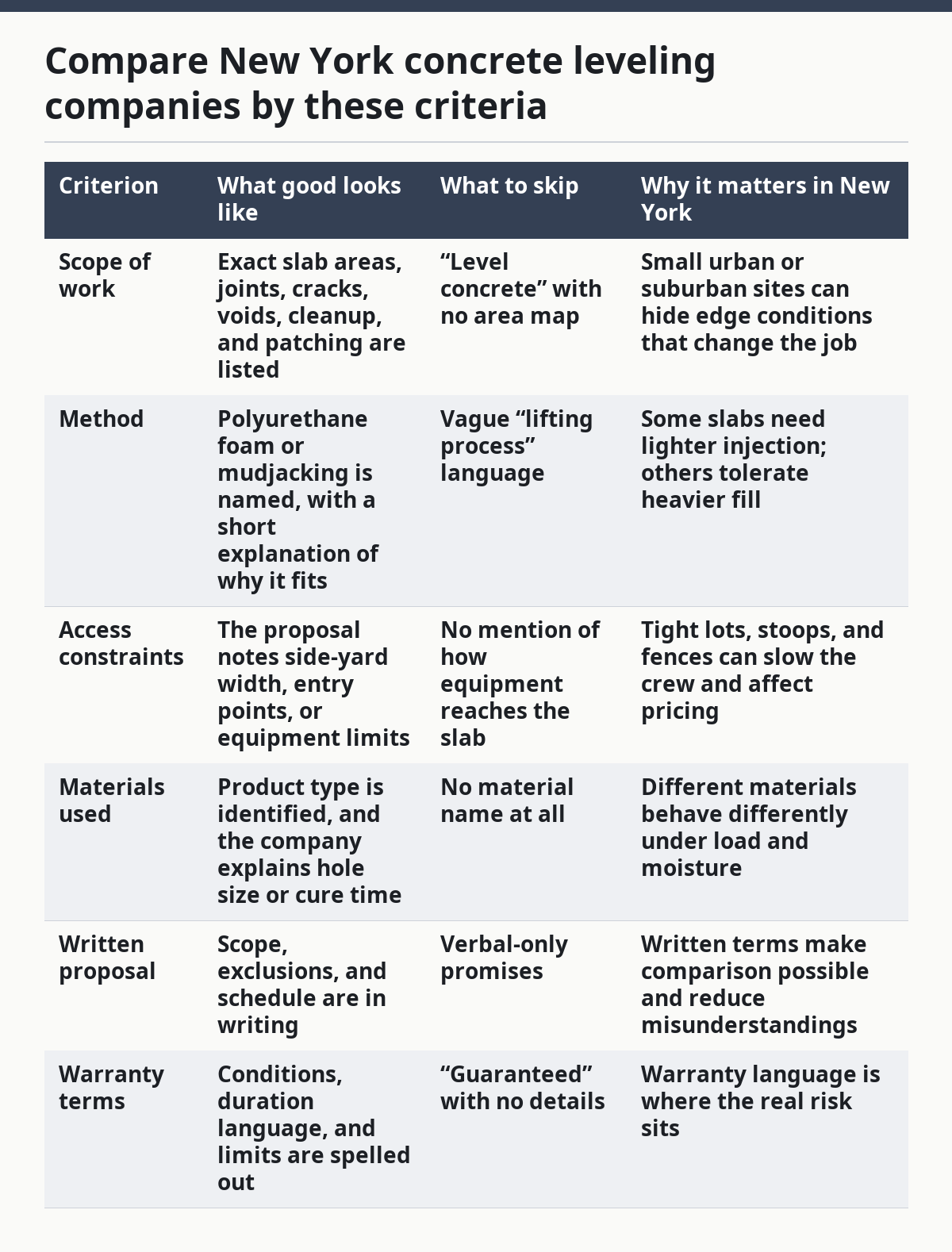
This table gives you the head-to-head view a reader can use in person. If two bids are close, the better one is usually the one that explains the job more clearly, not the one that says the most reassuring thing. A company that writes “access through rear gate only” has already thought about the site; a company that leaves access blank may be planning to figure it out on arrival.
For a small, simple, highly accessible slab, the clearest proposal may be the best choice. That is true for a short front walk or a single garage section with open access. It is not true for a larger slab with settled corners, buried steps, or hard-to-reach areas.
Polyurethane foam or mudjacking: which method is the better fit?
Polyurethane foam is usually the better fit for lighter, tighter-access jobs, while mudjacking can still make sense for some larger slabs and void-filling situations. The right choice depends on slab condition, access, and how much weight the structure can take.
The material choice affects more than the label on the quote. Polyurethane foam is injected through smaller holes and expands under the slab. Mudjacking uses a heavier slurry, often called mud or grout, that is pumped beneath the concrete. Both are used for slab lifting, but they behave differently in wet, soft, or constrained settings.
For a New York property, the deciding factors often look like this:
- Tight access: Foam often wins when the crew must work from a narrow side yard or a limited entry point. Smaller equipment and smaller injection holes can help.
- Heavier settlement or broader voids: Mudjacking may be discussed when the contractor wants a denser fill under a larger area.
- Finished appearance: Foam holes are typically smaller, which can matter on visible front walks or stoops.
- Cure time and downtime: Foam systems are often presented as faster to return to service, while slurry methods can require more waiting. The exact timing should be in the proposal, and you should ask a professional to confirm the schedule for your slab.
- Underlying soil issues: If the ground is still moving because drainage is poor, either method can be a short-term fix unless the drainage problem is addressed too.
What a generic article gets wrong is treating all leveling methods as interchangeable. They are not. A company that offers only one method is not automatically weak, but it should explain why that method fits your slab. If the contractor cannot say whether the slab has a void, a washout, or a simple edge settlement, the estimate is too shallow.
A smart comparison here is to ask for the method name, the material name, and the reason that method was selected. If the answer is “because we always use it,” that is a bad sign. If the answer is tied to access, slab thickness, or the size of the settled area, the contractor is thinking like a specialist.
What should the written proposal say on a New York job?
The written proposal should say exactly what will be lifted, how it will be lifted, what is excluded, and how the warranty works. If it does not, you are comparing sales language instead of service.
On a New York concrete leveling job, a useful proposal usually includes:
- the address or precise service location
- the slab area to be lifted, by section
- the lifting method
- the material name
- how access will be handled
- whether hole patching is included
- whether crack repair, caulking, or joint sealing is included
- the expected work duration
- cleanup expectations
- the warranty terms and exclusions
A proposal that says “lift front walk” is too thin if the walk has multiple panels, a stoop edge, or a step transition. A proposal that says “lift front walk panels A and B, patch injection holes, no structural crack repair included” is much easier to compare.
This is also where good companies separate themselves from vague ones. A careful proposal will name the scope in plain language and avoid promising perfection. Concrete can be raised and supported, but it may not return to a brand-new appearance. If the slab is already badly cracked, the company should say whether lifting is appropriate at all, or whether replacement is the better fix.
A common mistake is treating exclusions as red flags only when they appear. They are normal; the problem is when they are hidden. For example, a bid that excludes drainage correction is not necessarily bad. A bid that fails to mention drainage in a yard that visibly holds water is incomplete. In New York, where freeze-thaw cycles and poor runoff can both contribute to settlement, that omission matters.
A second mistake is comparing only the total price without checking what the price actually buys. Two bids can look far apart until you notice one includes hole patching and cleanup while the other does not. That is why written proposals are the real comparison tool.
How do access constraints change the estimate and the outcome?
Access constraints can change the estimate, the equipment choice, and the likelihood that the crew can finish in one visit. A company that ignores access is not giving a real bid.
New York properties often come with practical limits that affect slab lifting:
- narrow side yards
- fenced backyards
- stoops with tight landings
- pavers or decorative borders around the slab
- limited street parking or loading room
- winter salt damage and cramped entry paths
- utility lines, meters, or downspouts near the work area
These conditions matter because leveling crews need room for hoses, pumps, drilling access, and material handling. If the crew has to work around a long carry, multiple steps, or a blocked side gate, the labor time goes up. That does not always mean a much higher price, but it should change how the company plans the work.
A useful comparison is to ask whether the company looked at the access route as carefully as the slab itself. For example, a front sidewalk in Queens with a 3-foot side passage is a different job from an open driveway in upstate New York. One may fit foam injection with modest setup; the other may be easier to stage with larger equipment. The point is not which region is better. The point is that access is part of the job, not an afterthought.
A bad job often starts with bad access planning. If the crew brings the wrong equipment for the site, they may rush setup, skip parts of the slab, or leave a visible mess around the injection points. They may also understate the time needed and then try to compress the work. That is how small misunderstandings become poor results.
The best proposals mention access before you ask twice. If one company notes “rear access only; carry-in required” and another says nothing, the first company is likely seeing the site more clearly. That level of detail is worth more than a lower number with no site awareness.
Which company is the right fit for your kind of job?
The right company depends on whether your slab is simple, visible, hard to reach, or likely to need a careful warranty. The wrong company is the one whose process does not match the site.
For a simple, accessible slab — such as a short walkway or a driveway edge with open access — choose the contractor with the clearest written proposal and the cleanest scope. If two bids are close, the deciding factor is usually documentation, not price. A job like this should not need a long pitch, but it should still name the method and the warranty terms.
For a tight-access New York property — such as a side-yard walk, stoop landing, or narrow front approach — choose the company that explicitly addresses access constraints and material choice. This is where polyurethane foam often has an edge, but not automatically. The right bid is the one that explains why the method fits the site.
For a larger or more complex slab — such as a section with visible voids, uneven settlement, or repeated movement — choose the contractor that talks about the cause as well as the symptom. If the company ignores drainage, soil washout, or recurring settlement, the lift may not last as long as the paperwork suggests.
Skip any company that gives you a verbal quote only, will not name the material, or treats the warranty as an afterthought. Skip the bid that is cheapest only because it leaves out patching, cleanup, or access difficulty. And skip the contractor who says every job is the same. In concrete leveling, that answer is almost never true.
If you want the budget side of the decision, use the linked New York cost guide for the pricing background and come back to this page to compare the companies themselves. Price explains the range; process tells you which contractor is worth calling.
Drafted with AI; not yet reviewed by a person.