Last updated: November 21, 2026
Quick answer: for 3 common failure patterns—water entry, edge movement, and repeated traffic wear—concrete slab surface and edge care usually starts with repair, not a cover-up. Concrete slab surface and edge care means catching small wear early, keeping water out, and fixing chips, scaling, and cracks before they spread. For a New York slab, the edge usually fails first because it takes the hit from carts, plows, traffic, and freeze-thaw cycles, so the right move is usually early repair, not waiting for a bigger break.
Key takeaways
- Surface wear and edge damage are not the same problem, so they need different fixes.
- In New York, water, deicing salt, and freeze-thaw cycles make edge chips and surface scaling show up faster than in milder climates.
- A sound slab with a few damaged edges is often a repair job, not a replacement job.
- A weak contractor answer is “just patch it.” A better answer explains why the crack, chip, or spall started.
- The best maintenance plan is usually simple: keep water out, keep joints open, and repair damage before traffic widens it.
What does slab surface and edge care actually mean?
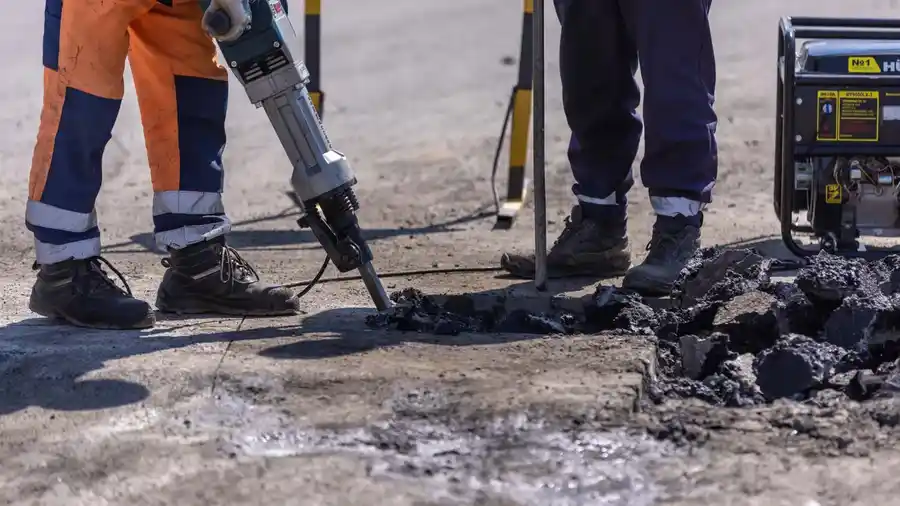
Concrete slab surface and edge care means keeping the top face and the exposed sides of a slab in good condition so the slab can carry load, shed water, and resist wear. The surface is the flat walking or driving area; the edge is where the slab stops, meets another slab, or meets a curb, wall, step, or opening.
The surface usually fails by dusting, scaling, pop-outs, worn finish, surface cracks, or localized spalling. The edge usually fails by chipping, corner breaks, settlement at the joint, or long cracks that start at a corner and run inward. Those are not cosmetic details in a busy building; they are often the first sign that water, movement, or poor support is working on the slab.
For New York buildings, the problem gets sharper because winter weather cycles push water into tiny openings, then freeze it. Deicing salts and repeated foot or vehicle traffic make exposed edges especially vulnerable. The American Concrete Institute’s guidance in ACI 302.1R and ACI 546.3R treats surface finish and repair as different jobs for a reason: the fix depends on whether the issue is wear, moisture, movement, or structural support, and a professional should confirm which condition is present. See ACI’s guidance on floor and slab construction and concrete repair.
A generic article gets this wrong when it treats every chip like a patch job, so a professional should inspect the slab first and match the fix to the cause. A chipped edge on a stable slab may need a bonded repair and joint sealing. A broken corner caused by settlement may need a deeper structural fix or a section replacement.
Why do New York slabs need different care?
New York slabs need different care because weather, traffic, and building type change how damage starts and how fast it spreads. A sidewalk slab on a busy block faces different forces than a garage slab, a basement slab, or a slab at a loading area.
Freeze-thaw cycles matter because water expands when it freezes. If water sits in a crack, joint, or edge chip, the opening can widen over winter. Deicing salt makes the problem worse by keeping moisture present and by increasing surface distress on concrete that was already weak or poorly finished.
Building type also matters. Older masonry buildings often have slabs tied to older foundations, repaired utility openings, or patched edges at vaults and entrances. Multifamily garages and commercial loading areas see tire loads, turning forces, and impact at corners. Basement slabs may have moisture vapor issues rather than impact damage, while sidewalk slabs often fail at joints, lifting edges, and tree-root movement.
In New York, that means a contractor should look at the whole setup, not just the visible chip. The important question is not “what can be spread over this spot?” It is “why did this slab surface or edge fail here?” If the answer is drainage, movement, or corrosion, the repair has to address that cause or the problem comes back. For related guidance, see our pages on concrete repair, joint sealing, and waterproofing.
Surface wear: when cleaning is enough and when it is not

Surface wear only needs cleaning when the concrete is sound and the damage is limited to dirt, stains, or light abrasion. If the slab is structurally intact, regular cleaning, joint clearing, and moisture control can slow more serious wear.
That means sweeping grit off the slab, washing stains that hold moisture, and keeping drainage pointed away from edges. In a garage or loading area, keeping sand, salt, and debris from staying on the surface matters because those materials hold water and grind the top layer. In an entrance or sidewalk area, a worn finish can often be protected by better drainage and a compatible sealer, if the slab is dry enough and the surface condition allows it.
Surface repair becomes necessary when the slab shows scaling, pop-outs, pitting, or weak top material that keeps breaking loose. Those are signs that the top layer has lost durability. A coating over failing concrete does not cure the weak layer underneath, so a professional should decide whether the slab needs light resurfacing or patching instead of only another cleaner or sealer. A 2024 inspection date for the area can help document whether the condition is stable or changing.
That is where a bad job becomes obvious. A coating applied over damp, dirty, or loose concrete peels. A patch placed over active dusting or ongoing moisture can fail early. The better answer is to stop the cause first, then repair the surface with a material made for the specific condition.
Edge damage: what it means and why it keeps spreading
Edge damage means the slab has lost material at its side, corner, or joint line, and that loss is creating a weak point that traffic and water can keep enlarging. An edge chip may look small, but the force concentrates there every time someone rolls a cart, turns a tire, drags equipment, or steps on a broken corner.
Edges fail faster than the center because they have less confinement and less support. If the slab under the edge has settled, the crack opens wider under load. If the edge sits at a joint and the joint is packed with debris, the slab cannot move cleanly, so the edge starts taking the stress. In a New York winter, that exposed break can grow after a single freeze-thaw cycle.
The practical rule is simple: a chipped edge that is still sound is one kind of job; a chipped edge with movement, hollow sound, or a continuing crack is another. The first may be repaired with a bonded edge patch and joint care. The second may need more than a patch because the support problem is still there.
A contractor who skips the cause is not solving the problem. If the edge broke because the base is soft, the slope is wrong, or the joint has failed, the repair needs to address that. Otherwise, the next season brings the same break, only larger. See also our garage floor repair and concrete crack repair pages for related issues.
Repair now or wait: which choice is better?
Repair now is usually the better choice when the damage is active, at a joint, or tied to water. Waiting only makes sense when the defect is tiny, stable, and not in a traffic path.
Here is the practical comparison.
| Criteria | Repair now | Wait and monitor | Winner for this condition |
|---|---|---|---|
| Water entry | Seals the opening before freeze-thaw works on it | Leaves the opening exposed | Repair now |
| Edge chipping | Stops chips from widening under traffic | Lets corners keep breaking | Repair now |
| Small hairline surface crack | May be more work than needed if it is stable | Can be watched if it is dry and unchanged | Wait and monitor |
| Joint opening with debris | Clears and seals the joint before movement worsens it | Debris keeps grinding the edge | Repair now |
| Settlement or rocking slab | May reveal a deeper issue that needs more than a patch | Delays the real fix | Neither, if the slab is moving |
| Dusting or scaling | Can stop further loss if the top layer is still salvageable | Lets weak material keep breaking off | Repair now |
| Cosmetic stain only | May not need immediate work | Often fine if it is not moisture-related | Wait and monitor |
| High-traffic entrance or garage lane | Reduces trip and impact risk | Damage usually worsens faster | Repair now |
| Dry, isolated blemish | Can be tracked over time | Reasonable if it is not spreading | Wait and monitor |
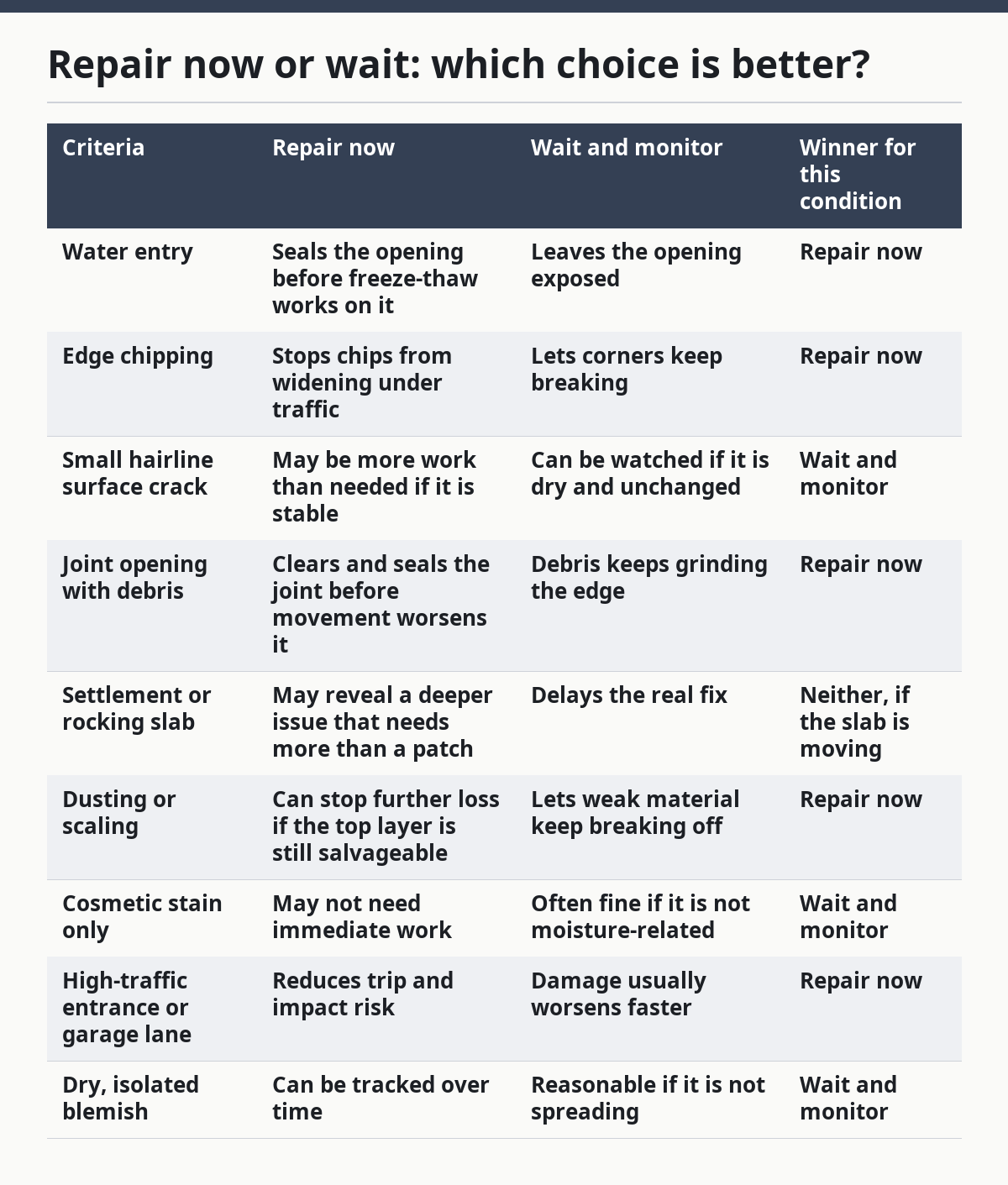
The honest rule is this: repair now wins whenever water or traffic can make the damage grow. Waiting wins only when the defect is truly stable and not opening up. If a slab edge is already moving, neither a sealant nor a surface patch is enough on its own.
What should a contractor check before quoting the job?
A contractor should check the cause of the damage, not just the size of the visible break. That is the difference between a repair that lasts and a repair that only hides the problem for one season.
The first check is movement. If the slab edge rocks, sinks, or sounds hollow, the support may be failing. The second check is water. Drainage, ponding, leaking downspouts, and snowmelt paths all matter because water drives edge failure. The third check is joint condition. A joint clogged with grit, broken filler, or old patch material can force the slab edge to take the load.
The fourth check is the surface itself. A contractor should tell the difference between sound concrete with a damaged edge and weak concrete all across the face. If the top layer is scaling or the slab is dusty, a patch may not bond well unless the loose material is removed and the cause of weakness is addressed. The fifth check is access and use. A driveway, loading dock, sidewalk, or basement corridor all need different repair timing and access planning.
For a New York building, it also helps to ask whether the area has winter salt exposure, foot-traffic concentration, or repeated vehicle turning. Those conditions change the repair detail. The best contractor answer is usually specific: what failed, why it failed, what gets repaired now, and what still needs monitoring later.
How much does slab surface and edge repair usually cost?
The cost depends on how deep the damage goes, how much concrete has to come out, and whether the job includes support work, joint repair, or surface restoration. A small cosmetic patch costs less than a structural repair at a settled edge, and a full resurfacing job costs more than a localized patch.
Three things usually drive the price. First is access: basement work, sidewalk work, or tight urban access can raise labor time. Second is preparation: broken concrete has to be removed, cleaned, and shaped so the new material bonds correctly. Third is diagnosis: if the contractor finds a drainage or support issue, the job can expand beyond the visible chip.
For a reader deciding who to call, the right question is usually “What is included in the quote?” Ask whether the quote covers removal of loose material, crack treatment, edge rebuilding, joint sealing, curing time, and any correction for drainage or support problems. A low number that skips those items can turn into a repeat repair.
For New York properties, local conditions can also affect timing and price. Winter limits some repairs, and busy sidewalks or mixed-use entrances can make staging and protection more complex. If a contractor cannot explain why the quote changed because of traffic, weather, or access, that is a warning sign. For more context, see our concrete sealing and commercial concrete repair pages.
What does a bad repair look like?
A bad repair looks neat for a short time and then starts breaking at the edges, separating from the slab, or cracking along the same line as before. The surface may look smooth at first, but the failure mode often shows up early if the cause was ignored.
One warning sign is patch material that feathers into dirty or loose concrete without proper prep. Another is a repair that does not match the movement of the slab. If the joint still moves and the patch is rigid in the wrong place, the break comes back. A third warning sign is a repair that traps water instead of shedding it. That is common when a broken edge gets filled but the slope and drainage are never corrected.
There is also the appearance test. A proper repair should blend with the slab in shape and function, but appearance alone is not proof of quality. A patch that looks tidy but sits over a hollow spot or active crack is still a weak repair. A contractor who promises a simple cover-up for a slab that is clearly moving is not solving the actual problem.
The most common bad outcome is delay. Small chips become larger breaks. Surface scaling becomes deeper loss. A joint opens wider. Then the repair has to cover more area, remove more material, and cost more than it would have when the slab first started to fail.
Which fix fits which slab problem?
The right fix depends on whether the slab has a surface issue, an edge issue, or a support issue underneath. That is the decision point that keeps a small repair from turning into a repeat call.
| Problem | Best fit | When it works | When it does not |
|---|---|---|---|
| Dirt, stains, light wear | Cleaning and routine care | The concrete is sound and dry | If the slab is scaling or weak |
| Hairline crack | Monitoring or sealing, depending on movement | The crack is stable and not opening | If water is entering or the crack grows |
| Small edge chip | Bonded edge repair | The slab is solid and support is good | If the edge is rocking or settling |
| Joint opening | Joint cleaning and sealing | The joint is active but the slab is stable | If the slab edge is already broken |
| Scaling or pop-outs | Surface repair or resurfacing | The top layer is weak but the slab is still sound | If the underlying concrete is badly damaged |
| Settlement at the edge | Structural repair or replacement of the affected area | The cause can be corrected | If the base keeps moving |
| Repeated freeze-thaw damage | Drainage correction plus repair | Water entry can be reduced | If the slab stays wet all winter |
The rule behind the table is simple: cleaning helps only when the slab is sound; patching helps only when the slab is stable; structural repair is needed when the slab is moving or poorly supported. That is why the same visible chip can lead to very different repair plans.
When should you stop repairing and replace the section instead?
You should stop repairing and replace the section when the slab has repeated failure, widespread weakness, or movement that a patch cannot hold. A repair is a local fix. Replacement is the answer when the problem is no longer local.
A good example is a slab edge that keeps breaking because the base beneath it has settled. If the support is gone, patch material has nothing reliable to bond to. Another example is a slab with widespread surface scaling, not just one damaged spot. If the top layer is failing across much of the surface, local repairs become a series of small wounds on a larger problem.
Replacement also makes sense when the edge damage affects safety or access and the geometry is already wrong. A trip edge at a main entrance, a loading area with broken corners, or a sidewalk slab that has shifted enough to create drainage and walking problems may need a larger scope. In a New York setting, that can be especially true where winter weather and high traffic keep stressing the same area.
The line between repair and replacement is not about pride or habit. It is about whether the slab still has enough sound concrete, support, and movement control to hold a repair. If those basics are gone, a bigger repair is usually a cheaper result than a sequence of small failures.
What should you ask before hiring a contractor?
You should ask what caused the damage, what the repair will do to stop it, and what condition would make the job a bad candidate for patching. Those questions force a contractor to talk about the slab, not just the material.
Ask whether the quote includes joint cleaning, crack preparation, edge rebuilding, curing time, and moisture or drainage correction. Ask what happens if the contractor finds a hollow edge or active settlement after the area is opened. Ask whether the repair is designed for foot traffic, vehicle traffic, or both. Those are different loads, and they should not get the same answer.
It also helps to ask what the repair will not fix. A truthful contractor will say that a patch will not stop a settling slab from moving or a wet slab from getting wet again. That answer is useful because it shows the contractor understands the limit of the work.
For New York buildings, ask about timing in cold weather and about protection of nearby finishes, entrances, and adjacent slab edges. If the contractor cannot explain how winter, salt, or repeated traffic affect the repair detail, the proposal is too shallow. The best quote is usually the one that names the cause, the scope, the limit, and the aftercare.
What care keeps a repaired slab in better shape?
The best care is usually simple: keep water away, keep joints clear, and keep an eye on any spot that was repaired once already. Concrete does not need fussing, but it does need conditions that stop water and movement from working on the same weak point.
Clean the surface often enough to remove grit, salt, and debris. Make sure water drains away from the slab edge instead of sitting beside it. Keep joints and cracks from filling with dirt, because packed debris holds moisture and blocks movement. If a repaired area starts to show a new line, a new chip, or a soft spot, do not wait for the next season to check it.
That is the part many owners miss. A repair is not the end of the problem if the conditions that caused the failure stay in place. In New York, that usually means winter water, salt, traffic impact, and older slab movement need regular attention. If those are managed, the slab surface and edges have a much better chance of lasting.
What is the right call for most New York slab problems?
Choose repair now if the slab is sound, the damage is local, and water or traffic can make it worse. Choose monitor-and-wait only if the defect is small, dry, and stable. Neither if the slab is moving, settling, or breaking in several places, because that needs a deeper fix.
That is the practical answer for a New York building owner, manager, or superintendent. Surface care protects the slab face. Edge care protects the weak point that breaks first. The right contractor is the one who tells the difference and does not confuse a cosmetic patch with a real repair.
What if the slab only has a small chip?
A small chip can be repaired if the slab around it is solid and the chip is not tied to a moving crack or a loose edge. The risk is not the size alone; it is whether water and traffic can keep working on the break. If the chip sits at a joint or corner, it deserves more attention than a same-size chip in the middle of a stable slab.
Can a sealer fix edge damage?
A sealer can help reduce water entry, but it does not rebuild broken concrete or correct movement. If the edge is already chipped or broken, sealing alone will not restore support or stop impact damage. It is useful as part of care, not as a substitute for repair.
How do I know if a crack is serious?
A crack is more serious when it is growing, letting in water, crossing a traffic path, or connected to settlement or edge breakage. A stable hairline crack may be watched, but a crack that moves with load or opens at a joint needs attention. If the slab sounds hollow or the crack widens seasonally, the problem is beyond simple surface care.
Does New York weather make repairs harder?
Yes, New York weather makes repairs more demanding because freeze-thaw cycles and salt exposure push small defects to grow faster. That does not mean every slab needs replacement. It means repairs should focus on keeping water out, fixing the edge before winter stress gets worse, and checking whether the slab is really stable before patching it.
Drafted with AI; not yet reviewed by a person.