Last updated: November 20, 2026
Key Takeaways
- An attached landing can need its own diagnosis when its movement, support, or crack pattern differs from the slab beside it.
- You are not trying to repair anything yet.
- A step has its own movement issue when the signs stay local to the stair unit instead of spreading across the whole front entry.
- A step should not get its own diagnosis when the real movement is in the house foundation, the front entry slab, or another slab that the step is simply following.
A concrete step or landing needs its own slab diagnosis when it moves, cracks, or separates differently from the house foundation or the slab beside it. If the step is opening up at the joint, tipping, or sinking on its own, it should be checked as a separate slab problem. For When Does a Concrete Step or Landing Need Its Own Slab Diagnosis?, the key question is whether the step or landing moves on its own. The sections below explain when that is true, what to look for, and when the step is just a symptom of a bigger foundation issue.
What this page covers, and what it assumes
This applies to attached concrete steps and landings that meet a front entry slab, porch slab, or house foundation. It assumes you can see the joint, spot cracks, and tell whether the edge is moving over time, not just stained or weathered. If you have an active trip hazard, a wide vertical offset, or a step that feels unstable underfoot, a qualified concrete or foundation professional should look at it. The Concrete Network notes that settlement and movement should be evaluated before repairs, and the International Code Council emphasizes that site conditions and structural movement can affect slab performance. (Source: Concrete Network, ICC)
The key idea is simple: a step can move on its own, or it can move because the slab or house beside it is moving. Those are not the same problem, and they do not get the same diagnosis. A proper read starts with the joint, the stair edges, and the ground right next to the attachment point. According to the U.S. EPA, water management around the foundation is part of controlling movement risk. EPA
When a concrete step has its own movement problem
Picture this: you’re standing at the front entry and the step sits a little lower than last season, while the porch slab beside it still lines up with the door threshold. That is the kind of separate movement that points to its own slab diagnosis. It is not enough to notice a crack; the pattern matters. A 1/8-inch change can be minor in one setting and a warning sign in another.
A separate diagnosis is more likely when the step has its own base, its own fill, or its own pour edge. That is common at attached entries where the step was placed against the house later, or where a landing was built as a small slab extension. The visible clue is simple: the step moves in one direction while the main slab stays put.
- Look for a crack that starts at the joint and runs across the step face.
- Check whether one stair edge is lower than the next by more than a hairline.
- Watch the gap where the step meets the wall or porch slab.
- Compare the step surface to a level line across the landing.
The catch is that a clean-looking joint can still hide movement underneath. A 1/4-inch gap that stays the same for years may be normal separation. A gap that opens in one season, or a joint that sheds sand and soil, points to active movement and deserves a closer read. For comparison, the American Concrete Institute and local building departments routinely distinguish construction joints from movement-related separation. ACI, NYC Building Code
How does an attached landing get separated from the rest of the slab?
An attached landing gets separated from the rest of the slab when its movement, support, or crack pattern no longer matches the slab next to it. That is the test that matters, not the label on the plan. A landing can be part of the entry system and still need its own slab diagnosis if it settles on different soil or pulls away from the foundation. This is the same idea used in slab evaluation guides from the Concrete Network and the National Association of Home Builders. (Source: Concrete Network, NAHB)
Here’s the catch: a landing often fails at the connection first. The joint may open, the corner may drop, or the stairs may tilt while the main front entry slab stays level. That mismatch is the clue. It says the landing may be carrying weight on a different patch of soil, or on a smaller footed area that responds differently to water and frost.
Common reasons include:
- poor fill under the landing
- a thin edge that spans soft soil
- water at the downspout or gutter outlet
- freeze-thaw near the front entry
- an attached step that was poured after the house
A landing that is only stained, chipped, or lightly cracked is not the same thing as a landing that changes height relative to the house. A vertical offset of 1/8 inch may be minor in one setting and a warning sign in another, depending on traffic, slope, and whether the edge catches a toe. When the movement is uncertain, a licensed foundation or concrete specialist should confirm whether the landing is separate. (Source: Concrete Network)
What to check before deciding it needs a separate diagnosis
Picture this: you’re at the front entry with a tape measure, a 4-foot level, and a pencil. You are not trying to repair anything yet. You are trying to answer one question—does the step or landing move like its own slab, or like part of the house system?
Start with the joint between the step or landing and the house foundation. Then check the step edges, the landing edge, and any nearby crack in the front entry slab. The goal is to compare one surface to another, not just to inspect the concrete in isolation. That comparison is more useful than a single crack width.
- Measure the joint opening at three spots. Use a ruler or feeler gauge and note any gap wider than a thin hairline, then verify whether it changes along the length. A widening gap or crumbly edge points to active separation.
- Check for vertical offset at the stair edge. Place a straightedge or level across the crack and verify whether one side is higher by more than a small lip. A lip that catches a shoe is a warning sign.
- Compare the step to the adjacent slab. Set a 4-foot level across the landing and toward the porch slab, then verify whether the bubble shifts the same way. If one area slopes differently, the move is not uniform.
- Look for step-to-step mismatch. Measure each riser and tread, then verify that the stair edges stay consistent. Uneven risers can signal the entire stair unit is settling, not just the surface.
- Check for cracks that mirror the joint. A crack that runs parallel to the house or crosses from the landing into the step face often tracks movement. A random surface craze crack does not carry the same weight.
- Inspect the soil and drainage at the edge. Verify whether downspouts dump water near the step, whether soil has washed away, or whether mulch hides a void. Soft soil under the edge often explains a separate drop.
- Press on the step near the outer corner and listen for a hollow sound or rocking feel. Verify whether the movement is local or spread across the whole landing. Local movement often means the slab bears on a weak spot.
If those checks show different movement between the step, the landing, and the house foundation, the step deserves its own diagnosis. If everything moves together, the bigger slab or foundation may be the main issue. That is a different path, and it is the one a professional should confirm if the entry is unstable. (Source: ICC)
What signs mean the step has its own movement issue?
A step has its own movement issue when the signs stay local to the stair unit instead of spreading across the whole front entry. That usually means the defect is in the support below the step, the joint at the attachment point, or the way the step was tied to the landing.
The clearest signs are:
- the step drops lower than the landing while the house wall stays aligned
- the joint opens but the wall itself does not show matching movement
- only one corner sinks
- stair edges become uneven from one side to the other
- the landing and step no longer drain the same way
Here’s the practical part: a step can crack from load, but it can also crack from restraint. If the step is attached tightly to a stable slab and the ground below it settles, the concrete has to give somewhere. That often shows up at the joint line first. A 1/8-inch lip can be enough to signal a change when it is new.
A small cosmetic crack is not the same as a step that has lost support. The second case can make the entry unsafe, especially when the lip becomes a trip point or the tread tilts under foot. That is where a separate slab diagnosis earns its keep, and it is also where an on-site review is the safer next step.
When not to treat it as a separate slab problem
A step should not get its own diagnosis when the real movement is in the house foundation, the front entry slab, or another slab that the step is simply following. In those cases, the step is a symptom, not the source. Chasing the step alone can waste time and hide the bigger issue, so it is better to have a professional confirm the source if the movement is unclear.
Cracks run through the wall above the step: that suggests broader movement, not just a step problem — the main structure needs attention before the step is labeled separate.
The whole porch slab has dropped together: that points to shared support loss — treat the slab system as one unit, and consult a foundation professional before isolating the step.
Only surface scaling is present: that is wear, not settlement — the diagnosis should stay focused on surface condition.
The gap has been unchanged for years: a stable joint may be normal construction separation — monitor it instead of assuming active movement.
There is water intrusion at the foundation wall: moisture can drive multiple problems at once — address the drainage path before calling the step isolated.
A separate slab diagnosis is for movement, not for every crack or gap. The wrong label can lead to the wrong fix. On a front entry, that matters because the step, landing, and house foundation often interact. The CDC also treats trip hazards and unstable walking surfaces as safety issues, not just appearance issues. CDC
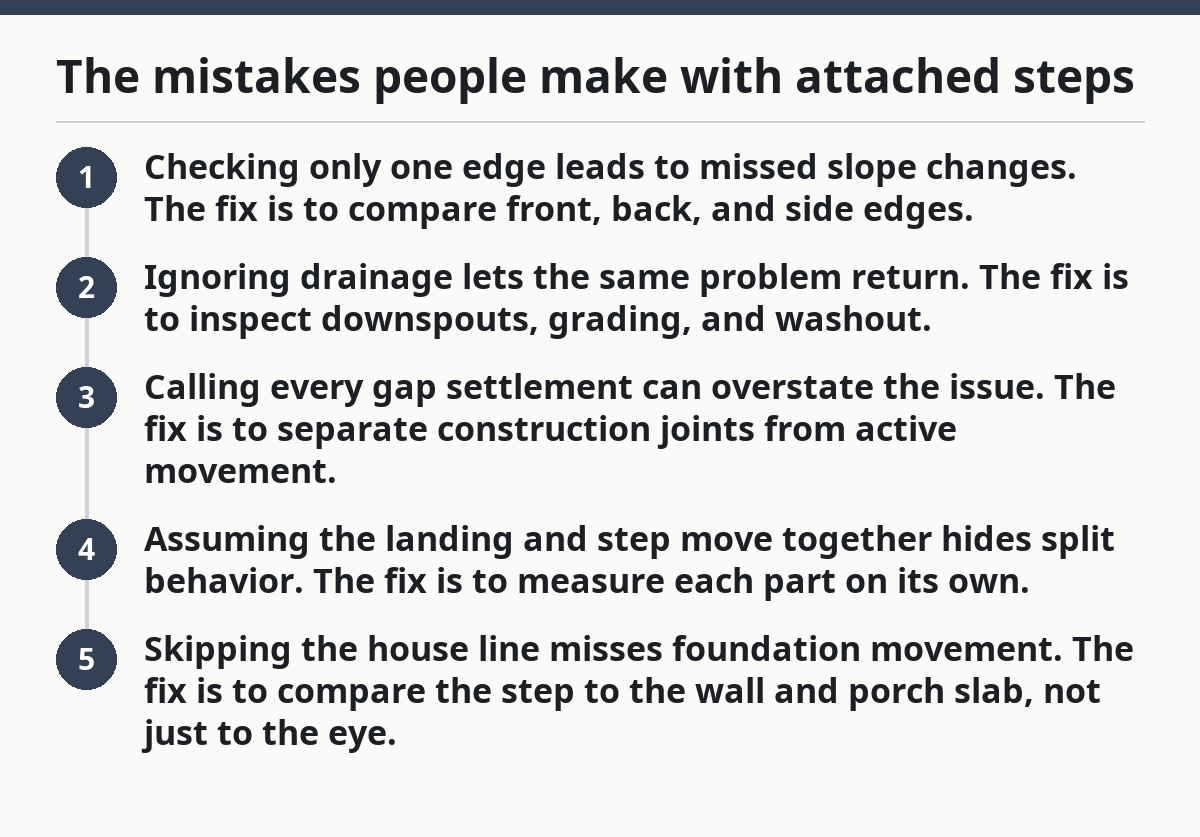
The mistakes people make with attached steps
Picture this: you see a crack at the entry, assume the step is the problem, and stop there. That is the most common mistake, and it leads to bad calls because it ignores the relationship between the step and the rest of the slab system. A measured check is better than a guess.
The next mistake is using only the size of the crack as the test. Width matters, but pattern matters more. A 1/8-inch crack at a stable joint may mean less than a tighter crack that has fresh displacement, dusting, and soil washout.
- Checking only one edge leads to missed slope changes. The fix is to compare front, back, and side edges.
- Ignoring drainage lets the same problem return. The fix is to inspect downspouts, grading, and washout.
- Calling every gap settlement can overstate the issue. The fix is to separate construction joints from active movement.
- Assuming the landing and step move together hides split behavior. The fix is to measure each part on its own.
- Skipping the house line misses foundation movement. The fix is to compare the step to the wall and porch slab, not just to the eye.
These checks do not require guessing. They require comparison. If the step is the only thing changing, treat it like its own slab diagnosis. If the whole entry is moving, stop labeling parts and look at the system. For larger entries, a qualified inspector can help sort local movement from structural movement before repair dollars are spent. (Source: Concrete Network)
Why attached steps move differently than the main slab
Attached steps move differently because they often sit on smaller support areas, thinner edges, or disturbed soil near the foundation. A house foundation may bear on deeper, more continuous support, while a step or landing sits on fill that was placed later and compacted less evenly. That setup creates a real difference in how each part behaves.
That difference shows up fast in cold weather and wet weather. Water can collect at the entry, freeze at the edges, and push weak concrete apart. The step may then settle, tip, or separate before the larger slab shows much change. A drainage issue can therefore create movement long before the concrete itself looks damaged.
A few field terms help here. Settlement means the slab drops because the soil below compresses or erodes. Differential movement means one part moves more than the part beside it. Those are the two patterns that decide whether the step needs its own diagnosis. A 1/4-inch change is often easier to spot than a hairline crack, which is why measuring matters.
For readers in New York, this issue comes up often where freeze-thaw, drainage, and old entry additions meet. The linked hub on Site-specific slab lifting scenarios in New York — The Complete Guide covers the broader regional context without repeating the diagnosis rules here.
FAQ
Why do steps settle differently than the main slab?
Steps settle differently because they often sit on smaller support areas, looser fill, or soil that gets wetter near the entry. The main slab or house foundation may spread load more evenly, so the step can drop or tilt first. In practice, that difference shows up as a joint opening, a corner drop, or uneven stair edges. When that pattern is limited to the step, the step may need its own slab diagnosis.
Can an attached landing be diagnosed separately?
Yes, an attached landing can be diagnosed separately when its movement does not match the slab or foundation beside it, but a professional should confirm it if the pattern is unclear. The main clue is differential movement: the landing sinks, cracks, or slopes differently from the front entry slab or wall. If everything moves together, the landing is probably part of a larger slab issue.
What signs mean a step has its own movement issue?
A step has its own movement issue when the crack pattern, height change, and joint opening stay local to the step. Look for one corner dropping, a lip at the stair edge, or a gap that widens at the attachment point. Those signs point to a separate support problem, not just surface wear.
Drafted with AI; not yet reviewed by a person.