
How to Keep a Slab Repair Project on Schedule During a Home Sale

Last updated: November 21, 2026
Keep the slab repair tied to the home sale timeline, not the repair crew’s calendar. The fastest way to stay on schedule is to check the real estate contract first, then line up the home inspector, seller disclosure, buyer approval, and closing date around one clear repair deadline.
Key takeaways
- Put the closing date and any inspection contingency in front of the repair plan before work starts.
- A short delay often starts with one missing piece: buyer approval, access, or a title item.
- The cleanest schedule protects the sale by matching the repair finish date to the contract, not to a guess.
- If the buyer wants a credit or extension, treat that as a timeline choice, not just a money issue.
- The best move is usually the one that keeps the buyer informed early and the title work moving at the same time.
What usually throws the home sale timeline off?
The home sale timeline usually slips when the slab repair is treated like a standalone job instead of part of the transaction. A home inspector may flag the issue, the buyer may ask for more detail, and the real estate contract may already have a closing date that leaves little room for delay.
The first thing to check is the inspection contingency. If the buyer still has a set number of days to object, repair work can stall while everyone waits for a decision. That is where deals lose time: not in the concrete work itself, but in the pause between discovery and approval.
A second pressure point is title. A title company may need repair paperwork, updated disclosures, or a revised closing date before it can clear the file. If that step is ignored, the slab project may finish on time and still miss the sale.
A third pressure point is access. A repair crew cannot stay on schedule if the seller, buyer, tenant, or agent cannot open the house when needed. That is a simple problem, but it can cost days.
The quick diagnosis
| What is slowing the deal | What it affects | What to check first |
|---|---|---|
| Inspection contingency | Buyer response time | Contract deadline |
| Buyer objections | Repair approval | Written reply and scope |
| Disclosure gap | Trust and renegotiation | Seller disclosure form |
| Title hold | Closing paperwork | Title timeline |
| Access problem | Work start or finish | Appointment window |
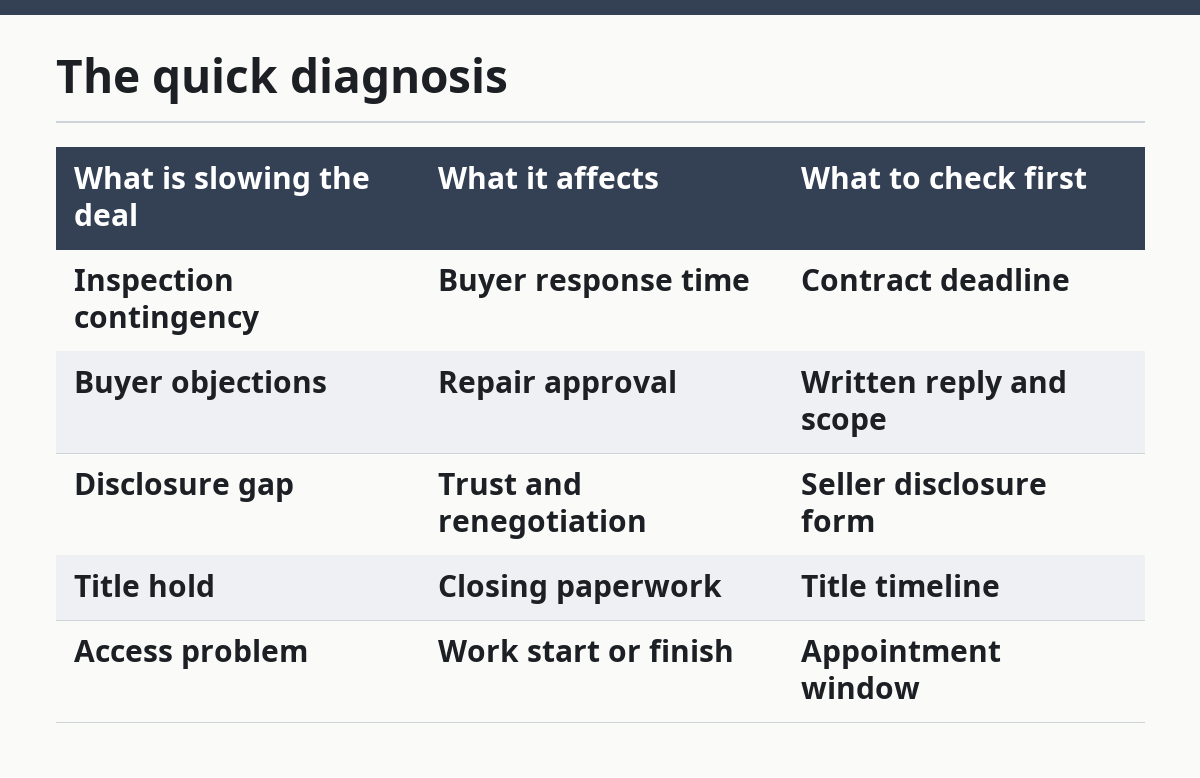
If the delay starts with the contract, do not push the repair first. Fix the paper trail first. A slab project can be fast; a stalled transaction can make even a short repair look like a long one.
What should I check first in the real estate contract?
The real estate contract should be checked first because it sets the dates that matter more than the repair crew’s estimate. Look for the inspection contingency, the closing date, any repair addendum, and any requirement for written approval before work begins.
Start with the smallest time window. If the buyer has only a short period to respond to inspection findings, that deadline becomes the anchor for everything else. A slab repair that begins before that response can create a dispute if the buyer has not agreed to the fix.
Then check whether the contract allows a closing extension. Some deals can absorb a few days if the repair is in progress, while others need the seller to finish before the title company will clear the file. Do not assume the extension is automatic.
Use this order:
- Read the inspection contingency date and mark it on the calendar. That tells you how much room exists before the buyer can object.
- Check the closing date and count backward 7 to 14 days for any repair buffer. That gives the title company time to review documents.
- Confirm whether written buyer approval is required before the slab work starts. If it is, do not schedule work that needs access before that approval lands.
- Ask whether the title company wants proof of completion, photos, or an invoice before closing. That can affect the last step more than the actual repair.
- Put the repair date in writing with the agent and contractor so nobody is working from memory.
The rule here is simple: if the contract says “before closing,” treat that as a hard stop. If it says “as soon as practical,” get a clearer written date or expect a dispute later.
How do I line up the repair with the buyer and inspector?
You line up the repair with the buyer and inspector by deciding who needs to see what, and when, before anyone opens a tool bag. The home inspector does not approve the repair, but the inspection report often starts the buyer’s objections, so the inspection timing matters as much as the work itself.
If the slab issue is still under review, keep the scope narrow and written. A vague promise to “fix the slab” can create a wider fight than the repair itself. Name the problem area, the method if already agreed, and the date the work is expected to finish.
The buyer’s main concern is usually not the concrete. It is whether the fix will delay closing, hide a larger problem, or change the price. A clear repair plan can calm that faster than a long explanation.
Use a simple sequence:
- Get the inspection report or the buyer’s repair request in hand before you schedule the work. That avoids repairing the wrong area.
- Match the repair window to the buyer response deadline. If the buyer has 3 days to reply, do not schedule a job that starts inside that window unless the buyer has already agreed.
- Tell the agent and buyer whether the repair will need a full-day access window or a shorter appointment. Access issues cause more delay than many people expect.
- Share the plan with the title company if the closing date is close. Some files need documentation before the final sign-off.
- Keep before-and-after records for the seller disclosure and the closing file.
A common mistake is overexplaining the slab problem to the buyer in casual messages. That can create new objections, especially if the buyer hears a bigger problem than the inspection report showed. A written update is safer than a long phone call.
What is the fastest way to keep the schedule moving?
The fastest way to keep the schedule moving is to treat the repair as one part of a three-part chain: approval, access, and closing paperwork. If any one of those three breaks, the repair can finish and the sale can still miss the target date.
A practical way to keep momentum is to work backward from the closing date. If closing is set first, every other deadline should be placed around it, not guessed later. That means the repair date, buyer response date, and title review date should all be visible on the same calendar.
The most useful comparison is this:
| Option | Best use | Main risk |
|---|---|---|
| Repair before buyer approval | Rarely useful | Can trigger objections |
| Repair after buyer approval | Best for most contracts | Leaves less time before closing |
| Ask for a closing extension | When work needs extra days | Buyer may resist |
| Offer a credit instead | When time is too tight | Buyer may still want more inspection proof |
A credit can move the sale faster than a repair if the buyer wants control of the work after closing. But that choice can also leave the seller with a lower net and no guarantee the deal stays smooth. A repair can reassure a buyer, but it can also eat up the calendar if the file is already tight.
The rule of thumb is simple: if the title company needs no more than ordinary paperwork and the buyer accepts the repair, finish the work before the closing date. If the timeline is already squeezed, a credit may be cleaner than forcing a rushed job that creates a new dispute.
What should I tell the title company and seller disclosure team?
The title company and seller disclosure team should be told early because they can slow the closing even after the slab work is done. A repair that is invisible to the paperwork can still block closing if the disclosure form is not updated or the title file needs proof of completion.
The seller disclosure should match what is known, what has been fixed, and what is still pending. Do not write around the problem. If the slab issue was discovered during the sale, that fact belongs in the disclosure flow, even if the repair is already scheduled. Leaving it out can create a buyer objection later that is harder to fix than the original issue.
The title company may ask for a repair invoice, a completion note, or a revised closing date. That request is not a surprise; it is part of the title timeline. If the closing is close, send the paperwork as soon as the repair date is confirmed, not after the crew leaves.
Keep these details together:
- the real estate contract date
- the inspection contingency outcome
- the repair appointment date
- any buyer approval in writing
- the updated seller disclosure
- the revised closing date, if needed
This is where many sales lose a day or two. The work is complete, but the file is still waiting on a form, a signature, or a note. A tidy paper trail matters as much as a tidy repair.
For a broader look at permissions and project constraints, the hub on slab repair permissions, approvals, and project constraints covers the approval side that sits behind this timeline issue.
When should I stop and get help?
You should stop and get help when the repair threatens the closing date, the buyer’s approval is unclear, or the contract language is too tight to read safely on your own. A repair delay is one thing; a contract dispute is another.
If the inspection contingency has already expired and the buyer is still asking for changes, the timeline may need a formal extension or addendum. That is not a guess-and-fix moment. It needs a clear written response so the sale does not drift into a title problem.
If the title company says the file is not ready because of missing repair documents, send the missing item fast and ask what exact form they need. A vague reply wastes time. A specific request can save a closing date.
If the buyer objects to the slab repair scope, do not keep revising the plan by text message. Put the change in writing through the agent and confirm whether the closing date still stands. That one step can prevent a repair from becoming a contract fight.
The safest line is this: if the issue changes the sale terms, it belongs in writing before the repair starts. If it only changes the repair day, the agent and title company still need to know.
Can a repair delay closing?
Yes, a slab repair can delay closing if it runs past the closing date, needs buyer approval first, or leaves the title file incomplete. The delay is often small, but it can still matter if the contract has no room for a closing extension. The fastest fix is to move the paperwork and the repair schedule at the same time.
What if the buyer asks for a credit instead?
A credit can keep the timeline moving when there is no room for a repair before closing. It shifts the work to the buyer after the sale and can avoid a hard scheduling conflict. The trade-off is that the seller may give up money without guaranteeing the buyer will stop pushing for more inspection terms.
Should I fix the slab before listing?
Fixing the slab before listing can help if the repair is likely to show up in inspection and the home sale timeline is already tight. It may also reduce buyer objections. But it is not the best move for every seller, especially when the repair would eat into the launch date or create disclosure questions that need careful handling.
Drafted with AI; not yet reviewed by a person.