Estimating, Pricing, and Buying Decisions — The Complete Guide

Last updated: November 20, 2026
Estimating, pricing, and buying decisions — The Complete Guide is about turning a number into a choice you can defend; it helps you decide what a job, product, or service is likely to cost, what to charge or pay, and when the number still works after labor, overhead, risk, and failure cost are included. The right answer is usually not the lowest number — it is the number that still works after labor, overhead, risk, and failure cost are included.
I write from the pricing and purchasing side of the table: cost models, bid comparisons, procurement terms, and the math that sits behind a “yes” or “no.” If you are making a high-stakes decision, consult a qualified procurement, estimating, or legal professional as needed; for background, see the American Society of Professional Estimators and the Project Management Institute on estimate traceability and cost management.
Key takeaways
- A good estimate is a decision tool, not a guess dressed up as certainty.
- Price only makes sense when it includes direct costs, indirect costs, risk, and the cost of making the wrong choice.
- The cheapest bid can look best on paper and still lose money in change orders, delays, or rework.
- Buy when the delivered outcome matters more than the sticker price.
- Walk away when the scope is vague, the assumptions are hidden, or the seller will not put exclusions in writing.
What a useful estimate actually contains
A useful estimate contains scope, quantities, assumptions, exclusions, and a margin for uncertainty. Without those five pieces, the number is just a slogan. A proper estimate can be defended line by line, which matters whether the job is a kitchen remodel, a software project, a freight shipment, or a bulk purchase.
Start with scope. What is included, and just as important, what is not? A quote that covers “installation” but excludes demolition, disposal, permits, or site prep is not wrong, but it is incomplete. That omission becomes expensive when the missing work shows up later as a change order.
Then list the quantities. If the work depends on 120 square feet, 80 units, 14 labor hours, or 3 delivery days, the estimate should say so. Quantities are where bad estimates hide; a price that sounds precise can still be built on a bad count.
Next come assumptions. These are the conditions that must stay true for the number to hold. Examples may include “existing wiring is serviceable,” “material lead times stay under 2 weeks,” or “the order ships in one pallet,” but those should be verified with the seller or a qualified professional, because the estimate should be treated as broken if the assumptions are wrong.
Finally, add uncertainty. A tight, repeatable process may deserve a narrow contingency. A first-time project, an unverified site, or a volatile supply chain deserves a wider one. That is not padding; it is the cost of not knowing.
For readers who want a standards-based reference point, the American Society of Professional Estimators publishes guidance on estimating practice, and the Project Management Institute publishes cost management material that explains why estimates should be tied to scope and risk. Those bodies are not identical, but both reinforce the same principle: estimates should be traceable, not magical.
How do you price something without guessing?
You price something by building from cost up, then checking the result against the market. That is the cleanest method whether you are selling a service, evaluating a vendor, or deciding what a purchase should really cost over its life.
The simplest structure is:
- Direct cost
- Indirect cost or overhead
- Risk allowance
- Profit or required return
- Market check
Direct cost is the money that can be traced to the item or job: materials, subcontracted work, freight, assembly, licensing, or direct labor. If a part costs $18 from a supplier and shipping adds another $4, that is the starting point, not the final price.
Indirect cost is what the item consumes without being visible on the invoice: rent, admin time, tools, software, warranty handling, insurance, and accounting. Many pricing mistakes come from pretending overhead does not exist. If you do not recover it somewhere, the job may look busy while the business loses money.
Risk allowance covers the things that are likely enough to matter but not certain enough to book as direct cost. Examples include scrap, warranty returns, small scope changes, and schedule slippage. This is where low bids often fail. A seller who prices at bare cost is betting that nothing goes wrong.
Profit or return is the last layer, not the first. If there is no margin, there is no room to replace a mistake or invest in better service. For a buyer, this also explains why a quote can be rational even when it looks high. A vendor that includes realistic overhead and risk may be more dependable than one that omits them and adds them back later.
The market check keeps the number honest. If your computed price lands far above or below comparable offers, do not ignore that gap. Either your assumptions are off, the scope is different, or the market is accepting a different level of service, warranty, speed, or quality.
For finance and pricing concepts, the U.S. Small Business Administration has practical guidance on pricing and overhead management. For buyers who need procurement discipline, the Chartered Institute of Procurement & Supply is a solid standards source on total cost and supplier evaluation, but consult a procurement professional when the buying decision carries legal, financial, or operational risk.
Estimate, quote, bid, and invoice are not the same thing
They are different, and mixing them up causes bad decisions. An estimate is a forecast. A quote is a firm price for a defined scope. A bid is a competitive offer against other sellers. An invoice is the bill after work is done or goods are delivered.
This matters because people often compare documents that are not meant to be compared. An estimate and a firm quote are not equal. A low estimate can be useful for budgeting, but it should not be treated as a locked price unless the seller has made that commitment in writing and the terms have been reviewed. A bid can look attractive because it is narrowly scoped. An invoice can surprise you because the quote left out a taxable item, delivery charge, or service fee.
The right decision question changes with each document:
- For an estimate: “How accurate is this likely to be?”
- For a quote: “What is excluded?”
- For a bid: “What changes if the scope shifts?”
- For an invoice: “Does this match the agreed terms?”
The most useful habit is to ask sellers for the same structure every time: scope, assumptions, exclusions, timeline, payment terms, and change-order rules. If two bids use different assumptions, the cheaper one may only be cheaper because it left out work. Therefore, the comparison should start with whether the documents actually describe the same job.
A generic article often stops at “compare prices.” That is not enough. A better comparison asks whether one seller is pricing risk honestly, whether one includes warranty or training, and whether one has made the customer pay for uncertainty through exclusions. Those details change the real cost far more than a small difference in headline price.
A useful rule: if two offers look very different, they are probably not describing the same thing.
The honest side-by-side: low bid versus total-value bid
The low bid wins when the job is simple, the scope is fixed, and the penalty for failure is small. The total-value bid wins when delay, rework, support, or downtime would cost more than the difference in sticker price.
| Criteria | Low bid | Total-value bid | Winner for [condition] |
|---|---|---|---|
| Up-front cash outlay | Usually lower on day one | Often higher because more is included | Low bid for tight cash flow |
| Scope completeness | May exclude setup, cleanup, or support | Usually more explicit about inclusions | Total-value bid for complex work |
| Risk of change orders | Higher if assumptions are thin | Lower if the scope is written tightly | Total-value bid when scope may move |
| Execution quality | Can be uneven if pricing is too thin | Often better when margin funds process | Total-value bid for mission-critical work |
| Speed to award | Easy to compare, faster to choose | Takes longer because terms must be checked | Low bid for simple, repeatable buys |
| Long-term support | Sometimes weak or extra-cost | Usually better defined | Total-value bid when support matters |
| Predictability | Can be less predictable if exclusions appear later | More predictable if assumptions are clear | Total-value bid for budget certainty |
| Best use case | Standardized jobs with low downside | Projects where failure is expensive | Depends on consequence, not sticker price |
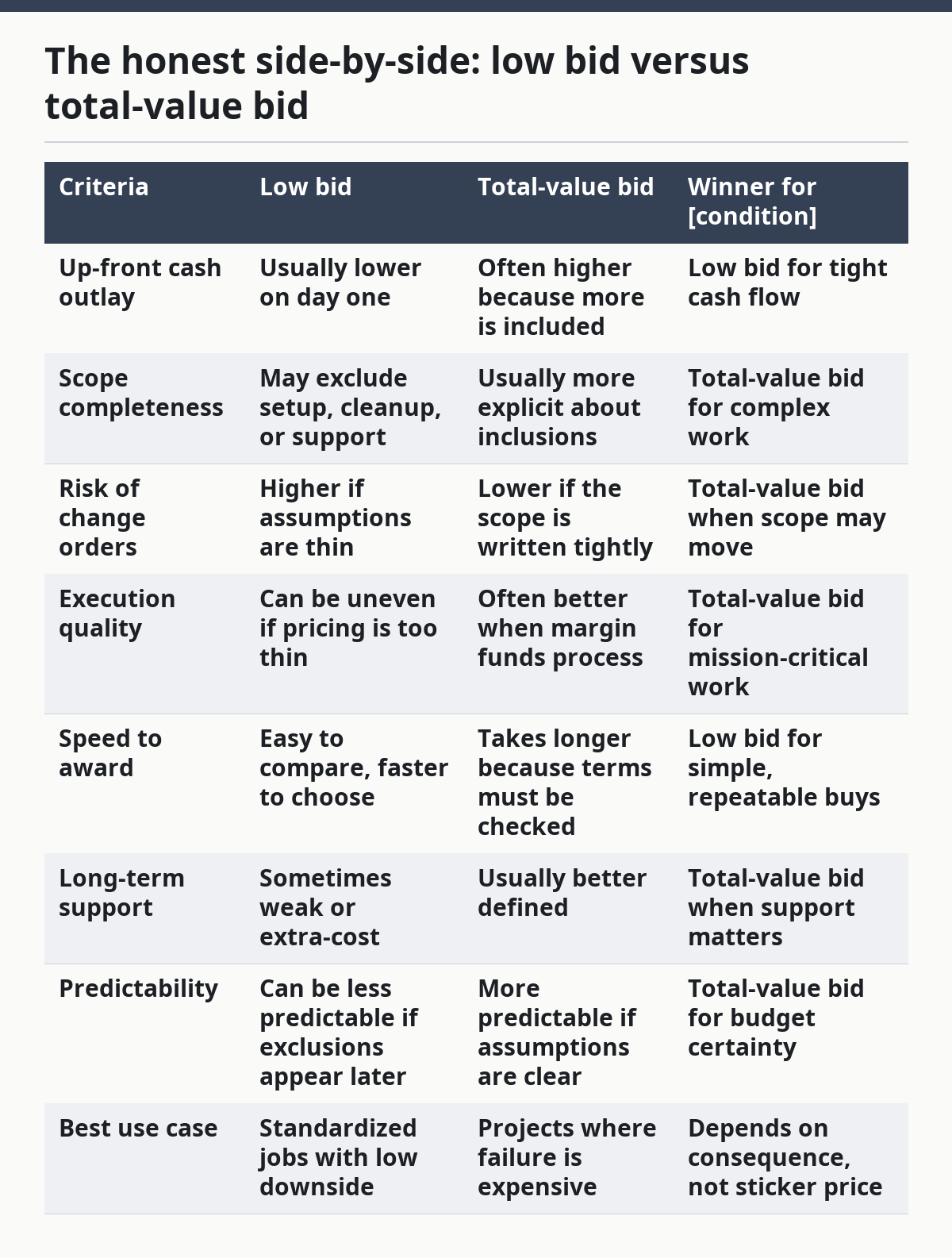
The low bid is not bad by definition. It is the right answer for standardized buying: office supplies, catalog parts, known materials, repeatable labor, and purchases where the specification is tight enough that every offer really is the same thing. The danger is that the low bid can hide missing scope, cheap materials, or weak after-sale support.
The total-value bid is the better choice when the purchase lives inside a larger process. A service contract, an industrial component, a delivery schedule, or a build with coordination risk should be judged on total cost of ownership, not only the invoice. That extra cost may be worth paying because it reduces the chance of a later loss.
The wrong buyer for the low bid is anyone who needs certainty more than thrift. The wrong buyer for the total-value bid is someone comparing identical commodity items where support and process add no real value.
When the low bid is the smart choice
The low bid wins when the item is standardized, the consequences of failure are mild, and the seller’s exclusions are clear. In that lane, paying extra often buys nothing but a fancier presentation.
This is the right path for commodity purchases and tightly defined work. If the item has a clear spec — size, grade, delivery terms, warranty length, or service level — then the cheapest compliant offer may be the best answer, assuming the requirement is truly standardized and the buyer has verified the details. A box of fasteners, a repeated maintenance task, or a known bulk order usually does not need a premium buyer.
It also wins when the decision must be made quickly and the operational risk is low. A team replacing common supplies, ordering a known part number, or selecting among identical catalog products can often choose on price alone after checking shipping, returns, and tax. In those situations, the analysis should be short, not theatrical. Therefore, the goal is to confirm comparability, not to create complexity.
The weakness is just as clear: the low bid gets dangerous when scope is imperfect. A quote that omits install time, disposal, permits, or training can beat a fuller offer by a wide margin and still cost more in the end. That is not because the seller is dishonest in every case. Sometimes the buyer failed to specify the job.
The low bid is also a bad choice when failure is costly. If a missed deadline stops production, or a weak component causes rework, the initial savings can disappear fast. A small discount does not offset a large operational hit.
The right buyer here is practical and disciplined. They know the spec, they can compare apples to apples, and they are not paying for service layers they do not need. The wrong buyer is anyone whose real problem is reliability, not price.
When the total-value bid wins
The total-value bid wins when the job has hidden costs, the outcome matters, or the scope changes easily. That includes custom work, service contracts, technical installs, recurring purchases with support, and anything where one failure can eat a month of savings.
This is where total cost of ownership matters. A higher price can be cheaper if it includes fewer failures, less downtime, better warranty handling, or lower maintenance. A vendor that offers setup, documentation, training, or a longer warranty is not just adding extras; they may be moving costs out of your later budget and into the original price, where you can see them.
The strongest case for total-value pricing is when the buying decision is part of a chain. For example, a machine, software system, or service provider can create follow-on costs in training, integration, support, compatibility, and replacements. If the purchase ripples into five other departments, the invoice is not the whole story.
A generic article often says “think long term” and leaves it there. That advice is too soft. The real question is whether the extra cost prevents a likely, expensive failure. If a better part prevents downtime, if a better contractor prevents rework, or if a better service plan prevents expensive internal labor, the premium is measurable in avoided cost.
The weakness is that total-value bids can be abused. Sellers know that support, service, and reliability sound good, so they may bundle extras the buyer does not need. If the added features do not reduce real risk or save measurable time, the buyer is paying for reassurance, not value. As a result, the buyer should separate useful protection from marketing.
The right buyer here is risk-sensitive and specific. They care about uptime, service quality, and long-term cost. The wrong buyer is shopping for a simple item where the premium features do not change the result.
What to check before you buy or award the job
You should check the assumptions, exclusions, warranty, payment terms, and change rules before you buy or award the job. Those five items cause more regret than the headline number.
Start with assumptions. If the seller assumes site conditions, lead times, minimum order quantities, or access conditions that may not hold, ask for those assumptions in writing. A number built on unstable assumptions is a forecast with a weak spine.
Then inspect exclusions. Are disposal, travel, fuel, installation, onboarding, taxes, or calibration missing? Exclusions are not a defect by themselves, but they must be visible. A hidden exclusion is where a cheap quote becomes an expensive project.
Warranty matters because it changes the cost of failure. A 30-day warranty and a 12-month warranty are not equivalent, even if the upfront price is the same. The same logic applies to support response time, service credits, and replacement terms.
Payment terms matter because they shift risk. Net 30, deposit requirements, milestone billing, and retainage all affect cash flow, so review them with the contract or procurement team before you compare offers. A buyer with tight cash may choose a slightly higher price if the payment schedule is safer. A seller may accept a lower margin if the terms reduce collection risk.
Change rules are the last filter. If the scope changes, who writes the new price, and how fast? A solid change-order process is not bureaucracy; it is how both sides keep the project from turning into a dispute.
For procurement discipline, the Federal Acquisition Regulation is a useful reference point because it makes scope, terms, and documentation central to buying decisions. Not every purchase needs federal-level process, but the logic is worth copying.
What to do when the numbers are close
When the numbers are close, choose the offer with fewer hidden costs, clearer terms, and lower execution risk. A small price gap should not override a big difference in clarity.
If one offer is 5% to 10% lower but leaves vague support terms, unclear exclusions, or a loose timeline, that discount may not be real. If another offer is slightly higher but specifies delivery, service, and warranty in plain terms, the extra money may buy predictability. Predictability has value because it reduces management time and downstream friction.
A good tie-breaker is the question: “Which offer will still look good after the first problem?” That question cuts through sales language fast. A poor contract looks fine until there is a defect, a delay, or a change request. Then the missing details become expensive.
If the offers are both acceptable, compare the seller’s responsiveness, clarity, and willingness to document changes. A seller who answers directly and writes clean terms is often easier to work with than a seller who wins on price but answers every question with a new exception. This is not a personality contest. It is a clue about how the relationship will behave once money has changed hands.
When the offers are close, the buyer who needs the least rescue should usually win.
The verdict: which one to choose and why
Choose the low bid if the scope is fixed, the item is standardized, and the cost of failure is small. Choose the total-value bid if the purchase carries risk, support needs, or downstream costs that the sticker price does not capture. Neither if the scope is vague, the assumptions are hidden, or the seller will not put exclusions and change rules in writing.
That is the cleanest decision rule because it matches the real job of estimating, pricing, and buying. The goal is not to find the smallest number. The goal is to find the number that survives contact with the work.
Exception scenarios where the verdict flips
The overall verdict flips when the supposed “cheap” option is actually a different product, a different service level, or a different risk profile. Three common cases do that.
First, the low bid flips into the wrong choice when the job has coordination risk. If one supplier needs your team to do more work, the lower quote may simply be moving cost to another budget line. In that case, the fuller offer is cheaper in practice.
Second, the total-value bid flips into the wrong choice when the premium features do not reduce any real loss. A seller may bundle extras like faster support or extended coverage, but if your use case rarely needs them, the extra cost is wasted. Paying for unused insurance is still waste.
Third, both options fail when the scope is not ready. If the specification is incomplete, the comparison is noise. You do not have two bids; you have two guesses.
A fourth flip happens in urgent buys. When time matters more than price, the best choice may be the option that can deliver reliably right now, even if it is not the cheapest or the most feature-rich. Delay is a cost. Therefore, urgency can outweigh a narrow price advantage.
FAQ
How do I know if an estimate is too low?
A too-low estimate usually leaves out scope, assumptions, or risk. If the number is far under comparable offers, ask what is excluded and what happens if the conditions change. If the seller cannot answer clearly, the estimate is probably incomplete rather than efficient.
Should I always choose the cheapest quote?
No. The cheapest quote is the right choice only when the scope is identical, the quality requirement is clear, and the cost of failure is low. If support, warranty, reliability, or change management matters, a slightly higher quote can be the cheaper total decision.
What is the difference between price and value?
Price is what you pay upfront. Value is what you get after quality, durability, support, time saved, and failure avoided are counted. A $500 item can be more expensive than a $700 item if the cheaper one breaks, delays work, or needs replacement.
How many quotes should I compare before buying?
Three is often enough for a normal purchase because it shows the market range without creating analysis paralysis. If the quotes differ widely, the job is not to collect more numbers; it is to fix the scope and ask why the offers are not comparable.
When should I walk away from a deal?
Walk away when the scope is vague, the exclusions are hidden, the payment terms are risky, or the seller refuses to document changes. A bargain that cannot be explained in writing is usually not a bargain for long.
Drafted with AI; not yet reviewed by a person.