
How to Tell If Your Driveway, Sidewalk, or Patio Needs Slab Lifting

Last updated: November 19, 2026
Quick answer: A driveway, sidewalk, or patio usually needs slab lifting when a settled concrete slab has a height change of about 1/4 inch or more, creates a trip hazard, or holds standing water. This guide on how to tell if your driveway, sidewalk, or patio needs slab lifting helps you spot the problem early and decide when to call for an inspection.
A sunken concrete slab usually needs lifting when one side drops enough to create a trip hazard, let water sit on the surface, or leave a visible gap at a joint. If your driveway, sidewalk, or patio no longer sits level with the slab next to it, that is the clearest sign to call for an inspection. In practice, the question is not whether concrete has age-related flaws; it is whether the slab has moved enough to affect use.
Key takeaways
- A slab does not need lifting just because it has a crack; the question is whether the crack comes with sinking, rocking, or a height change.
- Trip hazards, standing water, and uneven joints are among the fastest signs to check on a driveway, sidewalk, or patio.
- Small cosmetic flaws are common, but a slab that moves when walked on or changes height at the edge is a different problem.
- A quick visual check can tell you whether you need repair now or can keep watching the slab for a little longer.
- The right next step is an inspection, not guessing from one crack alone.
What slab lifting is actually trying to fix
Slab lifting is meant to bring a settled concrete slab back to a usable level, not to make old concrete look new. When soil underneath washes out, compresses, or shrinks, the slab can drop at one corner, one edge, or across an entire panel. That is why a driveway panel may sit 1/2 inch lower than the one beside it, or a sidewalk square may tilt enough to catch a toe.
The problem is usually easiest to see where concrete meets concrete. Look at control joints, expansion joints, porch steps, garage aprons, and the seams between patio sections. If one side sits 1/4 inch to 1 inch lower than the other, the slab may already be past the point of ignoring it. Height changes matter more than hairline surface cracks.
A common mistake is to judge the slab by appearance alone. Staining, spalling, and surface cracks can happen without settlement. Lifting is about movement. If the slab is still flat and stable, it may not need lifting at all. If it has dropped, tilted, or left a gap that a hose, shoe, or wheel catches, the concrete has crossed into a structural use problem.
For homeowners comparing repair options, this page is the first filter. It helps decide whether to call for slab lifting at all; the hub on concrete slab lifting can handle the broader topic from there. For related guidance, see the pages on concrete crack repair, foundation settlement signs, and sidewalk repair.
How can I tell if my driveway, sidewalk, or patio needs lifting?
You can tell by checking for height changes, trip edges, standing water, and joints that no longer line up. Those four signs are the ones that most often point to settled concrete instead of normal wear. A slab that looks rough but still sits level is different from one that has dropped 3/8 inch or more at an edge. For a quick field check, this is the most direct way to tell whether how to tell if your driveway, sidewalk, or patio needs slab lifting applies to your slab.
Use this quick inspection in daylight after the surface has dried:
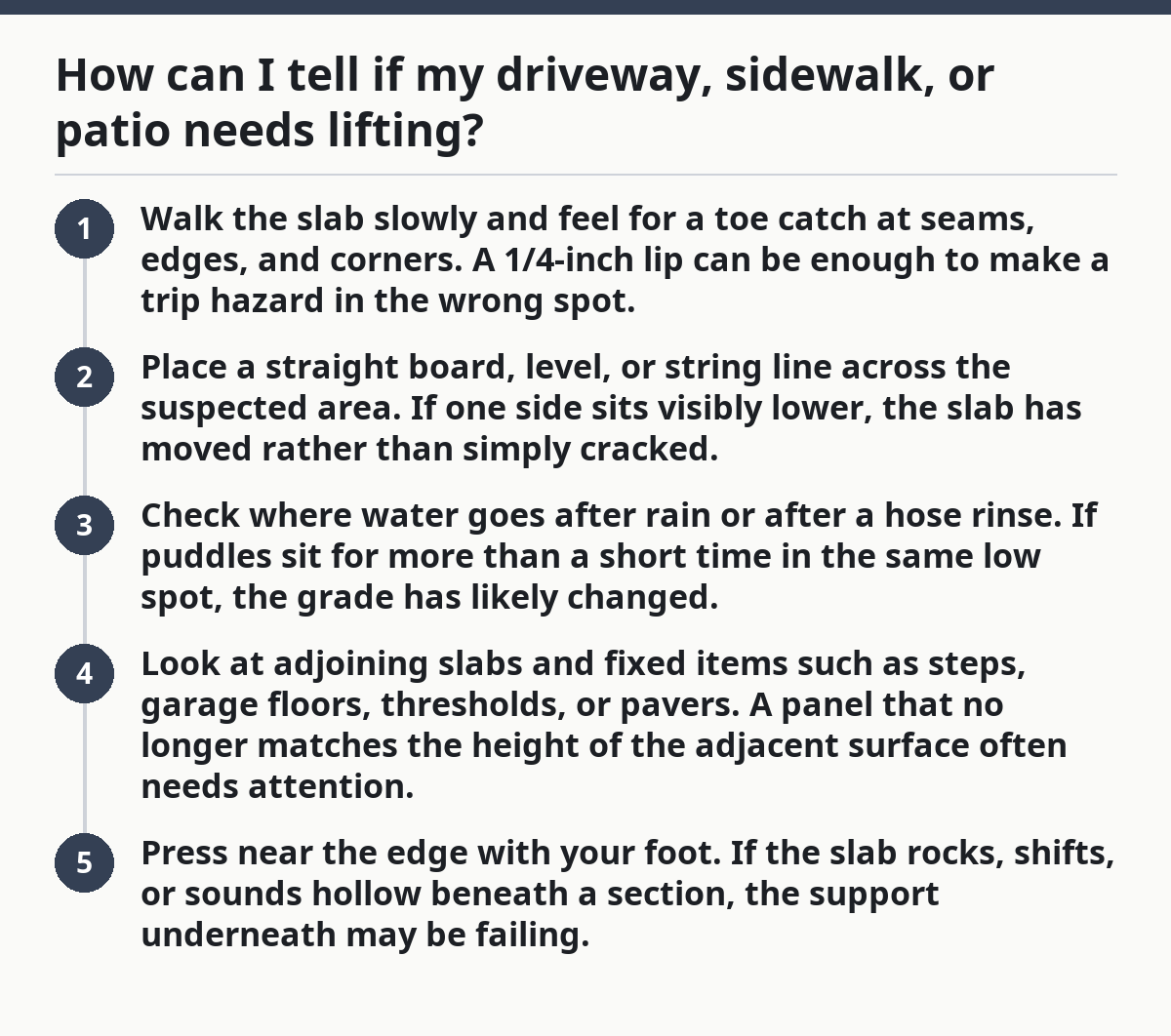
- Walk the slab slowly and feel for a toe catch at seams, edges, and corners. A 1/4-inch lip can be enough to make a trip hazard in the wrong spot.
- Place a straight board, level, or string line across the suspected area. If one side sits visibly lower, the slab has moved rather than simply cracked.
- Check where water goes after rain or after a hose rinse. If puddles sit for more than a short time in the same low spot, the grade has likely changed.
- Look at adjoining slabs and fixed items such as steps, garage floors, thresholds, or pavers. A panel that no longer matches the height of the adjacent surface often needs attention.
- Press near the edge with your foot. If the slab rocks, shifts, or sounds hollow beneath a section, the support underneath may be failing.
The result you want is simple: a flat, stable path for feet, wheels, and water. If the slab still drains properly and the height difference is small, you may be able to monitor it. If the movement is obvious, the slab is telling you it needs a closer look.
This check is not for decorative hairline cracks alone. It is for the cases where the concrete has lost support and created a usable-surface problem. If you want to compare the symptoms with other concrete issues, start with the section on what causes concrete slabs to sink.
What cracks, gaps, and uneven joints mean
Cracks, gaps, and uneven joints matter when they come with displacement, not when they are only cosmetic. A crack that stays flush on both sides is usually less urgent than a crack where one side has dropped 1/2 inch. The same is true for joints: a joint line that has opened or shifted is more serious than a thin line with no height difference.
Pay attention to these patterns:
- Cracks that step up or down: one side rises above the other. That step can catch a wheel or foot.
- Open gaps at joints: the gap may widen because the slab moved away from what it used to meet.
- Diagonal cracks near corners: these often show stress at a weak point, especially where a driveway meets a garage apron.
- Cracks that keep widening season after season: movement over time is more important than the crack itself.
- Broken edges with a sunken panel nearby: the edge may have fractured because the slab lost support.
What a lot of homeowners miss is that a crack alone does not prove settlement. Concrete shrinks as it cures, and surface cracking can happen from age, heat, or load; if the crack is changing, ask a qualified concrete professional to inspect it. The clue that points to lifting is a crack plus a change in level, or a crack plus water that now drains the wrong way.
A useful rule: if you can slide a 1/4-inch coin, a shoe edge, or the wheel of a stroller across the defect and feel it snag, the repair question has shifted from cosmetic crack repair to slab movement. That does not automatically mean lifting is the only answer, but it does mean the slab deserves inspection.
For context on common concrete behavior, the American Concrete Institute’s guidance on joints and cracking is a solid reference point, and the Portland Cement Association also explains how concrete slabs crack and move over time. The ACI is a practical source for slab behavior, and PCA materials on shrinkage and cracking are useful when you are comparing surface cracking with actual settlement.
Why water pooling is a warning sign, not just a nuisance
Water pooling often means the slab has settled enough to change the slope, and that is one of the strongest clues you need lifting. Concrete that once shed water away from a house, garage, or walkway may start holding puddles in the same place after every rain. That is not just annoying; it can help soil wash out farther under the slab and make the problem worse.
Look for these drainage clues:
- A shallow basin that stays wet after the rest of the surface dries
- Mud stains or algae at the low point
- Water running toward a garage, doorway, or foundation instead of away from it
- Downspout discharge that lands near the settled area
- Frost-prone spots that stay damp longer than surrounding concrete
Pooling on a patio is especially easy to dismiss, because the slab is not carrying cars. That is a mistake. Standing water can reveal a slope problem long before the slab becomes unsafe to walk on. It can also make the surface slick, soften nearby soil, and feed more erosion under the edge.
The trade-off is that not every puddle means lifting. A patio may pool because of poor original grading, roof runoff, or a clogged drain. The key question is whether the low spot is new, growing, or tied to a slab edge that has visibly dropped. If the water problem began after a visible settlement or after a winter freeze-thaw cycle, lifting is more likely to be part of the fix.
Signs the slab has become a trip hazard
A slab becomes a trip hazard when the height change is enough to catch a foot, wheel, or cane. The most common danger is a vertical lip between two pieces of concrete, especially on sidewalks and at patio transitions. Even a modest offset can be a problem if the walkway is narrow, the surface is busy, or the defect sits where people step naturally.
Watch for these red flags:
- One slab edge that rises above the other
- A corner that tilts and creates a wedge-shaped step
- A sidewalk panel that no longer matches the adjacent panel
- Misaligned steps where the landing and tread no longer meet cleanly
- A transition from driveway to garage floor that creates a jolt for tires
If the slab is in a path people use every day, the bar for concern is lower. A 1/4-inch to 1/2-inch offset may not look dramatic from across the yard, but it can still catch a shoe on the way out the door. Sidewalks are the biggest concern because people are moving while carrying bags, watching traffic, or looking elsewhere. Patios matter too, especially when children, older adults, or guests use them.
This is the point where “I’ll just watch it” can become the wrong call. A slab that already creates a trip hazard is not a cosmetic issue anymore. It affects daily use, and the next rain or freeze cycle can make the edge worse. If the hazard is at an entry, on a public-facing sidewalk, or beside steps, the inspection should move up the calendar.
When a sunken concrete slab should be inspected now
A sunken concrete slab should be inspected now if the movement is new, getting worse, or affecting how people use the surface. Waiting makes sense only when the slab is stable, the offset is minor, and drainage is still working. Once a driveway panel dips near a garage or a sidewalk creates a catch point, the problem is no longer theoretical.
Call for an inspection promptly if you see any of these:
- A lip that is clearly noticeable underfoot
- Water collecting in the same spot after rain
- A slab that rocks or sounds hollow at the edge
- Misaligned steps or a landing that no longer meets the first tread cleanly
- Cracks that now include a vertical shift
- Soil washing out from the side or underside of the slab
The bad habit here is waiting for a crack to “tell the whole story.” It usually doesn’t. Many slabs crack and stay serviceable. The issue is settlement. If the slab has dropped enough to create a hazard or drainage problem, an inspection is the next sensible step.
This is also where a homeowner should be honest about limits. If the slab has broken into loose pieces, if the edge has crumbled heavily, or if nearby soil is badly eroded, lifting may not be the only repair needed. The concrete may still be liftable, but the surrounding conditions matter. That is one reason an inspection is useful before choosing a fix.
What to expect from a repair-minded inspection
A repair-minded inspection should identify whether the slab is stable, sinking, or damaged beyond simple lifting. A good contractor will look at the slab edge, the surrounding grade, joints, nearby steps, and drainage patterns before suggesting a remedy. For a homeowner, the goal is not a sales pitch; it is a diagnosis.
A useful visit usually answers five practical questions:
- How much has the slab moved? A small change may be monitored, while a larger offset points to repair.
- Is the movement active? Fresh erosion, wet soil, or ongoing settlement changes the urgency.
- Is lifting even appropriate? Some slabs are too broken, thin, or unstable for lifting alone.
- Will the surrounding grade need attention? If runoff is still moving under the slab, the fix may fail early.
- What safety issue exists right now? A trip hazard or bad drainage changes the schedule.
This is where cost starts to matter, but this page is not the place for pricing details. The factors that affect price are the size of the slab, how much lift is needed, access, and whether the job is a driveway, sidewalk, or patio. A small sidewalk panel is not the same job as a long driveway approach.
One honest limitation: slab lifting is not the right answer for every settlement problem. If the concrete is badly fractured, the subgrade is failing broadly, or the surface has multiple conflicting issues, replacement may be the better route. That is exactly why the inspection matters before anybody commits to a fix.
If you are comparing bids later, ask what problem the contractor thinks caused the settlement and whether the repair addresses drainage as well as the height change. A good diagnosis should explain the visible signs in plain language.
Questions people ask when they are deciding what to do next
These are the questions that usually come up after the first walk-around, and they help turn a vague concern into a decision.
Is a crack always a sign of settlement?
Not always. A crack can come from shrinkage, age, heat, or load without settlement. The crack becomes more meaningful when one side is higher or lower than the other, or when the crack is paired with sinking, pooling water, or a changed joint line.
When is a slab unsafe to use?
A slab is unsafe to use when it creates a real trip hazard, rocks underfoot, or no longer supports normal foot traffic and wheeled traffic cleanly. A visible lip of 1/4 inch or more at a busy walkway, step, or entry deserves immediate attention. If you have to step over it instead of through it, treat it as a safety problem.
Can pooling water damage concrete?
Yes, pooling water can damage concrete by encouraging erosion under the slab, weakening the support below it, and making the surface slick. Repeated wetting can also point to a slope problem that will keep getting worse if nothing changes. If the same puddle returns after every rain, the slab should be checked.
Do I need lifting if the slab is only slightly uneven?
Not always. A slight unevenness that is stable, does not catch feet or wheels, and does not hold water can sometimes be monitored. If the offset is growing, affects an entry or sidewalk, or shows up with gaps and drainage problems, the safer choice is to have it inspected rather than wait.
Drafted with AI; not yet reviewed by a person.