Last updated: November 19, 2026
Quick Answer: New York slab lifting services near me usually begin with an inspection; many jobs are settled after one site visit. Need slab lifting in Brooklyn, Queens, the Bronx, Manhattan, Staten Island, Long Island, or Westchester? This page gets you to the next step.
New York slab lifting services near me: what this page covers
This page is the local starting point for New York slab lifting services near me, with service-area coverage, inspection guidance, and the regional conditions that affect the job. Looking for the broader process guide? The hub on concrete slab lifting covers how the method works and when it helps. You can also compare related concrete repair options and sidewalk repair details.
New York is not one flat market. A slab on a brownstone sidewalk in Brooklyn can fail for reasons that have nothing to do with a garage floor in Nassau County or a commercial apron in Westchester. Soil movement, buried utility work, freeze-thaw cycles, and drainage all change the repair path.
A half-inch drop is still a drop. An inch is worse. Before anyone asks how fast it can be raised, the better question is: why did it move here, and is lifting the right fix? For a broader look at local conditions, see the Brooklyn concrete services and Westchester concrete services pages.
Do you serve my area?
Yes, slab lifting service is typically available across New York City, Long Island, and Westchester, including Brooklyn, Queens, the Bronx, Manhattan, and Staten Island. Nearby towns and suburbs are often covered too, especially where the project can be reached without crossing a major bridge delay or a restricted access route. Check the Long Island concrete services page for more coverage details.
And access changes the schedule. A driveway in Nassau County, a stoop in Queens, or a loading area in Westchester may each call for different setup, equipment access, and traffic control. In dense parts of Manhattan and the inner boroughs, work windows can be tighter because of parking, sidewalk access, and building rules.
A good local provider should be able to say whether the job is realistic for your block, not just your ZIP code. For New York City guidance, the NYC Department of Buildings is a useful reference for permit and access rules. City streets can be a maze.
What New York conditions change the job?
Clay, fill, frost, and drainage can all push concrete out of plane, so New York conditions change the job in a very direct way. In many parts of Long Island and Westchester, expansive or variable soils and poor drainage can keep opening the same voids under slabs. In New York City, older utility cuts, backfill, and patchwork construction often leave uneven support under sidewalks, stoops, and slabs near foundations.
Freeze-thaw cycles matter too. If a slab holds water at the edge, it can keep settling or crack again after one winter season unless the drainage problem is addressed. So a local inspection should look past the visible dip and check downspout discharge, grading, gutter runoff, and any nearby sewer or utility work.
For a technical baseline on structural evaluation and repair terminology, the American Concrete Institute’s guidance on concrete repair is a useful reference point, and the New York State Department of Transportation standards can also matter when the work touches public ways or adjacent infrastructure. The American Concrete Institute and NYSDOT both publish material that helps frame repair decisions. That paper trail matters.
What does slab lifting usually cost in New York?
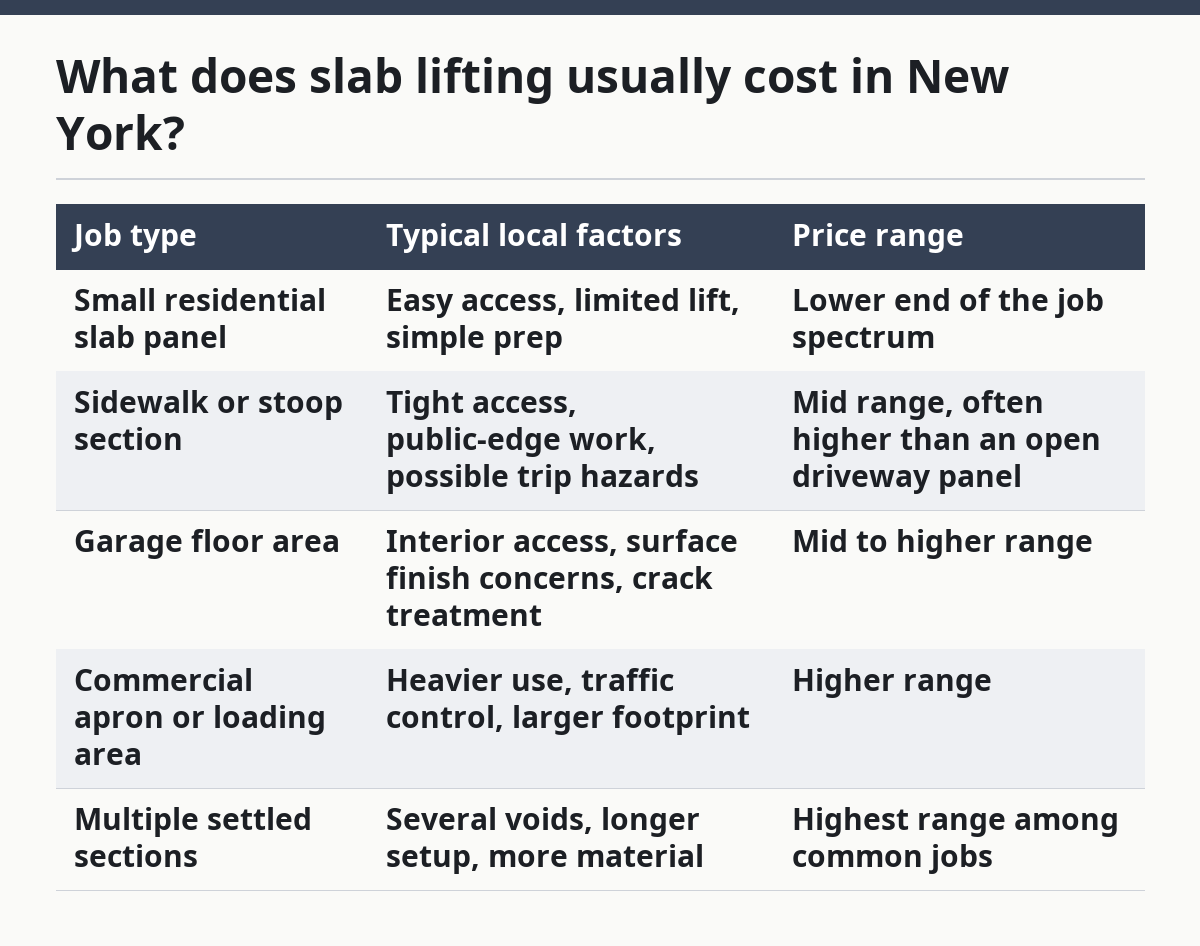
Pricing in New York usually depends on the size of the lift, the access, the slab thickness, and whether prep or sealing is included, so exact pricing is project-specific. A small residential panel is usually priced differently from a long sidewalk run, a garage floor section, or a commercial apron that needs more setup and traffic protection. Many estimates are built from a site visit, not a phone-only quote.
Here is a practical way contractors commonly separate the work for quoting in New York: ask a professional to confirm the scope, then compare the numbers by slab type and access. Local contractors should explain what they can see and what they still need to measure, and they should point to a source such as an on-site inspection or local permit note rather than guessing.
| Job type | Typical local factors | Price range |
|---|---|---|
| Small residential slab panel | Easy access, limited lift, simple prep | Lower end of the job spectrum |
| Sidewalk or stoop section | Tight access, public-edge work, possible trip hazards | Mid range, often higher than an open driveway panel |
| Garage floor area | Interior access, surface finish concerns, crack treatment | Mid to higher range |
| Commercial apron or loading area | Heavier use, traffic control, larger footprint | Higher range |
| Multiple settled sections | Several voids, longer setup, more material | Highest range among common jobs |
A quote that is far below the others deserves a second look. In New York, a low number can hide exclusions such as cleanup, crack sealing, joint repair, or access constraints. A realistic quote should say what area is being lifted, what finish work is included, and whether the job is residential or commercial.
Residential concrete repair in Brooklyn, Queens, and beyond
Residential concrete repair in Brooklyn, Queens, the Bronx, Manhattan, Staten Island, Long Island, and Westchester usually starts with safety and trip protection, then moves to whether the slab can be lifted or should be replaced. Steps, walks, driveway aprons, basement floors, garage slabs, and patios all fall into this category, but the right fix depends on the size of the settlement and the condition of the concrete.
For a homeowner, the signs that matter are pretty plain: a change in slope, a visible lip at the joint, pooling water, or a crack that keeps widening. If the slab is broken into several loose pieces, lifting alone may not hold up well. If the concrete is still structurally sound but has dropped because of voids beneath it, lifting can be the cleaner option.
Residential work in New York also has to respect neighbors, narrow lots, and existing landscaping. In rowhouse areas, that can mean tighter staging. In Long Island suburbs, there may be more room, but there is often more emphasis on driveway drainage and snowmelt runoff.
Commercial concrete repair and slab lifting in New York
Commercial concrete repair and slab lifting in New York usually focuses on keeping walkways, entrances, loading areas, and service pads usable with as little downtime as possible. A retail storefront in Manhattan, a warehouse apron in Queens, or a multifamily entry path in Westchester can all carry different traffic demands, but the goal is the same: reduce trip risk and restore level support.
Commercial jobs often need more planning than residential ones because of access windows, tenant movement, and delivery schedules. A project may need early-morning or off-hours work, especially where foot traffic cannot be blocked for long. In some locations, permits or building approval may be part of the process if the work touches public sidewalk space or affects access.
The trade-off is blunt. Commercial lifting can save a slab that still has usable life, but if the base is badly washed out or the slab is structurally damaged, replacement may be the better long-term move. For mixed-use buildings, the commercial concrete repair page explains the difference in more detail.
How to spot a bad quote or a weak inspection
A bad quote often skips the reason for settlement, the exact slab area, or the likely follow-up work. In New York, that is a problem because the same visible dip can come from drainage, voids, freeze-thaw damage, or utility disturbance, and those causes do not all respond the same way.
Watch for these warning signs:
- No site visit before quoting. A real inspection should look at the slab, the joints, runoff, and access.
- No explanation of whether the slab is repairable. If the concrete is badly cracked or broken, lifting may not be appropriate.
- No mention of nearby conditions such as downspouts, grading, or prior patch work.
- A promise that sounds absolute, like “permanent” or “never settles again.” That is not a serious way to describe concrete work in a freeze-thaw climate.
- A quote that leaves out cleanup, sealing, or traffic protection.
A contractor who works in New York should be able to discuss local soil and drainage conditions in plain language. If the explanation sounds generic, it may not fit the site. For public-facing work, the NYC DOT and local property rules can also shape the plan. Same story, different block.
When is the best time of year to schedule slab lifting here?
The best time to schedule slab lifting in New York is usually when the site is dry and access is easier, but urgent trip hazards should not wait for a perfect season. Spring and fall often make scheduling easier because extreme heat and winter freeze conditions are less disruptive.
Cold-weather work can still be done in many cases, but frozen ground, snow cover, and short daylight make inspection and cleanup harder. Summer can also be a challenge if long stretches of heat or rain complicate access. If the slab is near a doorway, driveway, or public sidewalk, timing may depend more on access and safety than on the calendar.
For city properties, the most practical window is often the one that fits building rules, neighbor access, and weather at the same time. That part is not glamorous, but it beats rushing.
What to ask for when you request an inspection
Ask for a site inspection that identifies the cause of settlement, the sections affected, and whether lifting or replacement is the better choice. That can help you avoid paying for the wrong fix.
A useful inspection in New York should cover:
- The exact slab area that has moved
- Visible cracking, separation, or edge loss
- Drainage patterns from roofs, yards, or paving
- Access limits for equipment
- Whether the area is residential or commercial
- Any nearby sidewalk, curb, or building constraints
If the repair touches a public sidewalk or an area governed by local rules, the contractor should flag that early. New York City sidewalk work, for example, can raise additional approval or safety issues that do not apply in a private backyard in Nassau County. For borough-specific needs, see the Queens concrete services page and Manhattan concrete services page.
Key takeaways
- New York slab lifting is a local job, not a one-size-fits-all one.
- Brooklyn, Queens, the Bronx, Manhattan, Staten Island, Long Island, and Westchester can all have different site conditions and access limits.
- Soil movement, drainage, and freeze-thaw cycles matter as much as the visible slump.
- Residential and commercial slabs are repaired differently because the risks and schedules are different.
- A strong inspection looks at the cause, not just the dip.
- A quote that leaves out access, cleanup, or follow-up work is not a complete quote.
Is slab lifting available in my part of New York?
Most likely, yes, if your project is in New York City, Long Island, or Westchester and the slab can be reached safely. The real question is whether the site can be inspected and worked on without major access conflicts. Near Brooklyn, Queens, the Bronx, Manhattan, Staten Island, or the surrounding suburbs, the next step is to schedule an inspection.
Can one crew handle both residential and commercial slab lifting?
Yes, but only if the crew has experience with both kinds of access and scheduling. Residential work usually means tighter spaces and more homeowner concerns, while commercial work often means traffic control, tenant coordination, and short shutdown windows. The best fit depends on the site, not just the slab.
How do I request an inspection?
Request an inspection by describing the location, the size of the settlement, and whether the area is residential or commercial. If possible, note whether water pools nearby, whether the slab has cracked, and whether the issue is on a driveway, walkway, stoop, or loading area. That information helps the contractor decide what equipment and access plan are needed.
Should I lift or replace the slab?
Lift it if the slab is still structurally usable and the problem is mainly loss of support underneath. Replace it if the slab is badly broken, crumbling, or no longer sound enough to keep. In New York’s climate, that choice also depends on drainage and whether the same water problem will return after the repair.
Drafted with AI; not yet reviewed by a person.