What Can Stop a Slab Repair Job After Approval?

Last updated: November 21, 2026
A slab repair job can stop after estimate approval because the job is not really ready yet. The usual blockers are a permit still pending, a utility markout not completed, bad weather, crew schedule changes, access problems, or material delays. The first check is simple: ask what is waiting right now and who has the next move.
Key takeaways
- Approval of the estimate does not mean the crew can start the next day.
- The most common hold-ups are outside the homeowner’s control: permits, utility locates, weather, and supply timing.
- Access can stall a job even when everyone agrees on the scope, especially on tight urban sites.
- A clean answer comes from one question: “What is the current blocker, and what has to happen before start date?”
- If the delay involves active gas, electric, water, or city permit issues, stop guessing and get the contractor’s written status.
What can stop a slab repair job after approval?

A slab repair job can stop after approval when one required step has not cleared yet. The estimate is only the price and scope; it is not the same thing as a green light to break concrete, set equipment, or mobilize a crew.
The biggest blockers are easy to name. A permit office may still be reviewing paperwork. A utility markout may still be pending. Rain, frost, or strong wind can shut down a pour, lift, or injection day. The crew may be tied up on another job for several days. Material availability can also push the start date if the right mix, grout, foam, or patch material is not on hand.
The fastest way to sort it out is to ask for the one-liner version of the delay. Use this order: permit first, utility locate second, weather third, crew schedule fourth, materials last. That order matters because it shows what the job can change today and what it has to wait out.
If the contractor cannot say which step is pending, that is a warning sign. A vague answer usually means someone is still waiting on a reply from the permit office, a utility locator, or a supplier. This page fits the larger slab repair permissions, approvals, and project constraints hub, which is where the paperwork side of the topic belongs.
What does the permit office usually hold up?
The permit office usually holds up the job when the paperwork is not complete, not reviewed, or not cleared for the type of repair planned. That can happen even after the estimate is approved, because approval of cost does not replace a city or building permit.
Permit delays often come from missing forms, the wrong project description, or a plan that needs more review. In a building with strict rules, a slab repair may also need sign-off before work can begin in a basement, lobby, sidewalk, or shared area. A simple phone call is not always enough; some offices only answer through an online portal or a written status update.
The cost of this delay is time, not just annoyance. A crew may lose its slot, materials may sit, and a repair that could have started in a few days can drift into the next available window. That is why the most useful question is not “Is the estimate approved?” but “Is the permit cleared?”
Two practical signs point to a permit hold. First, the contractor keeps saying the job is “waiting on the city.” Second, no start date is given, only a range like “after review” or “once approved.” If the delay is tied to a permit office, ask for the exact item still open and the date it was submitted.
Why can utility markout delays stop work?

Utility markout delays can stop work because no one should cut or drill into a slab until buried lines are located and marked when that step is required. If the markout is late, incomplete, or not accepted, the job sits.
This is not a small technicality. A slab often hides water, gas, electric, sewer, or communication lines. A missed locate can turn a repair into a much bigger problem. That is why utility locate timing can control the start date as much as the contractor’s own schedule.
One useful rule is to treat “locate pending” as a hard stop, not a soft delay. If the crew says they are ready but the marks are not there, the work should wait. The delay may be one day or several, depending on the utility company and the site.
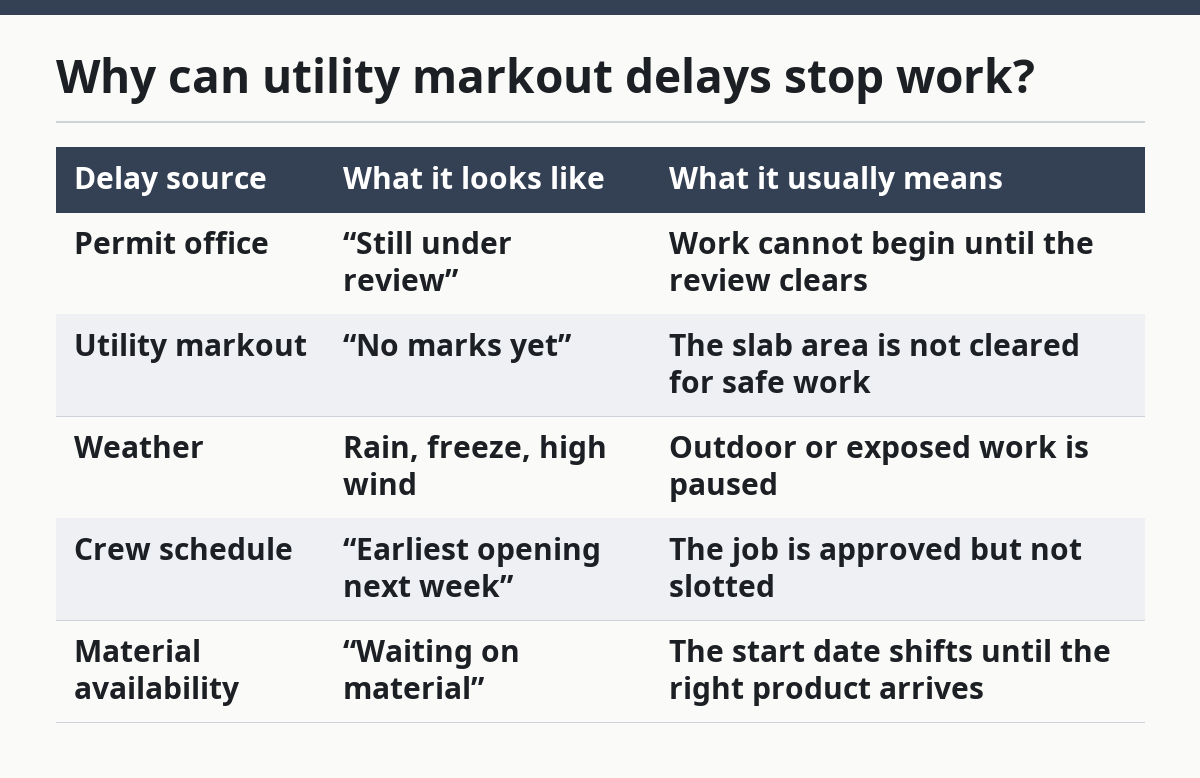
| Delay source | What it looks like | What it usually means |
|---|---|---|
| Permit office | “Still under review” | Work cannot begin until the review clears |
| Utility markout | “No marks yet” | The slab area is not cleared for safe work |
| Weather | Rain, freeze, high wind | Outdoor or exposed work is paused |
| Crew schedule | “Earliest opening next week” | The job is approved but not slotted |
| Material availability | “Waiting on material” | The start date shifts until the right product arrives |
If the homeowner is asking whether the job can start anyway, the answer is usually no when the utility marks are incomplete. That is a safety and liability problem, not a paperwork preference.
How do weather and site access delay the start?
Weather and site access delay the start by making the job unsafe, impractical, or impossible on the planned day. Even after approval, a slab repair can be blocked by a storm, a frozen surface, standing water, or a site that the crew cannot reach.
Weather holds are obvious on paper and frustrating in real life. Rain can keep a patch from setting correctly. Cold can slow cure time. Wind can interfere with certain materials and equipment. If the work involves exterior concrete near a sidewalk, driveway, or loading area, the weather can stop the job even when the crew is ready.
Access problems are just as common in tight New York building types and older properties. A locked basement, blocked alley, occupied parking lane, narrow stair, or no elevator access can keep the crew from bringing in tools and materials. If a truck cannot get near the slab, the day may be lost before it starts. A site that looks open on a drawing can still be blocked in real life.
A good access check is simple: can the crew reach the work area, unload tools, and move material without waiting on a key, a guard, or a parked car? If the answer is no, the repair is not ready yet.
This is also where a delay can become a planning mistake. A homeowner may think the job is approved because the price is signed, but the site still needs a clear path and an open window of access. If those are not in place, the start date moves.
Which delay should you fix first?
You should fix the smallest solvable delay first, then move outward to the ones that depend on outside approval. Start with the item that can be answered in one call or email, not the one that needs a week of waiting.
- Ask for the blocker in one sentence. Get the exact reason: permit pending, utility markout, weather hold, crew schedule, or material wait. The result you want is a plain answer, not a vague “soon.”
- Check whether paperwork is complete. If the permit office has not cleared the job, ask what field or document is missing. One missing page can hold the whole start date.
- Confirm the utility status. If marks are still pending or unclear, ask who ordered the locate and when the area will be cleared. No clear markout usually means no start.
- Review weather risk against the job type. If the forecast is bad on the planned day, ask whether the crew is shifting to the next workable window. A one-day slip is often better than a failed repair.
- Test access before the crew arrives. Make sure gates, keys, loading spots, and the work path are usable. A blocked route can waste an entire scheduled day.
- Ask about materials and crew timing. If every other issue is clear, the remaining hold is often supply or schedule. That may be the hardest one to speed up, but it is still worth naming.
Stop and get direct help when the answer involves a permit office, utility markout, or buried line uncertainty. Those are not guess-and-go problems. If the contractor cannot explain which step is open, ask for a written status update before you expect a start date.
What delays are outside the homeowner’s control?
The delays outside the homeowner’s control are usually the permit office, utility markout timing, weather, and the crew’s existing schedule. These are common because they depend on people or conditions outside the house, not on whether the estimate was signed.
That does not mean the homeowner has no role. It means the best move is to ask for status, not to push the crew to start early. A signed estimate does not give anyone control over a city review, a locator route, or a storm front. It also does not create a slot if the crew is already committed elsewhere.
The hardest part is waiting without getting a clear date. To reduce that, ask for the next checkpoint instead of a finish promise. For example: “Is the permit still pending, or is it waiting on final release?” “Are the utility marks scheduled or already complete?” Those questions shorten the chain of uncertainty.
If a contractor keeps promising a start date that shifts by a few days each time, the cause is usually external, not a change in the repair itself. Still, the contractor should be able to name the hold. If they cannot, that is the point to press for a written update.
FAQ
Why would a contractor postpone the job?
A contractor would postpone the job when one required condition is not met. The usual reasons are a permit not cleared, a utility markout not finished, bad weather, or a crew schedule conflict. If the reason keeps changing, ask for the current blocker in writing before you assume the delay is normal.
What delays are outside the homeowner’s control?
Delays outside the homeowner’s control are the ones tied to outside approvals or conditions. That includes the permit office, utility locate timing, weather holds, and a crew that is booked on another site. A homeowner can help by answering calls quickly, but cannot force a city review or change the forecast.
Can repairs start before utility locates are complete?
Repairs should not start before utility locates are complete when the slab area needs marking. Buried lines can sit under the work zone, and starting early creates a safety risk. If someone says the crew can “work around it,” ask for a clear explanation of how the area is being cleared and who is responsible for the locate.
How long should I wait before asking for an update?
You should ask for an update as soon as the promised start date passes without a new one. A short delay can be normal, but silence is not helpful. Ask what is pending, who is handling it, and what the next checkpoint is so the job does not drift without explanation.
Where to check the hold-ups
You should check the permit office, the utility status, and the weather before you assume the slab repair is stalled for good. For weather, the National Weather Service is a useful public source for local conditions and alerts; for utility timing, your local one-call system or utility locator is the source that matters. In the United States, 811 is the standard number for utility location requests, and Common Ground Alliance explains the 811 process on its site.
Those sources help with the two delays that confuse people most: outside approvals and buried-line clearances. If the delay is about safety, line location, or permit status, do not treat it like a calendar nuisance. Treat it like the step that has to clear before the job can move.
If the estimate is approved but the job still has no start date, the answer is usually not a mystery. One step is still waiting, and the right next move is to name it.
Drafted with AI; not yet reviewed by a person.