Last updated: November 21, 2026
Quick answer: if a small patio dip has stayed the same for 1 or 2 storms and water still drains away, it is usually a maintenance issue; if it changes, holds water, or creates a trip hazard, it is a repair candidate. In this guide to How to Decide If a Small Patio Dip Is a Repair Job or a Maintenance Issue, the first check is simple: look at whether the patio slab still drains, stays safe to walk on, and changes over time.
Key takeaways
- A dip is not automatically a repair just because it is visible. Safety and drainage matter more than appearance alone.
- If the low spot makes water sit near the house, the edge, or a doorway, consult a professional; that is more than routine upkeep. See concrete.org for concrete durability and drainage guidance.
- A dip that has stayed about the same for months is often a monitoring case, not an urgent fix.
- Surface wear and a slight hollow can be normal on an older patio slab, but broken edges, loose sections, or a clear trip hazard point toward repair.
- The cheapest answer is often observation first, then a small corrective step if the condition proves active.
What is the dip doing?
A small patio dip is a repair job when it affects safety or drainage, and it is a maintenance issue when it is only a minor low spot with no real impact. That difference usually comes down to what the water does after rain, how the slab feels underfoot, and whether the change has been steady or sudden.
Since minor settlement under part of the patio slab is a common cause, start there. Soil can shift, wash out, or compact under one area while the rest stays put. On a low-risk exterior slab, that does not always mean immediate work, but it does mean the homeowner should watch the pattern, not just the depth of the dip.
A maintenance issue usually looks like this: the dip is small, the slab still feels solid, water moves away after rain, and the edge is not creating a trip hazard. A repair job looks different: the dip catches water, sends runoff toward the house, creates a lip at a joint or edge, or keeps changing after each storm or freeze-thaw cycle.
The wrong move is to treat every low spot like failure; if you are unsure, consult a concrete professional or drainage contractor. That can lead to paying for lifting or replacement when a slab only needs monitoring and a cleanout of dirt, leaves, or blocked runoff paths. The other wrong move is to shrug off a dip that is part of a bigger settlement pattern, because water damage and edge breakage can follow. The EPA has general drainage and runoff guidance that is useful here.
A homeowner who wants a quick rule can use this one: if the dip is only a cosmetic nuisance, watch it; if it affects walking, drainage, or nearby materials, call it a repair candidate.
How do I check it in 10 minutes?
You can sort most small patio dips in 10 minutes with a visual check, a straight board, and a hose test. The goal is not to measure the slab like a contractor would; the goal is to decide whether the condition is stable enough for maintenance or serious enough to fix.
- Dry the area and look at the edges. Sweep away debris, then check whether the low spot is smooth or whether the slab edge has cracked, spalled, or separated. A clean, shallow hollow is less alarming than a broken perimeter.
- Walk the area slowly in flat shoes. Pay attention to any place that catches a toe or creates a clear stumble point. A trip hazard matters more than whether the dip looks dramatic from a distance.
- Pour or hose a small amount of water across the area. Watch where it goes. If water leaves within a short time and does not pool near a door, wall, or step, the dip may be a maintenance item.
- Place a straight board or level across the low spot. You are not trying to publish a precise number. You are checking whether the dip is only slight or whether it is deep enough to trap water and feel uneven.
- Mark the low area and check it again after the next heavy rain. If the dip looks the same after 1 or 2 storms, it is less likely to be active movement. If it changes, consult a professional and treat it as repair territory.
- Look for nearby clues. Soil settling, downspout splash, clogged drains, or erosion at the patio edge can point to a drainage problem rather than a slab problem alone.
A homeowner should stop here if the slab is clearly unsafe or if the dip is expanding. At that point, the question is no longer “repair or maintenance?” but “what is moving under this patio slab?”
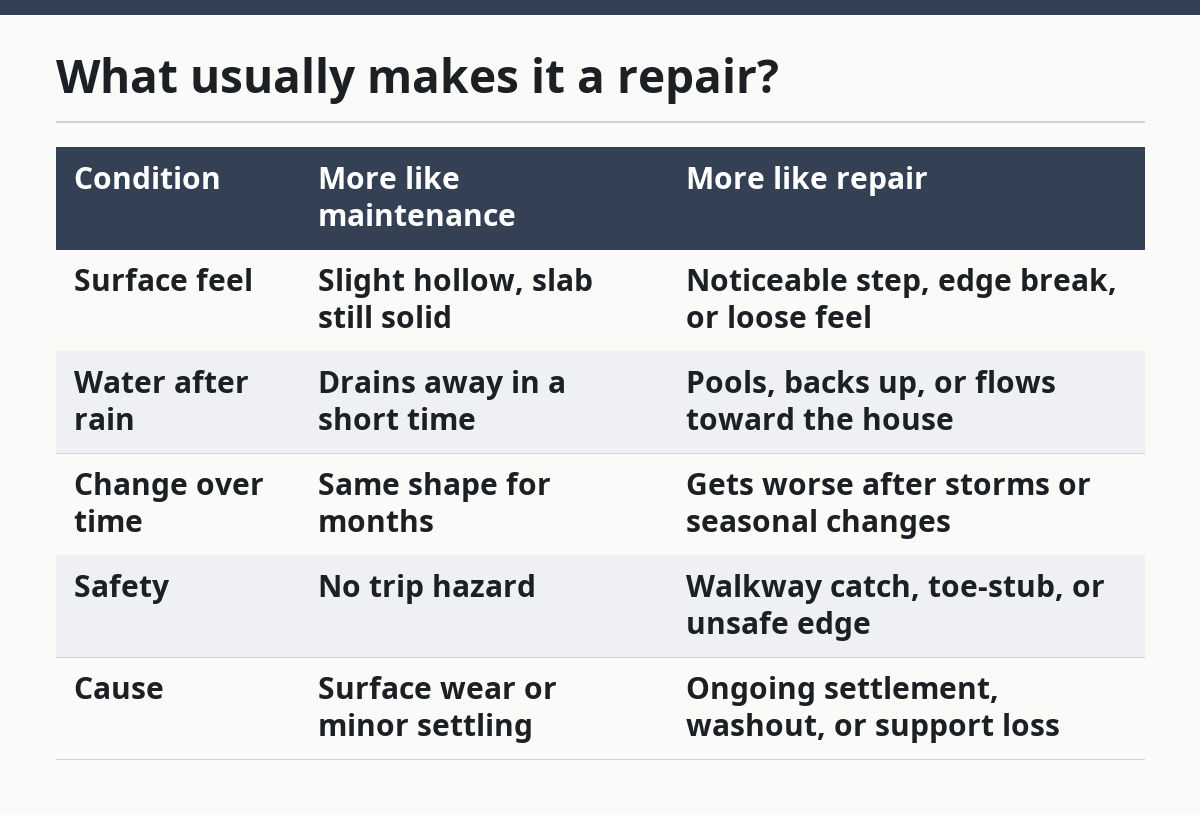
What usually makes it a repair?
It usually becomes a repair when the dip creates one of three problems: trip risk, water runoff trouble, or ongoing settlement. Those are the conditions that turn a small low spot into a job that needs correction rather than observation.
Here is the plain difference:
| Condition | More like maintenance | More like repair |
|---|---|---|
| Surface feel | Slight hollow, slab still solid | Noticeable step, edge break, or loose feel |
| Water after rain | Drains away in a short time | Pools, backs up, or flows toward the house |
| Change over time | Same shape for months | Gets worse after storms or seasonal changes |
| Safety | No trip hazard | Walkway catch, toe-stub, or unsafe edge |
| Cause | Surface wear or minor settling | Ongoing settlement, washout, or support loss |
A repair is also more likely when the low spot sits where people step most often, such as a route to a door, grill area, or narrow pass along the house. In particular, even a modest dip can be a real problem if it sits in the only walking line. The cost of ignoring that kind of spot is not just cosmetic; it is the risk of a fall and the chance that water keeps finding the same weak path.
A bad repair job has clear signs too. The patio may look patched but still pond water in the same place. The slab may be lifted unevenly, leaving a ridge that is worse than the original dip. A fresh repair should improve drainage and walking safety, not just change the shape on top.
If the patio slab is part of a larger concrete issue on the property, the hub page on concrete slab repair alternatives and exceptions gives the bigger decision tree. This page is only for deciding whether the small dip itself belongs in the repair pile.
When is monitoring enough?
Monitoring is enough when the dip is shallow, stable, and not causing a trip hazard or drainage nuisance. That means the homeowner can watch it over time instead of paying for work that may not solve a real problem.
This is the better choice when the patio is older, the low spot has been unchanged for months, and water still exits the slab without sitting long enough to matter. Minor settlement that has already stopped often shows up this way. Surface wear can do the same thing, especially on a patio slab that has seen years of foot traffic, snow shoveling, or furniture dragging.
Monitoring is not doing nothing. It means checking the same spot after rain, after a freeze, and again a few weeks later. If the low area stays the same, the slab may just be living with minor settlement. If it starts to hold more water, gets looser at the edge, or starts to feel uneven, the decision changes.
The drawback of monitoring is time. A homeowner can wait too long and let runoff keep working at the edge of the slab or the soil beside it. The upside is avoiding unnecessary work when the dip is only an acceptable condition. That trade-off is why monitoring makes sense only when the slab is safe and the drainage is still serviceable.
A useful rule: if the dip is annoying but not causing damage, monitoring is reasonable. If it is helping water sit where water should not sit, it is no longer just a maintenance question.
What job options make sense?
The right fix depends on whether the problem is the surface, the support under the slab, or the edge condition around it. A homeowner should think in that order because not every patio dip needs the same solution, and the wrong fix can leave the dip unchanged.
- Clean and improve drainage first. If leaves, dirt, or clogged runoff paths are part of the problem, clearing them may stop water from collecting in the low area. This is the smallest and cheapest step.
- Monitor the dip for change. If the slab is stable and the drainage issue is minor, observation may be enough. Mark the area and revisit it after 1 or 2 storms.
- Address nearby water sources. Redirecting splash, runoff, or surface water away from the slab edge can reduce further settlement. This step matters when the patio sits near soil that washes out easily.
- Correct the slab support. If the dip is active and the base has settled, lifting or other repair work may be needed. This is where a true repair begins.
- Replace the affected section if damage is more than a dip. When the slab has broken edges, severe cracking, or a shape that cannot be corrected cleanly, replacement may be the better long-term option.
The main trade-off is cost versus certainty. A small maintenance fix can be enough if the slab is stable. A deeper repair costs more, but it can solve the cause instead of only masking the symptom. A homeowner who chooses the cheapest fix without checking the cause often pays twice.
What should a homeowner ask before calling?
A homeowner should ask three questions before calling for help: is it a trip hazard, does it change drainage, and is the dip getting worse? Those questions sort most patio slab issues faster than trying to guess the exact cause first.
It also helps to mention the setting, because a low spot near a doorway, wall, or step matters more than the same dip at the far end of a patio. If the area sees regular runoff, freeze-thaw, or soil washout, that context changes the repair decision. A contractor will usually care more about where the water goes than about how the dip looks from across the yard.
Keep the description plain. Say whether the patio slab has a low spot, whether water stands there after rain, and whether anyone has tripped on it. That gives a contractor enough information to judge whether the issue is likely a maintenance case, a repair case, or a sign of broader settlement.
A bad call often starts with the wrong question. “Can this be fixed?” is too broad. “Is this low spot safe to monitor, or does it need repair because of drainage or trip risk?” gets closer to the real decision.
Which mistakes cost the most?
The most expensive mistakes are waiting too long, fixing the wrong thing, and ignoring water. Those errors usually turn a small patio dip into a larger slab problem, and they are common because the slab can look harmless even while the base is moving.
One mistake is assuming that a shallow dip is harmless because it is not dramatic. That can cost a homeowner a fall risk or a growing drainage problem near the house. Another is paying for a surface fix when the real issue is settlement underneath, which leaves the dip coming back.
A third mistake is treating every uneven area as urgent. That can lead to unnecessary repair work on a slab that only needs monitoring and basic maintenance. The cost there is avoidable money and a repair that may not improve the actual problem.
The best habit is simple: check the water, check the walking surface, and check whether the shape changes. Those three checks usually tell the truth faster than a quick glance.
How small is too small to ignore?
A dip is too small to ignore when it creates a trip hazard, holds water, or changes over time. Size alone does not decide it. A shallow hollow that stays dry and stable is often a maintenance issue, while a small low spot at a doorway or edge can still justify repair.
When should a dip be monitored instead of fixed?
A dip should be monitored instead of fixed when the slab is solid, the water still drains away, and the shape has stayed the same for months. That is the right choice for minor settlement or surface wear that has not become unsafe. Check it again after a few storms and reassess if the condition changes.
Does every low spot need lifting?
No, every low spot does not need lifting. Lifting makes sense when the dip is active, creates drainage trouble, or causes a clear trip hazard, but a stable shallow dip may only need monitoring or drainage cleanup. If the patio slab is safe and the low area is not spreading, fixing it may not be worth the cost.
Drafted with AI; not yet reviewed by a person.