Can Concrete Slab Lifting Fix Water Pooling Without Regrading

Last updated: November 19, 2026
Key Takeaways
- Slab lifting can solve pooling when the slab is the low point and site drainage is otherwise sound.
- If the concrete is the lowest spot, lifting may be enough to restore drainage.
- Slab lifting raises settled concrete so water can shed again.
- A good lift should remove the water-trapping low spot and fit the site’s drainage slope.
Quick Answer
Quick Answer: Yes—can Concrete Slab Lifting Fix Water Pooling Without Regrading the Yard? often can, when the slab is the low spot. If the water is collecting because a driveway, patio slab, or sidewalk has settled, lifting the concrete can restore the drainage slope and move runoff away from the house.
That answer changes when the pooling comes from the yard, clogged runoff paths, or a bad drainage layout. In those cases, slab lifting may help at the edge, but it will not solve the whole problem by itself.
Water pooling on concrete slabs: the first thing to check
Water pooling on concrete slabs is often a slab-height problem, not a yard-wide grading problem. If the low spot is only on a concrete driveway, patio slab, or sidewalk, lifting the slab is usually the most direct fix because it changes the surface drainage where the water actually stands. This is the core issue in Can Concrete Slab Lifting Fix Water Pooling Without Regrading the Yard?
Start with the simplest question: where does the water sit after a normal rain? A shallow birdbath in the middle of a panel usually points to settlement. Water that hugs the house, a garage door, or a step-down edge can point to a slab that dropped 1/2 inch or more at one side. Water that spreads across the whole yard points more toward grading, downspout runoff, or drainage that lives beyond the concrete.
A contractor will usually look for:
- settled slab edges that create a dam
- low spots on a driveway between control joints
- a patio slab that slopes the wrong way
- downspout discharge dumping next to the slab
- soil erosion under the concrete that has opened a void
The important distinction is this: slab lifting changes the elevation of the concrete surface. It does not reshape the yard. If the water is coming from a roof valley, a gutter downspout, or a broad flat yard, lifting the slab may only move the puddle a few feet.
That is why this topic belongs next to drainage slope, not beside cosmetics. A slab can look intact and still be the reason water sits in one place. If the concrete itself is the problem, the fix can be clean and targeted. If the site is the problem, the concrete is only part of the story.
When slab lifting is enough, and when it is not
Slab lifting is enough when the concrete is the lowest point and the surrounding drainage is basically sound. If the yard already sends water away, but a panel settled and now holds 1/4 inch to 1 inch of standing water, lifting that section can often restore the shed the slab should have had in the first place.
It is not enough when the yard is flat, the downspouts dump near the slab, or the water is backing up from elsewhere. Regrading is the broader fix for a broader slope problem. If the whole area around the concrete lacks fall, lifting one panel may make the puddle smaller without ending it.
A useful rule of thumb is this: if the puddle forms only on the slab and disappears once the slab is brought back to match the surrounding grade, slab lifting is the right tool. If the puddle forms because the lot has nowhere to send water, the yard needs more than concrete repair.
Here is the practical difference:
- Lift the slab when the edge has settled, the joints have opened, or one section has dropped lower than adjacent concrete.
- Regrade the yard when water lingers in turf, soil, swales, or around the slab because the surface has no overall drainage path.
- Do both when the slab is low and the yard also pushes water toward it.
The downside of trying slab lifting alone on a bad drainage site is false confidence. The slab may drain for the next storm, then pool again because runoff from the yard, roof, or hardscape keeps feeding the area. That is why a good contractor looks at the whole drainage picture before recommending a lift. A repair is best when it fixes the source, not only the symptom.
How concrete slab lifting works on a driveway, patio, or sidewalk
Concrete slab lifting raises settled concrete so the surface can shed water again. On a driveway, patio slab, or sidewalk, the goal is to restore the pitch that was lost when the slab sank or one edge settled more than the rest. In Can Concrete Slab Lifting Fix Water Pooling Without Regrading the Yard?, this is the part that changes the answer.
The process usually goes like this:
- Map the low spot with a level or laser. The result should show how much the slab has dropped and whether the dip is isolated or spread across several panels.
- Inspect the slab joints, cracks, and edges. The goal is to see whether the slab is still structurally liftable or whether the damage is too broken up for a clean adjustment.
- Identify the support issue under the slab. Voids, washed-out fill, or soft soil often explain why the concrete moved.
- Choose the lift method. Mudjacking uses a cement-based slurry through drilled holes; polyjacking uses expanding polyurethane foam through smaller holes. Either can raise a slab if the base is suitable.
- Lift in small increments. The slab is brought up little by little so the new surface slope directs water away instead of creating a hump.
- Seal the holes and check the runoff path. Once the panel is level or nearly level, the concrete should shed water toward the intended drainage route.
The exact result depends on the slab and the site. A patio slab that dropped 3/4 inch at one corner may only need a subtle lift. A long sidewalk panel may need a more careful adjustment because a small height change over 6 or 8 feet affects the slope a lot more than it does on a short pad.
Two standards matter in the field even when the exact project is local: ASTM C881 is often referenced for epoxy materials in concrete repair, and ACI guidance is commonly used when contractors judge concrete condition and repair compatibility. For drainage and concrete condition, see ASTM International and the American Concrete Institute: https://www.astm.org/ and https://www.concrete.org/.
What a good lift should change in the runoff path
A good lift should remove the low point that traps water and return the slab to a drainage slope that makes sense for the site. On a driveway, that usually means water moving away from the garage door or toward the street. On a patio slab, it usually means water moving away from the house foundation or off the edge of the pad instead of sitting near furniture, posts, or thresholds.
The key measurement is slope, not just height. A slab that is “level” in the casual sense may still drain badly if it no longer has enough fall. In plain terms, a concrete surface can be even and still be wrong for water. A slight pitch is often necessary so runoff keeps moving.
What changes after a proper lift:
- puddles shrink or disappear on the slab surface
- the low edge no longer collects runoff from adjacent concrete
- water reaches the planned discharge point instead of sitting in a shallow bowl
- the repaired section looks aligned with neighboring panels instead of sunken below them
What does not change:
- yard grading outside the slab
- downspout runoff that dumps too close to the repair
- clogged gutters, compacted soil, or swales that send water back toward the concrete
That last point matters because a lift can look successful after one rain and still fail later if the site sends fresh water back to the same spot. If the patio drains better but the downspout still empties beside it, the water problem has only shifted. The right question is not “Did the slab come up?” It is “Did the water path change?”
A contractor who understands surface drainage will look at the whole path, from roof edge to discharge point, before deciding whether the slab is enough of the solution.
Common mistakes that leave the puddle behind
The most common mistake is fixing the low concrete panel while ignoring the water source. That mistake can cost a second service call, because the slab may be raised correctly and still end up wet after every storm if the yard or gutter system keeps feeding it.
Another mistake is over-lifting the slab to make it look flat. A slab that rises too high can create a new trip edge, force water toward the house, or make an adjacent panel hold water instead. The repair should restore slope, not create a crown that fights the rest of the surface.
A third mistake is treating every depressed slab as the same. A settled driveway panel with stable edges is a very different job from a patio slab with multiple cracks, soil loss under one side, or a soft base that keeps moving. If the base material is still shifting, lifting the slab alone may be temporary. A qualified contractor should inspect the site before deciding on the repair.
The fourth mistake is ignoring downspout runoff. A 2-inch or 3-inch downspout that dumps at the base of the slab can undo a careful lift faster than most people expect. Even if the exact pipe arrangement is simple, the water volume is not.
Here is what a better approach looks like:
- verify the low spot before any repair
- compare the slab elevation to the surrounding grade
- check gutter discharge and runoff patterns
- lift only enough to restore drainage
- confirm the water now moves off the slab in the first heavy rain
A bad job often looks “fixed” on day one and fails in the next storm. A good job leaves no soft dip, no obvious backfall, and no standing water sitting on the repair.
What this costs to fix in practical terms
The cost depends on slab size, access, how far the concrete has settled, and whether the problem is a single panel or several connected sections. A small patio slab or short sidewalk segment is usually simpler than a long driveway run, and the price rises when the contractor has to work around trees, tight access, drainage features, or multiple low spots.
The repair method affects cost too. Mudjacking often fits larger voids and broader slabs, while polyjacking can suit smaller holes and faster return-to-use situations. Neither method is automatically right for every water pooling problem. The better question is which one can restore the correct slope without adding a new drainage issue.
What affects price most:
- the square footage involved
- the number of low spots
- how much lift is needed
- whether the slab is cracked, broken, or just settled
- whether nearby drainage work is needed at the same time
What affects time:
- a small repair may take a few hours
- a larger driveway or multi-panel patio may take most of a day
- cleanup and final inspection add time even when the lift itself is fast
The money-saving mistake is chasing the cheapest quote without asking what it includes. If the contractor does not confirm the slope afterward or ignores the downspout runoff, the lower bid can turn into a repeat problem. A good estimate should explain whether the fix is meant to solve the concrete problem only, or whether the drainage issue also needs separate work.
This is the part where the hub on concrete slab lifting methods and applications belongs: the method matters, but so does the reason the slab failed in the first place.
What to ask before you hire someone
You should ask whether the contractor is fixing the slab height, the drainage path, or both. That one question separates a real repair plan from a quick lift-and-leave job.
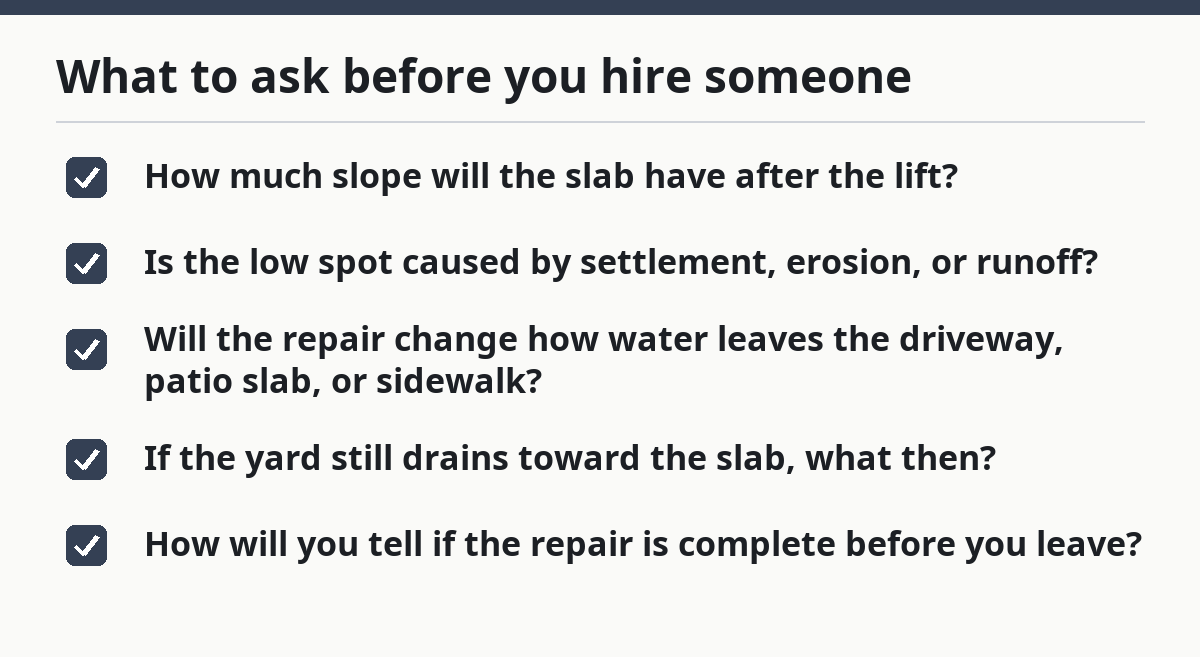
Ask these specifics before work starts:
- How much slope will the slab have after the lift?
- Is the low spot caused by settlement, erosion, or runoff?
- Will the repair change how water leaves the driveway, patio slab, or sidewalk?
- If the yard still drains toward the slab, what then?
- How will you tell if the repair is complete before you leave?
A contractor who talks only about “raising the slab” may be missing the drainage problem behind it. Someone who talks about grades, discharge points, and edge settlement is usually looking at the real cause.
The right repair is usually the one that matches the failure. If a settled slab edge is trapping water, lifting is sensible. If the surrounding yard is flat, the downspouts dump nearby, or the patio drainage has no clear exit, the answer may include slab lifting, regrading, or both. The worst outcome is paying for a repair that leaves the same puddle in a slightly different shape.
Will slab lifting stop standing water?
It can, but only when the slab itself is the reason the water sits there. If the concrete driveway, patio slab, or sidewalk is low because it settled, lifting it can remove the birdbath effect and restore drainage slope. If the surrounding yard or downspouts are the real problem, the standing water may return.
When does pooling mean the yard needs regrading?
The yard likely needs regrading when water pools beyond the slab, not just on it. If runoff spreads across soil, turf, or multiple hard surfaces and there is no clear direction for water to leave the area, the drainage problem is bigger than one concrete panel.
Can a level slab still drain poorly?
Yes, a slab can be level enough to look fine and still drain badly. Concrete needs the right pitch, not simply a flat appearance, so a surface that has lost its designed slope can hold water even if the panels line up neatly.
Drafted with AI; not yet reviewed by a person.