Last updated: November 20, 2026
Key Takeaways
- Yes, you can often get a free estimate for concrete slab lifting in New York, especially for residential work and straightforward projects.
- A contractor can usually give a better estimate when you send site photos, the location in New York, and a plain description of the slab problem.
- An in-home visit makes more sense when the slab problem affects more than one surface, or when the contractor needs to check access and slope in person.
- A free estimate may leave out details that affect the final job.
You can often get a free estimate for concrete slab lifting in New York, and this page explains when that is realistic for Can You Get a Free Estimate for Concrete Slab Lifting in New York? It also covers what the estimate can include, what it may leave out, and when a contractor may need a site visit.
For New York homeowners, a free estimate is often enough for a first price range, but not always enough for a final scope. The details below show when photos work, when they do not, and what to ask before booking.
Can you get a free estimate for concrete slab lifting in New York?
Yes, you can often get a free estimate for concrete slab lifting in New York, especially for residential work and straightforward projects. The catch is that “free” usually means a quick first look, not a full engineering review or a written scope with every repair detail. The U.S. Department of Housing and Urban Development says accessible, safe paths matter, and a slab issue that creates a trip hazard should be checked before repair is approved. Source: HUD
Picture this: you’re looking at a tilted sidewalk panel, a garage slab with a lip at the door, or a patio edge that has sunk 1 to 2 inches. You want a price without paying for a visit you may not need. That is the kind of project where many contractors will offer a no-cost estimate.
In New York, the answer also depends on access, season, and how much the slab has moved. A contractor may still quote for free if the problem is easy to see from the driveway, curb, or a few clear site photos. If the slab is tied into drainage, masonry, or a shared walkway, the first look may be free but the real scope often takes more time.
What free usually means
- A brief call or online form
- A review of site photos
- A short in-home visit or walk-through
- A rough project scope based on visible damage
- A price range, not a locked bid
Some contractors treat the estimate as a sales visit and absorb the time. Others charge for a deeper inspection if they have to measure multiple slabs, inspect trip hazards, or check whether lifting is even the right fix. That is normal, not a red flag.
What a contractor needs before they can estimate slab lifting
A contractor can usually give a better estimate when you send site photos, the location in New York, and a plain description of the slab problem. A clear first pass often takes less than 10 minutes to review if the issue is obvious. The American Society of Home Inspectors notes that photos and written notes help document visible conditions, but they do not replace an onsite look when movement or drainage is involved. Source: ASHI
Picture this: you’re standing beside a cracked driveway panel, phone in hand, trying to decide what to send. A few good photos and a short note can save a second visit. The goal is not perfection; it is enough detail to tell whether the slab is liftable and what kind of access the crew will have.
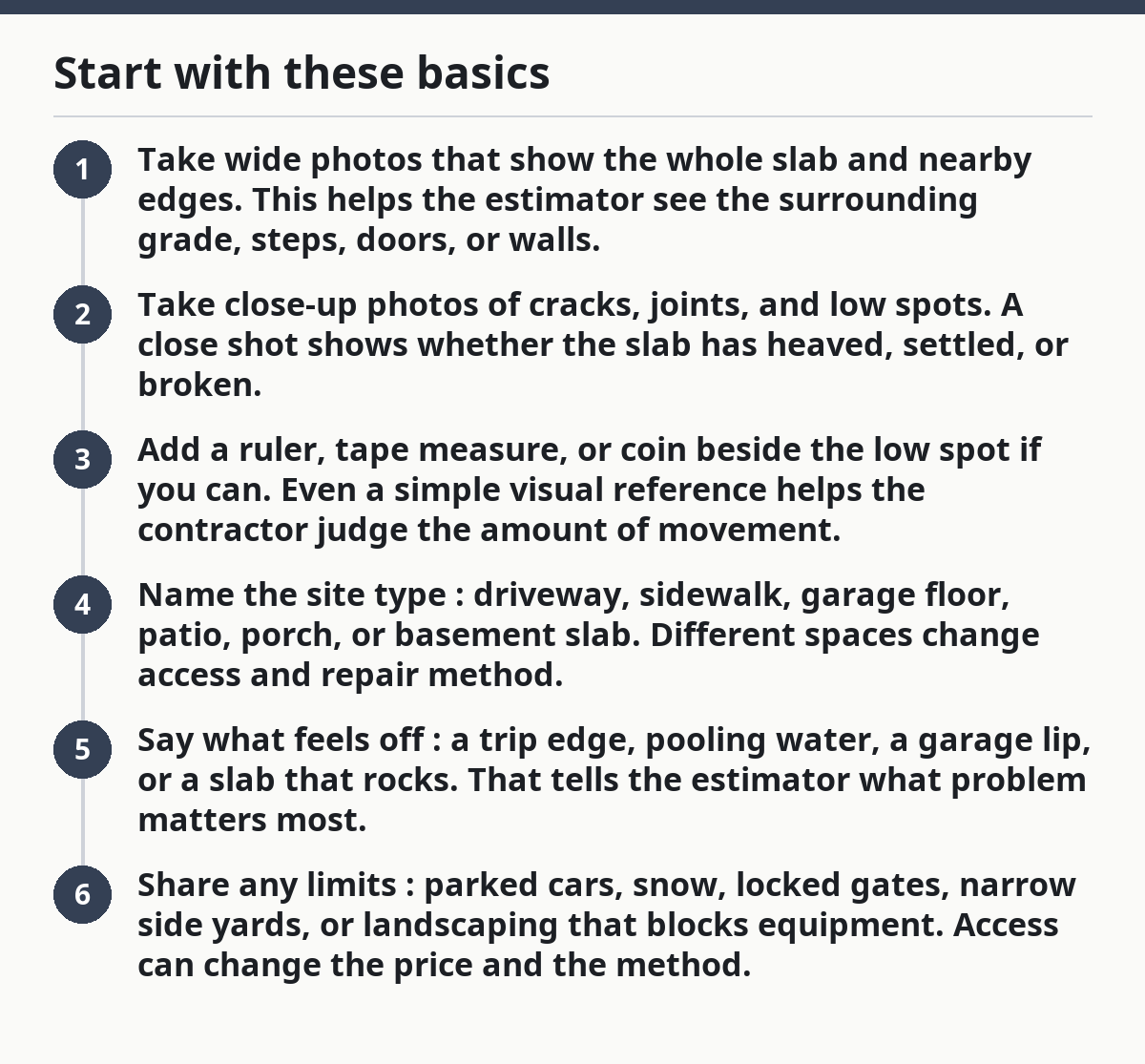
Start with these basics
- Take wide photos that show the whole slab and nearby edges. This helps the estimator see the surrounding grade, steps, doors, or walls.
- Take close-up photos of cracks, joints, and low spots. A close shot shows whether the slab has heaved, settled, or broken.
- Add a ruler, tape measure, or coin beside the low spot if you can. Even a simple visual reference helps the contractor judge the amount of movement.
- Name the site type: driveway, sidewalk, garage floor, patio, porch, or basement slab. Different spaces change access and repair method.
- Say what feels off: a trip edge, pooling water, a garage lip, or a slab that rocks. That tells the estimator what problem matters most.
- Share any limits: parked cars, snow, locked gates, narrow side yards, or landscaping that blocks equipment. Access can change the price and the method.
A good first estimate can start from those details. A weak one usually starts with a vague “send me a picture” and ends with a guess that changes later. If the slab ties into a stoop, retaining wall, or drainage run, the contractor may need more than photos to avoid underpricing the job. That is common in older New York properties.
When does an in-home visit make more sense than photos?
An in-home visit makes more sense when the slab problem affects more than one surface, or when the contractor needs to check access and slope in person. Photos work well for a simple slab, but they miss depth, pitch, and hidden edges.
The truth is, concrete slab lifting is not just about one panel. A slab that has sunk near a garage door may also affect weather sealing. A walkway panel near a front step may need a trip-risk check. In New York, winter freeze-thaw, settled fill, and old patchwork can make a photo-only estimate too thin.
A visit is worth it when:
- The slab is part of a project scope that includes several panels
- Water drains toward the house or garage
- The crack pattern suggests wider settlement
- The slab borders masonry, stairs, or utility covers
- You need a tighter estimate before approving work
A site visit also helps when equipment access is unclear. A contractor may need to know whether there is room for a truck, hose, or lift material setup. If a crew has to carry gear through a narrow side yard or around a backyard fence, that can change the job even if the slab itself looks small.
Here’s the catch: an in-home visit can be free and still not be a full design review. You may get a useful range, but not every contractor will commit to exact lifting points, final patch lines, or hidden void repair without writing that into the scope.
What a visit can settle
- Whether the slab is a good candidate for lifting
- How many slabs are involved
- Whether the issue is settlement, washout, or a broken section
- Whether the route in and out is workable
- Whether a lift would still leave a gap, crack, or drainage problem
If the contractor does not walk the full area, the estimate is only as good as the unseen parts. That does not make it useless. It just means you should treat it as a starting point. According to the Federal Trade Commission, written estimates are useful when they describe what is included and what can change. Source: FTC
What a free estimate may leave out
A free estimate may leave out the fine print that affects the final job. That is normal, but it means you should know what is still unknown before you compare contractors.
Picture this: you get a neat price in your inbox, but it barely mentions how many slabs are being lifted, whether small voids will be filled, or what happens at a cracked edge. The estimate might still be honest. It just may not be complete enough to compare apples to apples.
Common gaps in a free estimate
- Exact project scope
- Hidden damage under the slab
- Drainage fixes outside the lift itself
- Cosmetic patching after the lift
- Equipment access limits
- Whether nearby concrete is stable enough to stay in place
That matters because slab lifting is often a fix for movement, not a cure for every problem under or around the concrete. If the base has washed out, if the slab has broken apart, or if the surrounding grade keeps sending water under the panel, the lift alone may not hold up the way you want. A contractor should say that plainly.
A free estimate can also stop short of the material choice. Some jobs use foam injection, some use mudjacking, and some are not good candidates for either. If the contractor does not name the method, the estimate may be too thin to judge. On the flip side, a very detailed estimate without a site look can still be shaky if the ground conditions are not obvious. The International Concrete Repair Institute advises that repair work should match the observed condition, not just the visible symptom. Source: ICRI
Watch for estimates that sound free but hide a catch
- A free phone quote that changes after arrival
- A free visit with no written scope
- A “ballpark” price that excludes cleanup
- A quote that skips the number of panels
- A quote that ignores access in winter or after rain
A better free estimate will state what was seen, what was assumed, and what still needs confirmation. That saves both sides from surprise charges later.
How to compare free estimates without getting lost in the details
You can compare free estimates well if you look at the same few items in each one and ignore the fluff. The price matters, but so do the conditions that shape it.
The main point is to compare like with like. If one contractor quotes a single slab and another quotes the whole walkway, those numbers are not competing bids. They are different scopes.
Compare these points side by side
- Number of slabs or sections included
- Whether the visit was in-home or photo-only
- Whether the estimate names the lifting method
- Whether cleanup or patching is included
- Whether access limits are already factored in
- Whether the contractor says what could change the scope
This is the place to ask for clarity, not a long debate. If one contractor gives a clean range after a site visit and another gives a bare number from two photos, the first is usually the more useful estimate. Not because it is higher or lower, but because it reflects more of the real job.
In New York, older homes, narrow lots, and winter damage can make two slabs that look similar behave very differently. One may be a quick lift. Another may need more prep because of soil washout or a broken edge. That is why a price without a visible scope is weak.
If you want the bigger cost picture, the hub article on How Much Does Concrete Slab Lifting Cost in New York? gives the broader cost context this page does not repeat. Internal links that also help are Concrete Driveway Repair in New York, Uneven Sidewalk Repair in New York, and Foundation Slab Lifting in New York.
What to ask before you book the estimate visit
You should ask how the estimate works before you book the visit, because “free” can mean different things from one contractor to another. A few plain questions will tell you whether the visit is truly useful.
Picture this: you’re on the phone with a contractor, and the answer gets fuzzy the moment you ask about photos, travel, or scope. That is your cue to slow down. A clear estimate process usually sounds clear in the first minute.
Ask these 5 things
-
Is the estimate free?
Get the answer up front, and ask whether the price changes if the crew needs to come onsite. -
Can you estimate from photos first?
Some contractors can give a rough range from site photos before scheduling a visit. -
What do you need from me?
Ask whether they want measurements, access notes, or a picture of the low spot next to a tape measure. -
Will there be an in-home visit?
If yes, ask how long it usually takes and whether the visit includes a written project scope. -
What could change the estimate later?
This tells you whether the contractor has thought through drainage, access, and hidden damage.
A contractor who answers plainly usually makes the rest of the job easier. A contractor who dodges these questions may still do good work, but the estimate process is already telling you something about how the project will be handled.
One useful clue: if the contractor cannot explain why a site visit is needed, the estimate may be more sales call than job review. It is not always a bad sign, but it is not the same as a measured estimate.
What a good free estimate looks like in New York
A good free estimate in New York is specific enough to help you decide, but honest enough to say what is still unknown. It should reflect the site, not just the script.
The estimate may be free, but it should still show real judgment. That means the contractor has looked at the slab type, the access, the visible damage, and the likely scope. It does not need to be a long report to be useful. It does need to be clear.
A solid estimate usually includes:
- A note on whether the slab is likely liftable
- The kind of visit used: phone, photos, or in-home visit
- The general project scope
- Any visible trip hazard or drainage concern
- Any obvious access problem
- A statement about what was not inspected
That last point matters more than most people think. If a contractor says, “This estimate is based on visible conditions only,” you know what the number can and cannot cover. If the estimate pretends to know more than it does, that is a warning sign.
For New York properties, weather and access often shape the estimate more than the slab size alone. Frozen ground, wet soil, narrow lots, and shared walkways can all affect how easy it is to work. A free estimate that ignores those realities is not much help.
FAQ
What information do I need for an estimate?
You need the site address, a few clear photos, and a short description of the slab problem. If you can add the slab type, the location on the property, and any access limits, the estimate is usually more useful. A tape measure beside the low spot can help too, but it is not always required.
Can a quote be accurate from photos alone?
A quote can be directionally useful from photos alone, but it may not be fully accurate. Photos show surface damage and layout, not every access issue or hidden base problem. If the slab is simple and the photos are clear, the estimate may be close. If the site is tight or layered with other damage, an in-home visit is better.
Do all contractors charge for estimates?
No, not all contractors charge for estimates. Many slab lifting contractors will give a free first look, especially for simple residential work. Some charge for deeper inspections, longer site visits, or projects that need more measurement time. The fee question should be answered before the visit is booked.
Drafted with AI; not yet reviewed by a person.