What Documents Should You Gather Before Requesting a Slab Lifting

Last updated: November 20, 2026
Quick answer: gather photos, measurements, repair history, and property records before you request a slab lifting quote. For What Documents Should You Gather Before Requesting a Slab Lifting Quote?, those four items usually give the contractor enough to price the job faster and cut down on back-and-forth. This guide shows exactly what to collect, what each item helps with, and what can wait.
What to gather before you request a slab lifting quote
Picture this: you’re staring at a sunken walkway or a slab that pitches toward the garage, and you want one clean quote, not three days of phone tag. One fast way to get there is to hand over four document types: clear photos, simple measurements, repair history, and property records.
Key Takeaways
- Photos tell the contractor where the slab moved and how bad it looks.
- Measurements help turn a vague problem into a workable estimate.
- Old repair records can save time if the slab has already been patched or lifted.
- Property records help identify what sits under the slab and who owns the area.
- Site access notes keep the quote from changing later because of fences, gates, or tight corners.
The catch is that a contractor can only quote what they can understand from the first call. If you skip the basics, expect follow-up questions and a wider price range. If you send the right packet up front, the estimate gets tighter and the visit gets shorter.
A good starting packet often fits in a single email or text thread. If you have a shared photo album, even better. Name the location in plain language—“front sidewalk by the porch” works better than “north section”—and keep everything tied to the same area.
For a broader pricing context, this page sits under the site’s hub on estimating, pricing, and buying decisions. That hub covers the bigger decision path; this page stays on the prep work for the quote itself. For related guidance, see slab lifting pricing basics, foundation repair quotes, and concrete lifting methods.
What photos should you send with the quote request?
Send wide shots, close-ups, and context shots so the contractor can see the slab, the edges, and the space around it. Photos do the first round of sorting before anyone drives over.
Picture this: you’re standing in the driveway with your phone, trying to show a dip that only shows up from one angle. A good photo set solves that by showing the full slab, the problem spot, and anything nearby that affects access.
Take one wide photo from far enough back to show the whole slab or run of slabs. Take a second photo from the side where the uneven edge is easiest to see. Add close-ups of cracks, gaps, water pooling, or any separation at joints. Include a photo of the path to the slab, including gates, steps, parked cars, or narrow side yards. If the area has a drain, downspout, utility cover, or tree roots, photograph that too.
The goal is not art. The goal is context. A contractor can often tell from a phone gallery whether the issue looks like a small lift, a longer run, or a job that needs a different fix. That matters before anyone starts guessing at labor or equipment.
A few photo mistakes cause trouble fast:
- Cropped close-ups with no wide shot leave the size unknown.
- Dark night photos hide cracks and height differences.
- One angle only can make a slab look flatter than it is.
- Missing access photos can lead to surprise charges later.
You do not need special gear. A phone camera works fine if you stand far enough back and take the same area from 2 or 3 angles. If the slab sits in shade, use daylight or a phone flashlight so the edge line shows up.
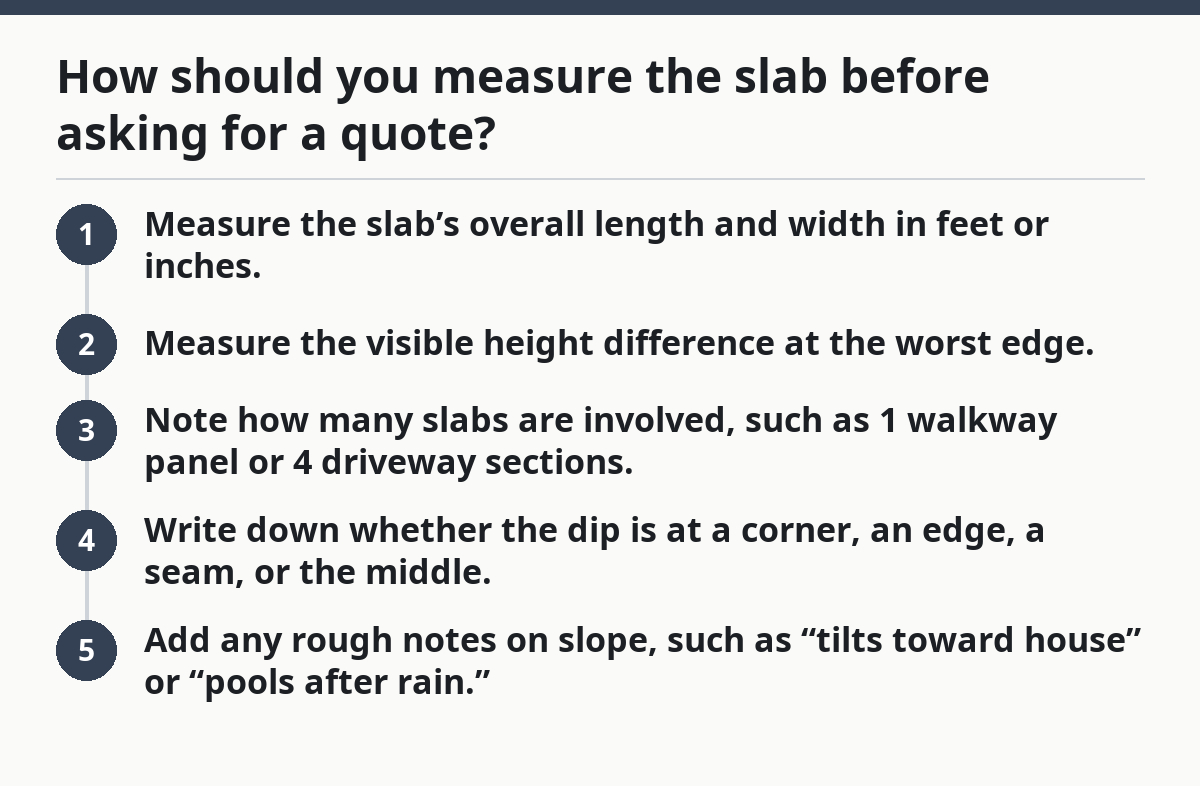
How should you measure the slab before asking for a quote?
Measure the length, width, and height change of the slab, then note the units you used. Those numbers give the contractor a starting point without making them guess from a photo alone.
Picture this: you’re trying to explain a patio that dropped near one corner, but “pretty bad” means nothing to a bidder. A few plain measurements turn that into a real job description.
Start with a tape measure and a notepad. If the slab is broken into sections, measure each one separately. If the problem is only on one side, measure that section and note the affected edge.
Use this simple process:
- Measure the slab’s overall length and width in feet or inches.
- Measure the visible height difference at the worst edge.
- Note how many slabs are involved, such as 1 walkway panel or 4 driveway sections.
- Write down whether the dip is at a corner, an edge, a seam, or the middle.
- Add any rough notes on slope, such as “tilts toward house” or “pools after rain.”
If you don’t have a level, don’t fake precision. A plain note like “about 1 inch lower on the left side” is still useful. A contractor can work with an honest estimate much better than a guessed exact number that turns out wrong on site.
There’s one trade-off here: rough measurements help speed the quote, but they won’t replace an onsite check if the slab has hidden voids or the ground is unstable. The point is to shrink the unknowns, not erase them.
A simple sketch on paper can help too. Draw the slab shape, mark the low spot, and label each side. If the slab is part of a longer run, sketch where one panel ends and the next begins.
What repair history should you collect?
Collect old repair records, dates, and photos of past fixes so the contractor knows whether the slab has already been patched, drilled, filled, or lifted. Repair history changes the quote because it changes the risk.
Picture this: you mention that a corner was fixed “a few years ago,” then the contractor arrives and finds old patch material, failed caulk, or drill holes from a previous lift. That history can affect access, the method used, and whether the old repair needs to be removed or worked around.
Gather anything you still have:
- Invoices from past concrete repair, mudjacking, or foam lifting work
- Photos taken before and after the repair
- Notes on when the problem returned
- Warranty papers, if any
- Messages or emails from the earlier contractor
If you know the year of the last repair, write it down even if you don’t have the paperwork. If you remember the fix was temporary or only touched one corner, say that. The contractor is not looking for a perfect case file. They are looking for clues about what failed before.
This is also where honesty saves time. If the slab has been lifted before, say so in the first message. If a crack was sealed and then reopened, say that too. The quote changes when the slab has a history of movement, because a repeat problem often means the ground under it keeps shifting.
One common mistake is leaving out old work because it seems minor. That can cost you a second trip or a revised quote. The better move is to send the repair record now, even if it feels messy or incomplete.
Which property records help the contractor quote faster?
Property records help by showing ownership lines, slab location, and site details that photos can miss. They are especially useful when the slab sits near a boundary, an easement, or a shared driveway.
Picture this: you’re asking about a sidewalk or driveway apron, and you’re not sure if the slab is fully on your property or partly tied to a shared area. A basic record search can reduce that confusion before the quote is written.
The most useful records are:
- A site plan or plat map that shows the lot layout.
- A recent property survey, if you have one.
- HOA or condo documents if the slab is in a shared space.
- Builder plans or permit papers, when available.
- Any record that identifies utilities, drainage lines, or easements near the slab.
You do not need a thick file cabinet. One page can be enough. A site plan with a marked area often does more work than a stack of old paperwork. If you have digital copies, send them as PDFs or clear photos of the pages.
These records help in two practical ways. First, they show whether the slab is part of a larger structure, like a garage approach or patio tied to steps. Second, they can flag tight conditions such as utility access, buried lines, or shared surfaces that may limit how the work gets done.
On the flip side, don’t hold up the quote waiting for a perfect survey if the issue is obvious and local. If you can’t find the records in 10 or 15 minutes, send the photos and measurements first, then follow with the record later. That keeps the estimate moving.
A lot of homeowners skip this step and then wonder why the contractor asks follow-up questions. The answer is simple: records help the contractor avoid quoting the wrong slab.
What site access notes belong in the first message?
Site access notes should cover how the crew gets to the slab, where equipment can sit, and what blocks the path. Those details affect labor, setup time, and sometimes the method used.
Picture this: the slab is easy to see from the street, but the work area sits behind a locked fence and a narrow side yard. That changes the quote more than most people expect.
Include these access details:
- Is there a gate, fence, or locked area?
- Can a truck or cart get close to the slab?
- Are there stairs, steep steps, or narrow passages?
- Is the surface soft, muddy, or landscaped?
- Will cars need to be moved?
- Are pets, sprinklers, or overhead lines in the way?
If access is tight, say so plainly. “Back patio is behind a 36-inch gate” is useful. “Hard to get to” is not. The more exact you are, the less chance of a surprise when the crew arrives.
While you take photos, gather this info at the same time. Shoot the route from the driveway or street to the slab. If a hose, planter, grill, or trash bin blocks the way, include that in the notes. A contractor can tell a lot from the route, not just the slab itself.
This is one of the biggest reasons quotes change after the first call. A slab may be small, but if the route is tight or the machine can’t get near it, the job takes more time. That is exactly the kind of detail a clean quote packet should surface early.
How do you package the information so the contractor can quote it?
Package the information in one short message with labeled files so the contractor can scan it in under a minute. Clear labels beat a long story every time.
Picture this: you’re sending five photos, a sketch, and two old invoices, but everything is named “IMG_4812” and “document final.” That forces the contractor to hunt for the one detail that matters most.
Use this format:
- Start with the address and the slab location in one line.
- Add 2 to 5 photos with simple labels like “front walkway wide shot” or “garage edge crack.”
- Include your measurements in a few plain lines.
- Attach repair records or say “no prior repair records found.”
- Add access notes in one short paragraph.
If you use email, put the location in the subject line. If you use text, keep the message short and structured. A sample line might read: “Driveway slab near garage, 12 ft by 8 ft, about 1 inch drop on right edge, previous patch in 2021, side gate 36 inches wide.”
Don’t bury the useful part under a full explanation of how the slab got damaged. The contractor usually needs the facts first, not the backstory. If they want more detail, they’ll ask.
The clearest packets share the same trait: they answer the first follow-up question before anyone asks it. That is the real payoff. Just enough specific material lets the contractor quote the job without chasing you for the basics.
What should you leave out of the quote request?
Leave out guesses, unrelated damage, and long stories unless they change access or the slab itself. Too much noise can blur the problem.
Picture this: you’re trying to get a quote for one sunken patio section, but the message turns into a list of every crack on the property. The contractor now has to sort useful facts from side issues.
Skip these unless they matter to the slab being quoted:
- Damage on other parts of the house
- A long complaint about the original builder
- Unverified guesses about what caused the settling
- Photos of unrelated cracks in brick, drywall, or curbing
- Personal history that does not change the work area
There is one exception. If the slab is tied to drainage, roots, a retaining wall, or a shared structure, mention that. Those are not side issues. They can change the work.
A short, accurate quote request is easier to price than a dramatic one. That is not a style preference. It is a practical one. The contractor needs the slab, the access, the movement, and the history. Everything else can wait unless it affects the job.
That is why the best packet usually feels almost boring. It should look like a clean case file, not a complaint log.
What information helps a contractor quote slab lifting accurately?
The most helpful information is photos, measurements, repair history, and access notes. Those four items tell the contractor what moved, how much space they have to work with, and whether the slab has already been repaired before.
If you also send property records, that can help when the slab sits near a boundary, shared area, or utility path. A clear photo set and a rough measurement are often enough to start. A better packet just reduces follow-up.
Do I need to measure the slab before asking for a quote?
No, but basic measurements make the quote faster and cleaner. If you can give length, width, and the approximate height change, you give the contractor a better starting point.
If you can’t measure right away, send photos first and explain that the dimensions are still pending. A quote based on photos alone is possible in many cases, but the estimate is usually stronger when the slab size is known.
For more detail on measurement conventions and site notes, see the surveying basics guide and the site access checklist. Authoritative references on concrete behavior and residential site work include the National Ready Mixed Concrete Association and the American Concrete Institute.
Drafted with AI; not yet reviewed by a person.