Last updated: November 20, 2026
Key Takeaways
- Mark utilities before slab lifting starts, so the crew can plan around buried lines.
- The locate step comes before drilling or lifting and shapes the job plan before tools touch the slab.
- One slab can sit over more than one utility, so wait for the locate before assuming the layout.
- The right answer depends on the area and on whether the lines are public, private, or both.
Utility marking should happen before any slab lifting job that could reach buried utility lines, because the locate tells the crew where the water line, electrical line, gas line, and other buried lines sit before equipment touches the concrete slab. Call before you dig first. This article on How Utility Marking and Line Locates Fit Into a Slab Lifting Job shows where the utility locate process fits, what it changes on site, and what to ask before the crew starts.
Utility marking before slab lifting: the short answer
Utility marking belongs at the front of the job, not after the slab is already moving. If the work could involve drilling, slab breaking, injection ports, anchor points, or any tool that may cross the slab edge, the locate helps the crew plan around buried lines and service clearance.
Picture this: you’re looking at a sunken concrete slab and trying to book the lift without turning a small repair into a utility strike. The utility locate process gives the crew a map of what might be under the slab, so they can set access points, choose the right method, and avoid blind cuts. That is the safer order.
A few details still matter:
- Marking is for known utility corridors, not a guess about everything underground.
- A locate on one side of a slab does not clear the whole lot.
- Private lines often need separate attention from public utility marks.
The truth is, slab lifting and line locates are linked because both jobs depend on where the ground can be disturbed. If you skip the locate, you leave the crew to work around buried lines with less margin and more risk.
How the utility locate process fits into a slab lifting job
The utility locate process comes before drilling or lifting, and it shapes the job plan before anyone sets tools on the slab. On most projects, the crew or property owner starts the locate request, waits for the marks, then reviews the marked areas before scheduling the lift itself.
Picture this: you’re standing at the edge of a driveway slab, and the plan is still flexible. That is often the right time to place the locate request, because the markings can change where the crew drills, where they stage equipment, and whether a section needs hand work instead of powered equipment. The marks steer the method.
A standard workflow looks like this:
- Request a locate before the job date. The idea is to give the marking service enough time to visit and mark buried utility lines with paint, flags, or both.
- Wait for the marks to appear and stay visible. Fresh paint and flags are easier to read than old marks worn down by weather or traffic.
- Walk the slab with the contractor. The crew checks the marked areas, the slab edges, and any likely drill points.
- Adjust the plan around the marks. The crew may shift ports, change access, or leave a narrow strip untouched until it can be exposed by hand.
- Keep the marks visible until the work is done. Don’t cover them with soil, pallets, or parked vehicles.
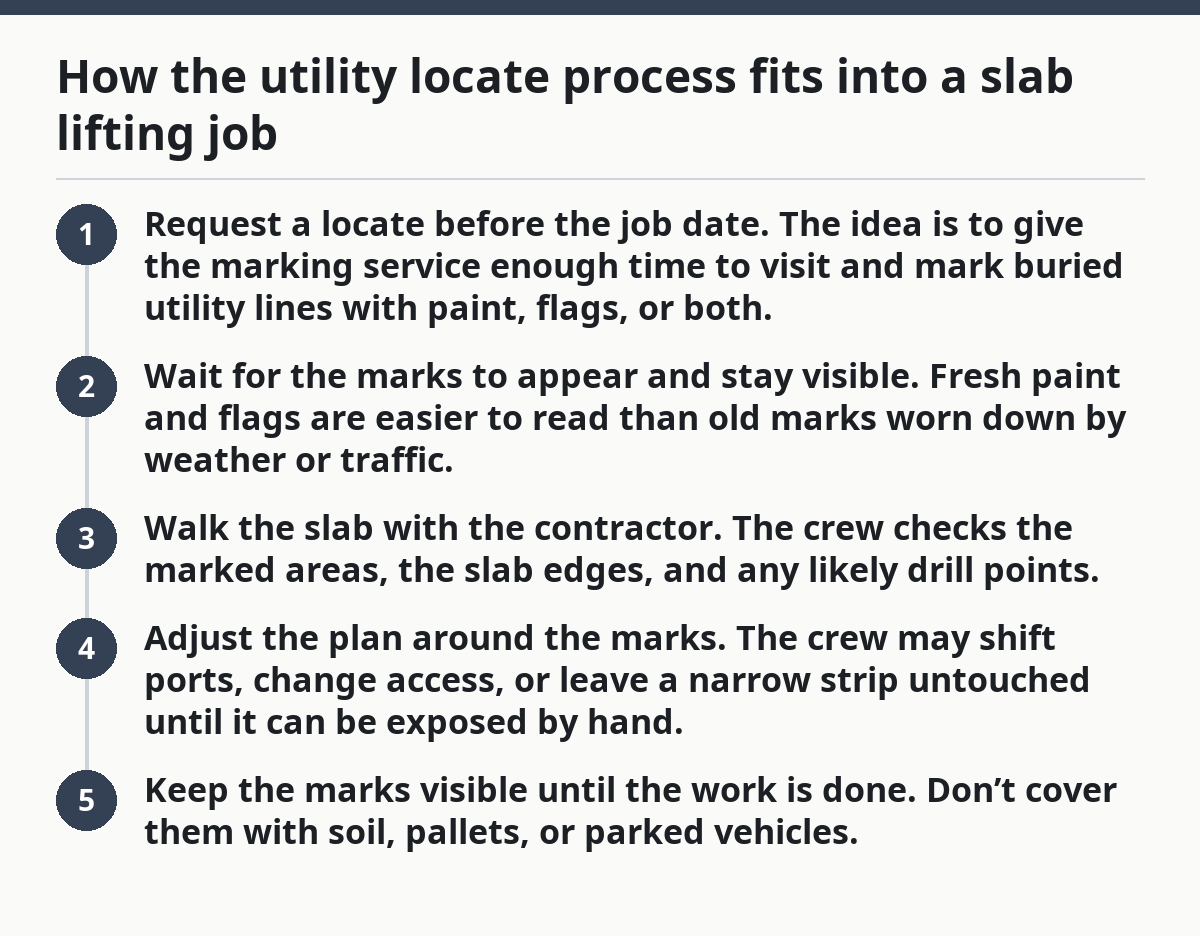
Every step above affects the next one. A locate that is rushed or ignored usually costs time later, because the crew has to stop and rework the layout. On a small residential slab, that can mean a short delay. On a larger commercial slab, it can mean a full reschedule.
If you want the broader repair sequence, the hub page on repair methods and process explains where this planning step sits in the larger job flow.
Which buried lines matter most under a concrete slab?
The buried lines that matter most are the ones that can be hit by drilling, probing, or slab edge work: water line, electrical line, gas line, sewer laterals, irrigation, and communication lines. Not every slab sits over all of them, but the crew has to assume more than one may be present until the locate says otherwise.
Picture this: you’re dealing with a front walk or garage slab and the surface looks simple. Under that slab, a service line can turn, branch, or run at a shallow depth, especially near the house, utility meter, or trench backfill. Simple concrete does not mean simple underground conditions.
The line locate matters even more when:
- The slab sits near a meter, cleanout, transformer, or utility box.
- The property has older service runs with no clear as-built records.
- The slab was added later over existing utilities.
- You see patching, trench lines, or old cuts in the concrete.
Here’s the catch: a marking service may locate public utilities, but private lines on the property can still need separate attention. That is one reason a slab lift can’t start with a general assumption that “the street call is enough.” On private property, the line between public and private responsibility changes the answer.
If the project is near a utility easement or utility corridor, ask where the crew plans to place injection ports, drill holes, or lifting points. Those are the places most likely to intersect a buried line if the layout is wrong by even a small amount. That is especially true where the slab meets a wall or a driveway edge.
Who arranges line locates?
The contractor often arranges the locate, but the property owner may need to make the request when the job is private, the property is complex, or local rules put that duty on the person controlling the site. The right answer depends on the area and on whether the lines are public, private, or both.
Picture this: you’ve got a concrete slab that needs lifting, and three people think someone else called it in. That is how jobs stall. Before the work date, ask who is filing the locate request, who is paying for any private locating, and who will confirm the marks on site. One name needs to own it.
A smart pre-job question list:
- Who is calling for the public locate?
- Who handles private utility lines if they run across the slab?
- How long does the crew want the marks to remain visible?
- What happens if the marks show a conflict with the planned drill points?
- Will the crew pause work if the marks are unclear or incomplete?
That checklist helps because the locate is a coordination step, not paperwork for its own sake. A small slab job can be delayed by a half day if the marks are missing. A bigger job can lose a whole crew slot. Ask early, and the schedule stays honest.
What a slab lifting crew should change after the marks are down
The slab lifting crew should change the access plan, the drilling plan, and the safety plan after the marks are down. That may mean moving a drill line, changing where equipment sits, or choosing hand exposure near marked corridors instead of pushing straight ahead with powered tools.
Picture this: you’re ready to start, but the paint line crosses the very edge where the crew planned to drill. That is not a stop sign for the whole job, but it is a reason to slow down and adjust. The mark wins over the guess.
Common changes after marking include:
- Moving the first access hole several inches or more away from the marked path.
- Using hand digging to expose a line before the slab edge is disturbed.
- Limiting machine access where heavy equipment would cross a utility corridor.
- Choosing a smaller repair zone instead of lifting the entire slab section at once.
Safety precautions here are practical, not dramatic. The crew should keep the marked area visible, avoid washing it away, and stop work if a line appears where it should not. If the marks show a crowded utility zone, the contractor may need a slower method or a different repair layout.
A bad job often looks like this: the crew ignores the marks, drills first, and only then checks what is underground. That can lead to a service hit, a rushed repair, or a patch that solves the slab issue while creating a utility problem. The price of that mistake is usually far higher than the time spent on the locate.
How long utility marking usually adds to the schedule
Utility marking usually adds a planning window before the slab lift, not a long on-site delay, but the exact timing depends on local service response, property complexity, and whether private lines need extra locating. In a simple case, the locate may be ready before the crew date; in a tangled site, it can push the lift back until the marks are clear.
Picture this: you’re trying to book a concrete slab lift around weather, access, and a busy crew calendar. The locate step is the part that can make a one-day job become a two-step schedule if the marks are late or incomplete. That delay is normal.
What changes the timeline:
- Multiple utilities close together
- Private lines with no records
- Large slab areas that need several access points
- Weather that obscures paint or flags
- A site where the marks conflict with the planned work path
Because multiple utilities close together can slow a job, a contractor should review the layout with a qualified locator or utility professional before starting. The same goes for private lines with no records, which can require extra verification. Consult a professional and check local utility guidance before setting the work date. For context, OSHA’s excavation rule and Common Ground Alliance guidance both emphasize locating underground utilities before ground disturbance.
The cost side is worth asking about too. A basic utility locate may be included in the contractor’s job coordination, while private locating or extra hand exposure can add cost. I’m not naming a fixed price here because local rates vary with the area and the number of lines involved. A contractor should still be able to tell you what part of the job is included and what would trigger an extra charge.
If the price quote never mentions buried utilities, that is a gap, not a bargain. Ask before the work starts.
What to ask before you book the slab lift
You should ask four direct questions before you book the slab lift: who is arranging the locate, which utility lines are covered, how the crew will work around marked areas, and what happens if the marks conflict with the repair plan. Those questions tell you whether the contractor is treating the utility locate process as a real safety step, and a qualified professional can confirm the local process if the answer is unclear.
Picture this: you’re on the phone with a contractor and want a straight answer, not a sales pitch. Keep it plain. Ask about the locate first. Then ask how the slab lift will change if the marks show a water line, electrical line, or other buried utility in the work zone.
Use this short checklist:
- Ask whether the locate covers public utilities only or also private lines.
- Ask how far in advance the request should be made.
- Ask whether the crew will hand expose any marked area before drilling.
- Ask what the crew does if the marks are missing or unclear.
- Ask whether the locate affects the final work order or price.
A contractor who answers clearly is easier to work with on the day of the job. A contractor who shrugs off the locate is a bad fit for a slab lifting project. The utility markings are part of the work, not decoration on the ground.
For national guidance on utility locating, the Common Ground Alliance’s best-practice materials and the “call before you dig” resources from local utility services are the right places to verify local procedure. State and municipal rules may change the exact process, so the local answer should be checked with the authority that applies.
FAQ
Why do utilities need to be marked?
Utilities need to be marked so a crew knows where buried lines are before digging, drilling, or cutting near a concrete slab. A mark is not perfect proof of depth, but it gives a usable surface reference that helps the contractor avoid the most obvious strike points and plan safer access.
Can slab lifting damage buried lines?
Yes, it can if the slab lift involves drilling, breaking, probing, or equipment movement near buried utility lines. The risk is higher where the slab sits close to a water line, electrical line, gas service, or private line with no clear record. That is why marking and a careful layout come first.
Who arranges line locates?
The contractor usually arranges the line locate, but the property owner may need to do it for private lines or in places where local rules put that duty on the person controlling the work site. The safest answer is the one written into the job plan before the crew arrives.
Drafted with AI; not yet reviewed by a person.