Last updated: November 20, 2026
If you’re hiring a slab lifting contractor in New York, the quick answer is to verify four things before work starts: the license, insurance certificate, business registration, and bond. Use the exact legal company name, not a trade name, and compare every document against that name. This guide explains how to verify a slab lifting contractor’s insurance and licensing in New York, where to check each record, and what a clean paper trail looks like.
The steps below settle what proof matters, what belongs on the certificate, and when a contractor’s documents should make you pause. This is information, not financial advice; for your own situation, a qualified adviser or attorney can help if the paperwork is unclear.
Key Takeaways
- A real contractor can show current documents, not promises.
- The name on the insurance certificate, license, and business filing should line up.
- “General liability” alone is not enough if the job involves workers on site.
- Bonding matters because it adds another layer if the contractor fails to do the work as agreed.
- If a document is expired, altered, or doesn’t match the company name, consult a qualified professional or the issuing office before you rely on it.
What you need before you start
Picture this: you’re standing at the kitchen table with an estimate in one hand and a company card in the other, trying to decide if the slab lifting contractor is real or just well dressed. You do not need special tools for this check—just the business name, the insurance certificate, and the state or local license information the contractor claims to hold.
Start with the exact legal name, not the brand name on a truck. Here’s the catch: “doing business as” names can hide the real filing, so the paperwork has to match the legal entity. You should also be ready to ask for the policyholder name, the insurer, the policy number, and the expiration date.
- Bring these items: the estimate, the company name as written, a phone, and a notepad.
- Look for these words: “certificate of insurance,” “workers’ compensation,” “general liability,” and any license number.
- Watch for this problem: a document that is blurry, incomplete, or missing the contractor’s address.
A quick check now can save you from a bad hire later. The right documents are not decoration, and New York’s business records can help you confirm whether the company name is live.
How do I check a slab lifting contractor’s papers in New York?
You verify them by matching the contractor’s name on every document, confirming the license with the issuing office, and checking insurance directly with the carrier or through the certificate details. Picture yourself at the counter or on the phone, asking for one document at a time and comparing the exact legal name, not a nickname. That is the whole game.
Follow these steps in order:
- Ask for the full legal business name and tax/entity type before anything else. Write it exactly as the contractor says it, then compare it with the estimate and contract. If the name changes between documents, that is a problem because the person you are hiring may not be the person carrying the coverage.
- Request a current certificate of insurance, not just a photo of a card. The certificate should show the insurer, policy number, effective date, and expiration date, usually in a standard ACORD-style format. If the certificate has no expiration date or lists “self-insured” without details, stop and ask for the full policy information.
- Check that general liability coverage is present and that workers’ compensation is listed if employees will be on site. A general liability policy is meant to cover certain third-party property claims; workers’ compensation is a separate policy for jobsite injuries. If one is missing and the crew is not a one-person operation, that is a red flag.
- Call the insurer or broker using a phone number you find independently, not one only printed on the contractor’s paperwork. Ask whether the policy number is active and whether the certificate holder is valid for the dates shown. If the office cannot confirm the policy, the document may be stale or altered.
- Verify the license through the correct New York licensing office for the work being done. Some work is regulated by state agencies; other work is controlled by local city or county rules. Use the legal business name and license number together. If the office has no record, or the number belongs to a different business, stop and confirm with the issuing agency or a qualified professional.
- Check the business registration with New York’s business filing records if the contractor is operating under a company name. You want the filing to show a live entity, not a dissolved or expired one. If the registration is inactive, the contractor may still talk a good game, but the paper trail is weak.
- Ask for proof of bonding if the contractor says they are bonded. A bond is not insurance; it is a separate financial backstop that can help if the contractor fails to meet certain obligations. If they claim to be bonded but cannot name the surety or provide the bond details, consult the surety or a qualified professional before relying on that claim.
- Compare every date and name across the certificate, license, bond, and contract before you let work begin. Consistency is a good sign: same company name, same address, current dates, and no crossed-out edits. If anything looks patched together, do not assume it is harmless.
If the paperwork lines up, that is a stronger sign the contractor is organized and traceable. A legitimate contractor usually does not get irritated by these requests. A sloppy one often does.
What should be on the insurance certificate?
Picture yourself reading the certificate line by line, not just glancing at the logo. You are looking for a current policy, the insured name, and the coverage type, because the certificate is only useful if it ties the jobsite risk to the right entity. A certificate with missing dates is almost useless.
The certificate should show at least the insurer’s name, the policy number, and the effective and expiration dates. If it lists only “certificate holder” information and no coverage type, that is not enough. For slab lifting work, you also want to see whether the company carries general liability and, if applicable, workers’ compensation.
- General liability is the policy that may address damage to someone else’s property.
- Workers’ compensation addresses injury claims for employees.
- Auto liability can matter if the crew drives company vehicles onto your property.
One common mistake is to accept a certificate that was issued months ago and never rechecked. Another is to assume the certificate proves every possible loss is covered. It does not. It only shows what the contractor says is in force at the time the certificate was printed.
If the certificate has a disclaimer that says it does not amend the policy, that is normal. What is not normal is a certificate with a missing effective date, a crossed-out policy number, or a company name that does not match the estimate. Those are the details that tell you whether the file is clean or shaky.
Source check:
For the structure of certificates of insurance, the ACORD certificate format is a common reference, and New York State’s insurance and labor agencies are the right places to confirm whether a coverage claim makes sense for the job. See ACORD’s certificate guidance and the New York State Department of Labor and Department of Financial Services for official verification paths.
How do I check a contractor’s license in New York?
You check it by using the issuing authority’s records, not by trusting a logo on a website. Picture this: you have the contractor’s license number in front of you, and you are matching it against the business name, issue status, and expiration date one field at a time. If the records do not line up, you do not have a clean verification.
New York licensing is not one single statewide folder for every trade. Depending on the work and where the job is located, the license may come from a state office, a city agency, or a local municipality. That means the first step is to identify which office governs the work, then search by the exact legal name and number.
- Confirm the issuing authority for the location of the job.
- Verify the status as active, current, or otherwise in good standing.
- Match the license holder name to the business on the estimate.
- Check whether the license is tied to an individual or a company.
If the contractor tells you the license is “in process,” that is not the same as licensed. If the record is expired, suspended, or not found, the safest move is to pause until the issuing office explains what happened. Slab lifting can affect property and, in some cases, structural conditions, so you do not want a paperwork mystery on top of the work itself.
This is where people get burned. They search the wrong office, find nothing, and assume that means the license does not exist—or worse, they find a similar name and call it close enough. It is not close enough, and New York State and local records should both be checked where applicable.
Why business registration and bonding matter too
Because the license tells you whether the contractor is recognized by the right authority, the business registration tells you whether the company exists as a legal entity, and the bond tells you whether there is another financial layer behind the promise to perform.
A business registration is the filing that links the company name to a live entity. If that filing is dissolved, inactive, or mismatched, the contractor may still be operating under a trade name, but the paper trail is weaker. That matters when you need to know who is actually responsible for the work.
A bond is different from insurance. Insurance is designed around covered losses. A bond is a promise backed by a surety, and it may help if the contractor fails to meet obligations tied to the bond terms. If someone says “bonded” but cannot provide the bond type, surety name, or confirmation details, you should treat that as unverified.
- Business registration: confirms the company exists in state records.
- Bond: adds a separate promise tied to performance or compliance.
- Insurance: covers certain accidental losses, depending on the policy.
The mistake here is assuming one document covers the others. It doesn’t. A contractor can be registered and still carry weak insurance. A contractor can be insured and still have a suspended license. You need all three pieces to line up if you want a cleaner risk check.
When should you stop the check and walk away?
Because the documents are supposed to support the work, the moment they stop matching is the moment to slow down. If the contractor keeps talking while the documents keep failing the same simple test, you have enough information to pause. You asked for proof, and the names do not match, the dates are stale, or the agency search shows nothing.
The certificate is expired: the policy may have lapsed — do not let work start until you see a current replacement.
The name does not match: the entity on the estimate, license, and insurance differ — ask for corrected documents or move on.
The license cannot be found: the contractor may not be authorized for that work — verify with the correct office, and if it still cannot be found, walk away.
The contractor refuses to name the insurer: you cannot confirm coverage — treat that as a hard stop.
The bond claim is vague: “We’re bonded” without details means nothing — ask for the surety information or consider another contractor.
The paperwork is altered: crossed-out dates, blurry scans, or missing fields suggest weak controls — do not rely on it.
On the flip side, if everything matches and the contractor can explain the documents without hedging, you have a much stronger sign that the company is organized and traceable. That does not guarantee good workmanship, but it does mean the basic legitimacy check is working.
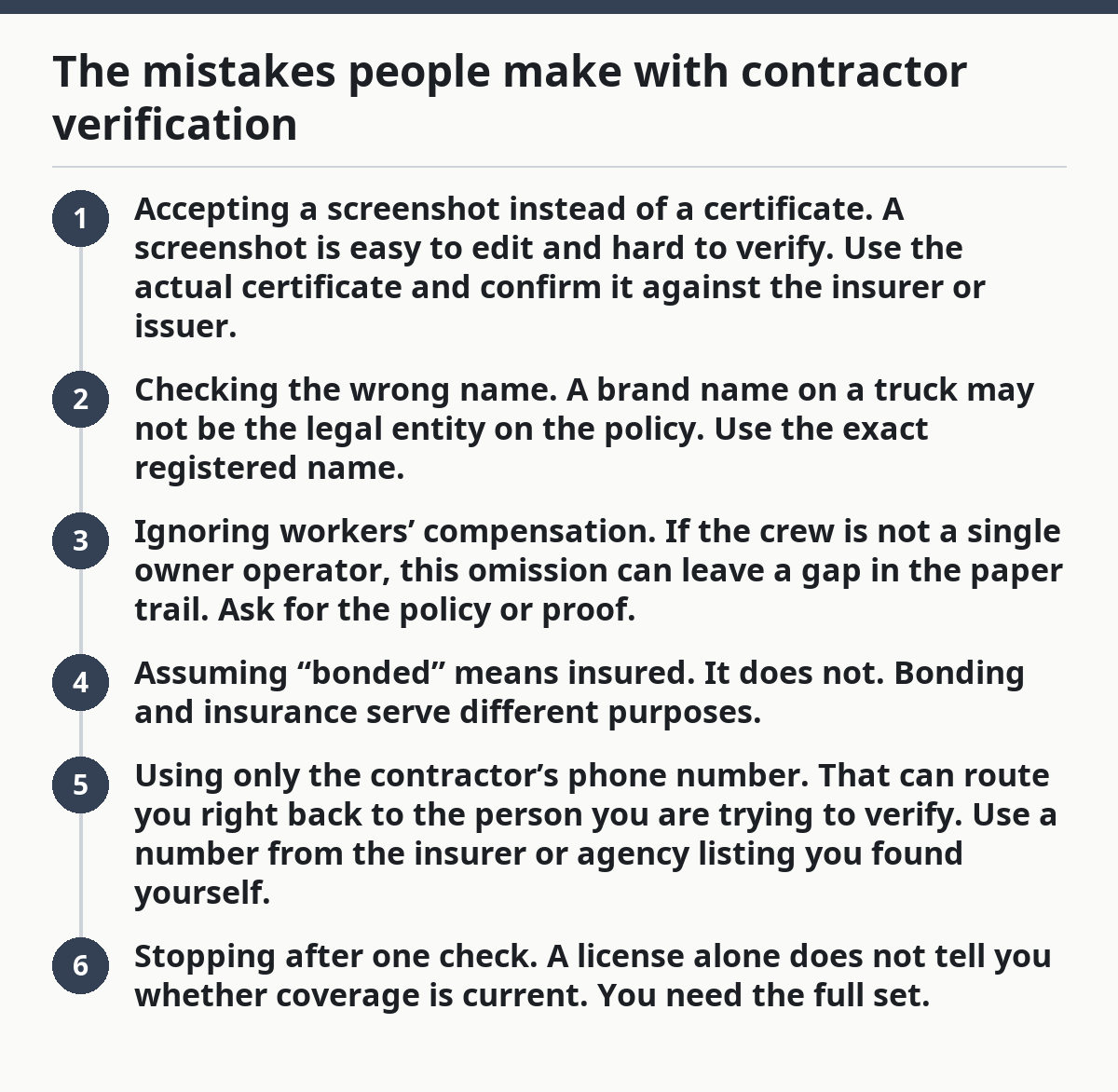
The mistakes people make with contractor verification
Picture yourself trying to save ten minutes and losing an afternoon. Most bad checks fail because the reader trusts the first document they get, or checks only one piece of the puzzle. That is where the errors start.
- Accepting a screenshot instead of a certificate. A screenshot is easy to edit and hard to verify. Use the actual certificate and confirm it against the insurer or issuer.
- Checking the wrong name. A brand name on a truck may not be the legal entity on the policy. Use the exact registered name.
- Ignoring workers’ compensation. If the crew is not a single owner operator, this omission can leave a gap in the paper trail. Ask for the policy or proof.
- Assuming “bonded” means insured. It does not. Bonding and insurance serve different purposes.
- Using only the contractor’s phone number. That can route you right back to the person you are trying to verify. Use a number from the insurer or agency listing you found yourself.
- Stopping after one check. A license alone does not tell you whether coverage is current. You need the full set.
The correct alternative is simple: verify each item separately, then compare the names and dates. Consistency matters, and the safest checks are usually the least flashy.
What if the contractor works across county lines or under a DBA?
Because the company works in more than one place, the paperwork may seem to shift with each job. That is common enough in New York, especially when a contractor uses a “doing business as” name or works across city and county lines, but the fix is the same—follow the legal identity, not the marketing name.
A DBA, or “doing business as,” is a trade name. It is not the same as the legal entity that owns the policy or license. If the contractor gives you a DBA, ask for the underlying legal business name and verify that name in every record. If they operate in more than one jurisdiction, check the license rules for the actual job location, because one approval may not cover every place.
Out-of-area paperwork is another trap. A license valid in one municipality may not satisfy another local office. If the contractor says, “We’re licensed everywhere,” ask them to show the exact local authority and current status for your address. If they cannot, the claim is too broad to trust.
Sources to trust when you verify
Because you are trying to separate sales talk from official records, the state record wins. Use the insurer named on the certificate, the relevant New York licensing office for the work, and the state business filing record for the company name. That combination gives you a cleaner check than relying on a brochure or a website badge.
For general background on licensing and insurance rules, New York State agencies and official records are the best places to start. The New York Department of State, the Department of Labor, the Department of Financial Services, and the state business filing search can help you confirm what the contractor says on paper.
Drafted with AI; not yet reviewed by a person.