What Signs Show a Slab Is Settling Slowly Rather Than Suddenly?

Last updated: November 20, 2026
Key Takeaways
- Slow slab settlement shows up as progressive movement, not one dramatic break.
- Check the same sign after 2 to 4 weeks; if it changes, movement is still happening.
- A door rubbing or sticking in the same corner is a strong clue of slow slab settlement.
- Small seasonal changes can mimic slow settlement, but they usually follow a repeatable weather pattern.
A slow slab settlement problem usually appears as small, repeatable changes—not a sudden drop. For What Signs Show a Slab Is Settling Slowly Rather Than Suddenly?, the clues are pretty plain: doors begin to rub, thin gaps widen in the same spots, and marks keep shifting over a few weeks.
This guide separates gradual movement from a one-time shift so you can decide what you’re actually looking at.
What slow slab settlement looks like day to day

Slow slab settlement shows up as progressive movement, not a single dramatic break. You’ll see the same crack, gap, or door issue get a little worse over days or weeks, while the rest of the room still looks mostly normal.
Walk the same hallway every morning. One door catches a bit more each week. The trim still looks straight at a glance, but the change is there if you keep checking the same edge.
The difference matters because sudden movement usually leaves a sharper pattern. Slow movement leaves a trail.
Not the same thing.
A slow pattern often includes:
- A crack that reopens after you fill it
- A door that rubs more at the latch side each month
- A baseboard gap that starts at 1/16 inch and slowly opens
- One corner that looks a little lower than the rest of the room
- Hairline separation where the wall meets the ceiling or trim
Repeatability is the giveaway. A crack from one event may look ugly but stay stable after that; slow settlement keeps changing shape, size, or fit. Mark a spot with pencil and check it again in 30 days — if it moved, that’s not a one-off.
Here’s the catch: slow settlement can look mild for a long time. Mild does not mean unchanged. It means you need a better eye and a simple record.
How can I tell if movement is still happening?
Movement is still happening if the same sign changes when you check it again after 2 to 4 weeks. A slab that has stopped moving may still show old damage, but the damage won’t keep growing in the same place.
Tape the crack, close the door, and measure a small gap at the trim. Three weeks later, the tape is split again or the gap is a little wider. That’s ongoing movement, not just an old scar.
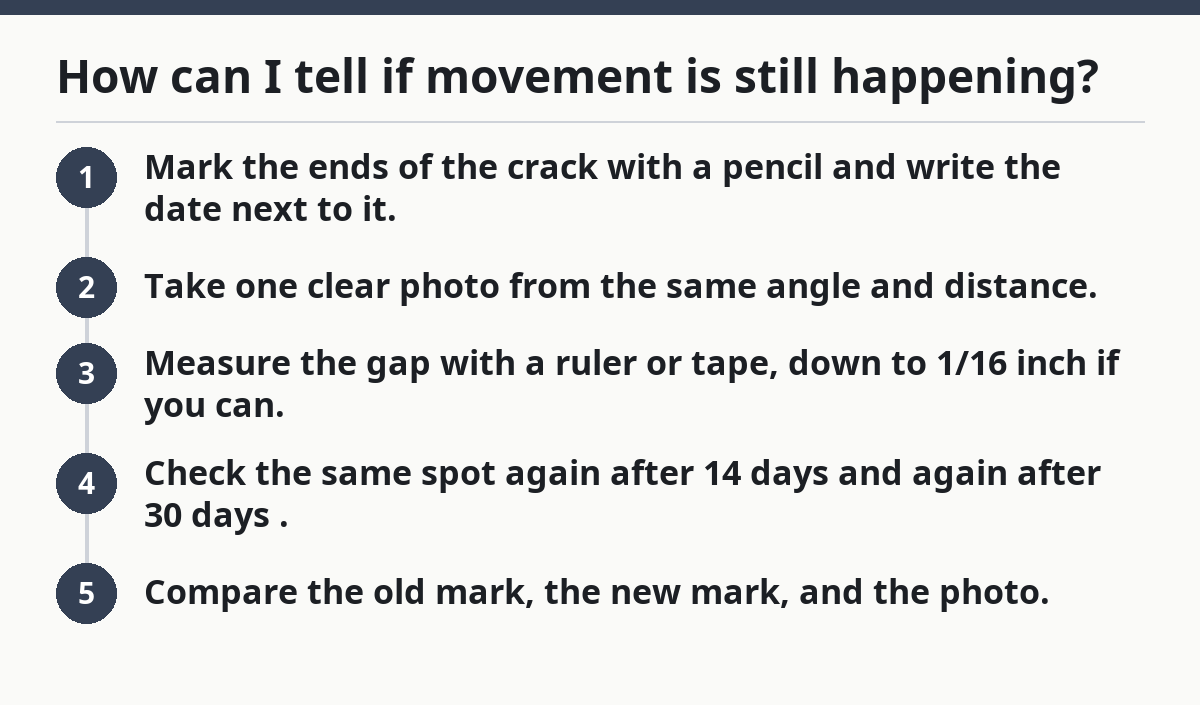
Use this simple check:
- Mark the ends of the crack with a pencil and write the date next to it.
- Take one clear photo from the same angle and distance.
- Measure the gap with a ruler or tape, down to 1/16 inch if you can.
- Check the same spot again after 14 days and again after 30 days.
- Compare the old mark, the new mark, and the photo.
If the line lengthens, the gap widens, or the door rubs more at the same edge, the slab is still moving. If the defect looks the same after a month, it may be old movement rather than active settlement.
You don’t need special tools for the first pass. A pencil, a camera, and a ruler will tell you more than memory will.
Door rubbing, sticking, and out-of-square frames

A door that rubs or sticks in the same corner is one of the cleaner clues of slow slab settlement. The change is usually gradual: the latch side tightens, the top gap shrinks, or the bottom edge starts scraping the floor.
Open the same interior door every day, and it only catches at the last inch. Then, over a month, it starts needing a hard push. That slow change often points to movement in the slab or framing above it.
What to watch for:
- The door swings fine after you shave the latch edge, then rubs again later
- The strike plate no longer lines up cleanly
- The gap above the door gets uneven by a small amount
- A door that used to latch easily now needs a lift or shoulder push
- One side of a double door looks higher than the other
Door problems are useful because they are easy to compare over time. If the issue appears in one room and keeps getting worse there, that supports slow movement. If several doors suddenly fail on the same day after a heavy impact, that points more toward a one-time shift.
A door issue by itself is not proof. It is a clue.
A repeating clue.
For a cleaner check, measure the clearance at the top and latch side with a ruler. If that clearance changes by about 1/8 inch over a few weeks, write it down. That kind of small drift is exactly how slow settlement announces itself.
Minor gaps and small seasonal changes that can confuse the picture
Small seasonal changes can mimic slow settlement, but they usually follow a repeatable pattern tied to weather. Slow slab settlement does not care about the calendar in the same neat way; it keeps moving in one direction even when the season changes.
You notice a thin gap near baseboard trim in late winter. In summer it tightens a little, then opens again the next cold spell. That back-and-forth can be normal seasonal movement in wood and finishes, not a slab dropping faster and faster.
Signs that lean toward seasonal change:
- Gaps open in winter and close in humid months
- Door rubbing eases when indoor humidity rises
- Hairline cracks stay about the same size year after year
- Caulk pulls away, then seems to relax a bit later
- The same room changes in a predictable cycle
Signs that lean toward slow settlement:
- The gap keeps widening across 2 or 3 checks
- The crack grows even when the season changes
- A door keeps rubbing more each time you measure it
- Only one corner or one wall line keeps drifting
The truth is, mixed signals are common. Wood trim, drywall, and flooring all move a little. So a minor gap is not enough by itself. The question is whether the change reverses with the seasons or keeps marching in the same direction.
A good rule: if you can predict the change from the weather alone, you may be seeing normal seasonal movement. If you can’t, track it for 30 days before you assume it’s harmless.
What a simple monitoring plan should record
A useful monitoring plan records the same spot, the same way, at least twice a month. If you want to tell slow settlement from a one-time drop, consistency matters more than fancy gear.
Stand in the same hallway and photograph the same crack every 14 days. The picture starts to tell a story the eye alone misses — the line creeps, the door edge shifts, the trim opens a little more.
Use a basic record sheet with:
- Date
- Exact spot
- Crack length or gap width
- Door behavior
- Photo angle
- Any weather change or heavy rain
That last line matters. Wet periods, dry spells, and freeze-thaw cycles can change how a slab behaves, especially in places with real winter swings. In New York homes, that means one month of rain and one month of dry air can make the edges of the problem easier to see, even if the root cause is still the same.
A good monitoring setup does not need a laser level to start. It does need the same point of reference every time. Put painter’s tape near the mark if it helps, and write the date on the tape.
What the record should show:
- A gap that stays the same for a month or two
- A crack that extends a little each check
- A door that moves from “slightly rubbing” to “hard to close”
- A corner that looks lower in each photo
If the notes show steady drift, you’re not dealing with a frozen defect. You’re seeing an active pattern.
What slow settlement is not
Slow slab settlement is not the same as a one-time drop, and it’s not the same as every crack you can see in a house. That matters because a bad label leads to bad questions, and bad questions waste time.
You see one crack near a wall and decide the whole slab is sinking. Then you check the next month and nothing changes at all. That may mean you caught an old crack, not active settlement.
Slow settlement usually has three traits:
- It develops over weeks or months
- It changes the fit of doors or trim little by little
- It keeps moving in the same place
It is not usually:
- A single new crack that stays the same size
- A cosmetic line in paint or drywall that never changes
- A seasonal gap that opens and closes with humidity
This is where a lot of generic advice goes wrong. It treats every crack like the same problem. For safety, check the pattern over time and consult a professional if you are unsure. A hairline wall crack, a door that rubs, and a widening gap at the baseboard can point to the same settling pattern, but only if they keep changing together.
A homeowner’s job here is not to label the cause with certainty from one look. It is to separate progressive movement from a fixed defect. That’s the part that helps the next contractor conversation go better.
If you’re comparing notes across rooms, keep the one with the clearest change. One real pattern beats five guesses.
What to ask a contractor when the signs are gradual
Ask a contractor to compare the change over time, not just look at the crack once. A good conversation starts with your dates, photos, and measurements, because slow slab settlement is easier to judge when there’s a paper trail.
Show up with three phone photos, one ruler mark, and dates from the last 30 days. Now the discussion shifts from “Is this bad?” to “Has it moved, and how much?”
Useful questions:
- Does this pattern look progressive or stable?
- Do the door rub and gap line up with the same area?
- What else should I monitor for the next 2 to 4 weeks?
- Is the change tied to one room, one wall, or a larger area?
- What would a more serious change look like here?
You’re not asking for drama. You’re asking for a read on movement. That’s the right lens for a slow-shifting slab.
A contractor should answer in plain terms and point to specific signs: a widening gap, a repeated door rub, or a crack that changes between visits. The weaker answer is a vague “it looks fine” without any comparison points.
For homeowners in New York, local ground conditions and weather swings can affect how a slab behaves, so the same visible sign may mean different things in different basements or foundations. That’s one reason the page on concrete slab settlement diagnosis for New York homes belongs next in the chain — it gives the wider context, while this guide focuses on the slow pattern itself. For broader background, see the American Society of Home Inspectors and the International Code Council guidance on foundation movement and building performance.
FAQ
Is slow settlement less serious than sudden settlement?
Slow settlement is often easier to track, but it is not automatically harmless. A gradual change can still create door rubbing, widening gaps, and repeated crack growth over weeks or months. The difference is the pattern, not the importance of the problem.
How can I tell if movement is still happening?
Movement is still happening if the same crack, gap, or door issue changes when you check it again after 14 to 30 days. Take photos from the same spot, measure the same edge, and compare the results. If the size or fit keeps changing, the slab is still moving.
What signs point to slow slab settlement instead of a one-time event?
Slow slab settlement shows up as repeated, small changes in the same place. Look for a door that rubs more over time, a gap that widens little by little, or a crack that keeps extending. A one-time event usually leaves damage that stays about the same after the initial shift.
Can seasonal changes look like settlement?
Yes, seasonal changes can look like settlement, especially around trim, drywall, and doors. The difference is that seasonal movement tends to reverse with humidity or temperature, while slow settlement keeps drifting in one direction over several checks. Logging the same spot for a month helps separate the two.
Drafted with AI; not yet reviewed by a person.