Last updated: November 21, 2026
Quick answer: 4 repair paths usually cover concrete slab repair alternatives and exceptions—sealing, patching, leveling, or replacement. In this guide, Concrete slab repair alternatives and exceptions come down to one question: is the slab still carrying the load it was built for, or has the movement gone beyond a surface fix? If the crack is small, the slab is level enough, and the base is sound, repair is usually the first move. If the slab is broken, sinking, or tied to a structural problem, the better answer may be replacement, stabilization, or a full engineering review. For crack evaluation basics, see the American Concrete Institute’s guidance on cracking in concrete (ACI 224.1R) and the Portland Cement Association’s repair resources (PCA).
Key takeaways
- Hairline cracking and shallow scaling often point to a repair, not a replacement.
- Settlement, voids, and repeated water entry change the job from patching to problem solving.
- The right fix depends on what the slab is doing under the surface, not just what the top looks like.
- In New York buildings, access, age, and structure often matter as much as the crack itself.
- A cheap patch can fail fast if the base is moving or the slab is acting as part of the structure.
What kind of slab problem is this?
A concrete slab problem is usually one of four things: a crack, a surface defect, a level change, or a structural failure. The first check is simple: look for whether the damage is only on the top, or whether one side of the slab has moved up, down, or sideways. A hairline crack in a basement floor is a different job from a cracked slab that supports a garage, stoop, or equipment pad.
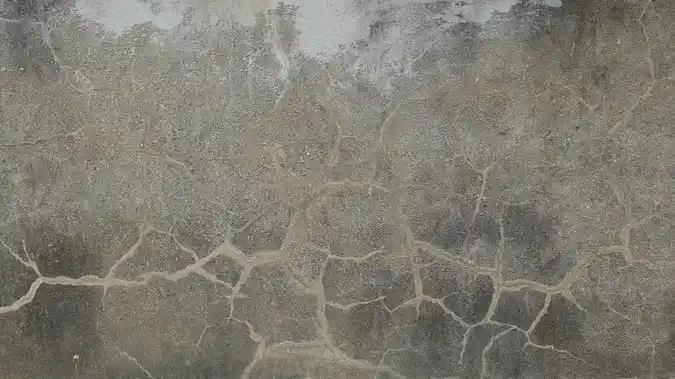
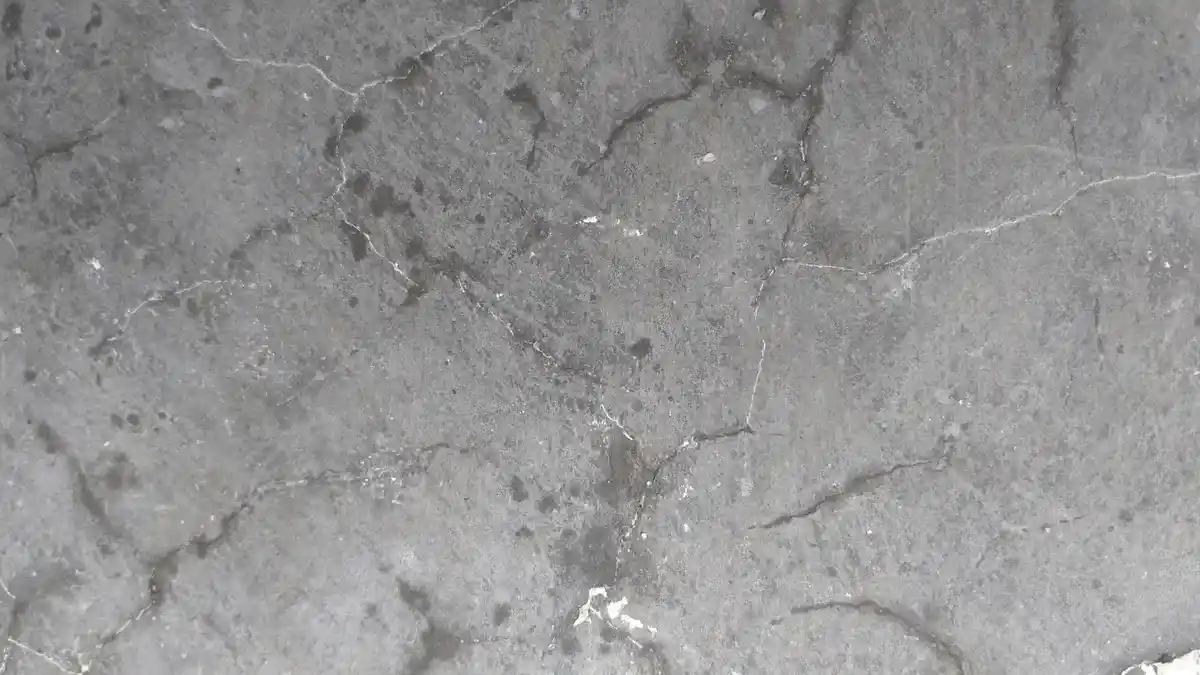
The most useful visual clue is the edge of the crack. If both sides line up and the gap is narrow, the slab may be stable enough for sealing or patching. If one side is higher by even a small amount, or if the crack widens at one end, the issue is often settlement, slab heave, or a void below the slab. For a stable crack versus an active one, consult a professional if the slab carries load or if the line is changing; ACI’s crack guidance is a useful reference (ACI 224.1R).
- Measure the crack width. Check whether it is hairline, narrow, or wide. What to check: whether the same width stays the same along the length. What not to do: assume every crack needs replacement. If the slab is structural or the crack is moving, consult a professional.
- Look for height difference. Place a straightedge across the crack. What to check: whether one side sits higher than the other. What not to do: fill a moving joint and call it fixed.
- Check for staining or dampness. Dark edges, white salts, or repeated wet spots point to water movement. What to check: whether the stain follows the crack or comes from a wall or drain. What not to do: cover moisture without finding the source.
- Watch the crack over time. Mark the ends and record the date. What to check: whether the crack length or width changes over days or weeks. What not to do: repair active movement as if it were dormant.
- Check nearby features. Doors, columns, drains, and walls can show the same movement. What to check: whether several symptoms point to one cause. What not to do: treat a slab symptom in isolation when the wall or footing may be at fault; consult a professional if the movement spreads. Source: ACI 224.1R.
- Decide whether the slab is structural. Some slabs are only floors; others carry load. What to check: whether the slab supports vehicles, equipment, walls, or columns. What not to do: use a cosmetic fix where the slab has structural duty.
In New York, building type changes the reading. A basement slab in a brick rowhouse may be a thin floor over fill, while a garage slab, sidewalk panel, or commercial slab can have a different load path and different repair rules. The same crack can mean a simple surface repair in one building and a deeper foundation issue in another. For more on slab condition and moisture, see the EPA’s wet basement guidance (EPA).
Which repair option fits the damage?
The right concrete slab repair alternative depends on whether the problem is cosmetic, moisture-related, or structural. A patch is for missing material. Sealing is for cracks that are stable. Slab leveling or slab jacking is for settled sections that need support restored. Replacement is for slabs that are too broken, too thin, or too unstable to keep.
The common mistake is treating all surface damage as the same job; consult a professional if the crack, spall, or settlement may be structural. A patch can hide an opening, but it cannot stop movement below the slab. A sealer can keep water out, but it will not bring a sunken slab back to grade. The key here is the movement pattern — notice how the slab either stays flat, drops, or rises. This is what separates a repair from a temporary cover. For repair selection, the PCA’s repair and maintenance pages are a useful starting point (PCA).
| Problem seen on the slab | Usual repair alternative | Best use case | Main limit |
|---|---|---|---|
| Hairline crack | Flexible sealant or epoxy injection | Stable crack with little or no movement; consult a professional if the crack is active | Does not correct settlement |
| Small spall or surface loss | Patch mortar or resurfacing | Shallow damage at the top layer | Can fail if the edge keeps breaking |
| Sunken panel | Slab jacking, foam lifting, or support repair | Section is settled but still intact | Fails if the base is unstable |
| Multiple broken zones | Partial or full replacement | Slab has widespread damage | More disruption and cost |
| Damp crack or water path | Crack sealing plus drainage fix | Water is entering through a stable crack | Won’t cure structural movement |
| Structural cracking near load points | Engineering review and possible replacement | Slab carries weight or ties into framing | Not a simple patch job |
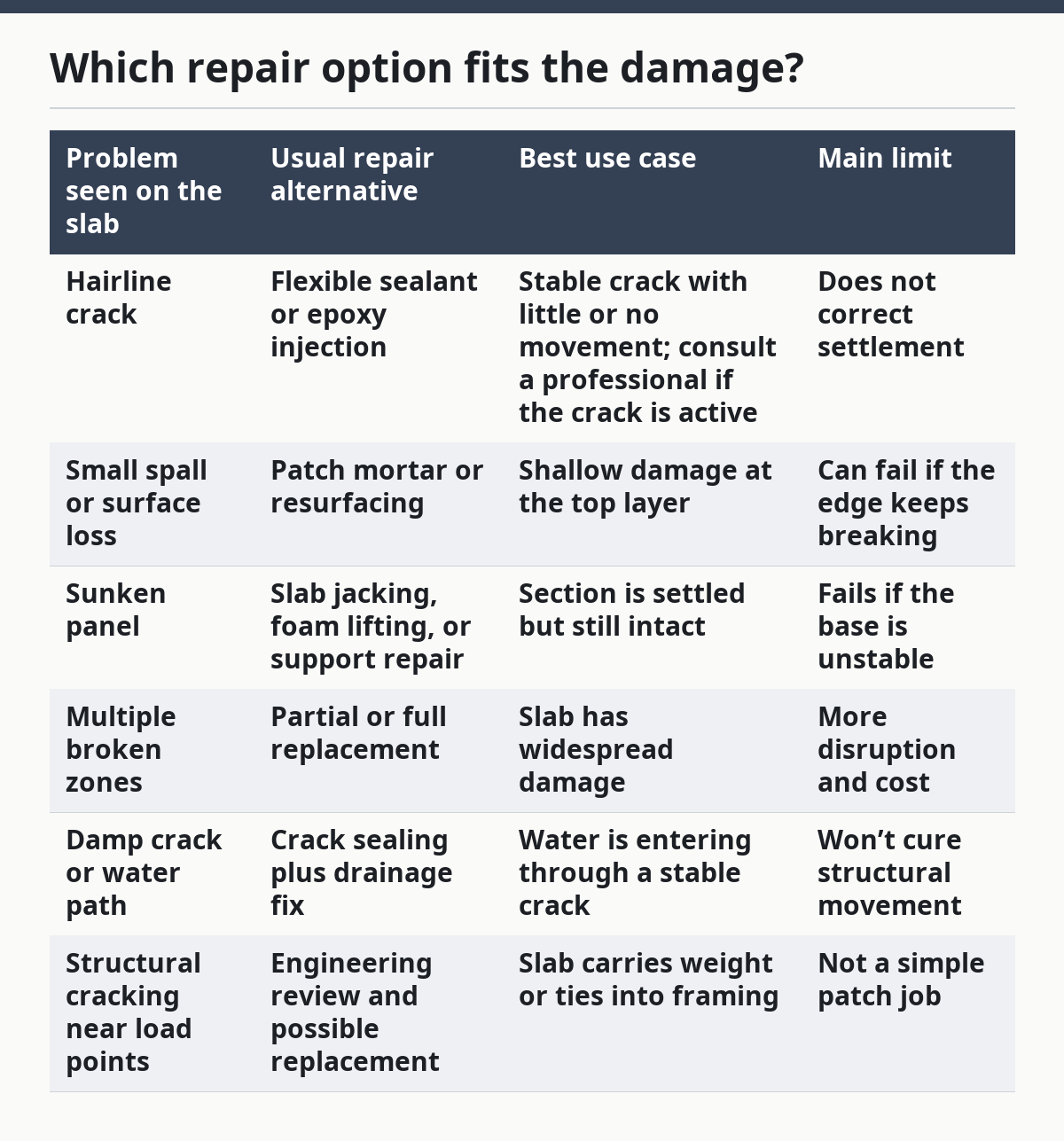
A repair alternative should match the cause, not the symptom. For example, a basement floor in a New York building with a wet crack may need sealing and water management, while a driveway panel with a dropped corner may need lifting, not patching. If the slab is part of a larger building system, the repair choice has to respect that larger system.
When does patching work, and when does it fail?
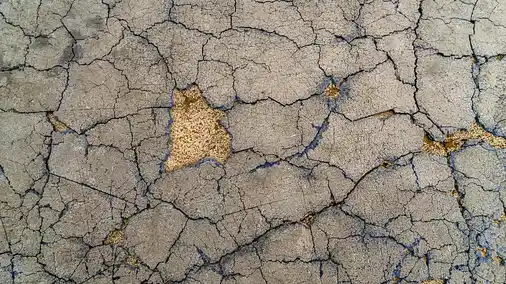
Patching works when the slab is stable and only the surface is damaged. It fails when the crack is active, the base is soft, or the edges keep breaking under traffic or vibration. In plain terms, patching is for missing concrete, not for movement.
The most reliable visual sign for patching is often a clean-edged defect with firm sides and no fresh widening, though a contractor should confirm that the slab is stable before anyone commits to the repair. The least reliable sign is a patch that sits over powdery concrete, damp concrete, or a crack that opens and closes with temperature or load. In that case, the patch can pop out, crumble, or separate at the seam.
- Clean out the damaged area. Remove loose concrete, dirt, and dust. What to check: the base should be solid, not sandy. What not to do: smear patch material over loose fragments.
- Square the edges where needed. Give the repair a shape the patch can grip. What to check: the perimeter should not be thin and feathered. What not to do: leave a razor-thin edge that will chip off.
- Check for moisture. Dry the area enough for the chosen repair material. What to check: no active seepage or standing water. What not to do: patch over a wet crack and expect it to hold.
- Choose the right material. Use patch mortar, epoxy, or a resurfacer as suited to the defect. What to check: the product matches indoor, outdoor, or structural use. What not to do: use the same mix for every slab problem.
- Fill and finish the repair. Place the material fully and level it correctly. What to check: no voids, honeycombing, or air pockets. What not to do: overwork the surface until it weakens.
- Protect the cure period. Keep traffic off the patch until it has set; if the slab will carry load, follow the product cure time or consult a professional. What to check: the repair stays intact during curing. What not to do: put weight on it too soon. Source: product manufacturer instructions and ACI repair guidance.
A patch is not the answer when the slab has a vertical offset, repeated cracking, or a soft sound underfoot that suggests a void. It is also the wrong choice when a building owner wants a cosmetic fix but the real problem is under the slab. In those cases, a contractor should explain why a surface repair would be wasted money.
What does slab leveling actually fix?
Slab leveling fixes a section that has dropped, not one that has broken apart beyond repair. The goal is to restore elevation by supporting the slab again, usually without tearing out the entire panel. That makes it useful when the concrete is mostly intact but no longer sitting where it should.
The first visible clue is a step or dip in the slab. A straightedge may show a difference across a crack, or a door may catch because the floor changed height. The key detail is the underside, not the top: if the slab has dropped because the base settled or a void opened up, lifting can make sense. If the slab is crumbling, lifting only raises a weak shell. For more on support loss and concrete movement, see the PCA repair resources and ACI guidance (PCA, ACI 224.1R).
| Leveling method | What it changes | Good fit | Drawback |
|---|---|---|---|
| Mudjacking / slab jacking | Fills below the slab and raises it | Larger settled sections with intact concrete | Can be heavier and less precise in some conditions |
| Foam lifting | Raises the slab with expanding material | Smaller or more sensitive areas | Can be the wrong match for badly broken concrete |
| Base repair before lifting | Restores support under the slab | Areas with washout or poor support | Takes more work before the slab can move back |
| Full replacement | Removes and rebuilds the section | Slab is broken, thin, or unstable | Highest disruption |
- Confirm the slab is liftable. Check whether it is intact enough to move. What to check: no major breakup or loose islands of concrete. What not to do: try to lift a slab that is already failing in pieces.
- Find the cause of the drop. Look for washout, fill settlement, or missing support. What to check: whether the low spot lines up with a drain, wall edge, or known soft area. What not to do: ignore the reason the slab moved.
- Check adjacent slabs and joints. Nearby panels may also be moving. What to check: matching height changes at seams. What not to do: level one panel without checking the rest.
- Choose the lift method. Match the method to access, slab size, and condition. What to check: whether the repair needs precision or volume. What not to do: choose by price alone.
- Set a realistic finish line. Not every slab returns to perfect grade. What to check: whether the result will be safe and usable, even if a faint line remains. What not to do: demand a cosmetic finish from a structural fix.
- Inspect after the lift. Watch for cracks opening or edges separating. What to check: whether the slab holds its new position. What not to do: walk away without confirming stability.
In a New York setting, leveling is often affected by access. Basement slabs may be tight to reach, and outside panels may sit near utility lines, stoops, or shared property edges. That does not make leveling impossible, but it does mean the safest choice depends on the site, not just the slab.
When is replacement the only honest answer?
Replacement is the honest answer when the slab has widespread failure, repeated movement, or damage that repair cannot stabilize. If the concrete is too thin, too broken, or structurally tied to other parts of the building in a way that cannot be corrected with a patch or lift, replacement stops the cycle of repeated fixes.
A replacement candidate usually shows several bad signs at once: broken edges, multiple cracks, active settlement, and failed prior repairs. The visual clue is not one neat crack; it is a network of damage. When a slab sounds hollow in several areas, or when the surface has scaled away over a wide zone, repair may only buy time.
The trade-off is cost and disruption. Replacement means more demolition, more cleanup, and more downtime. It is still the right call when the slab has become a recurring problem or when a repair would leave a weak section under load. A repair that fails in 6 months is more expensive than a replacement that lasts. For broader concrete durability and repair performance, see the PCA and ACI resources (PCA, ACI 224.1R).
- Check how much of the slab is damaged. Measure whether the problem is one panel or many. What to check: damage spread, not just depth. What not to do: treat broad failure as a small patch job.
- Identify load and function. Determine what the slab supports. What to check: vehicles, walls, equipment, or foot traffic. What not to do: assume all slabs have the same duty.
- Look for prior repairs. Repaired cracks that reopened are warning signs. What to check: whether the same line has been fixed before. What not to do: keep resealing a failing joint forever.
- Review the edge condition. Broken edges often mean the concrete is too weak to keep. What to check: crumbling sides, exposed aggregate, or separations. What not to do: rely on surface cosmetics when the edge is failing.
- Check the base and moisture source. If support is missing, the new slab needs more than a pour. What to check: drainage, fill, and subgrade condition. What not to do: pour new concrete over the same bad base.
- Decide whether the slab should be rebuilt in sections. Partial replacement can make sense when only one area failed. What to check: whether a clean cut line will isolate the problem. What not to do: remove more than needed without a reason.
Replacement is usually wrong for a simple hairline crack, a stable shrinkage crack, or a shallow cosmetic defect. It is also the wrong answer when the real issue is water intrusion that can be handled another way. A full tear-out should be the last step, not the first reaction.
How do New York building types change the repair?
New York building types change the repair because slab access, age, and ground conditions vary sharply from one structure to another. A basement in a prewar rowhouse, a sidewalk slab, a garage floor, and a high-rise service area do not fail the same way. The same visible crack can mean a different repair alternative in each setting.
The main difference is how the slab interacts with the rest of the building. In a low-rise building, a basement slab may sit over fill and be more sensitive to moisture and settlement. In a taller building, a slab may be tied to utility paths, loading areas, or structural work that makes the repair more complicated. The visual clue is whether the slab is isolated or connected to other systems. For side-by-side building context and concrete repair constraints, the PCA and ACI references remain useful (PCA, ACI 224.1R).
| New York building type | Common slab challenge | Usual exception to a simple repair | What to ask before work starts |
|---|---|---|---|
| Brownstone / rowhouse basement | Moisture, old fill, thin floor slabs | Repair is not enough if drainage is failing | Is the crack from water, settlement, or both? |
| Sidewalk / exterior panel | Freeze-thaw wear, edge breakup, lifting | Small patch may fail if the base is not sound | Is the subgrade stable and the panel eligible for repair? |
| Garage slab | Vehicle load, joint wear, corner settlement | Cosmetic patching is weak under traffic | Will the slab still support repeated loads? |
| Commercial slab | Equipment load, vibration, access limits | Repair may need staged work or engineering review | Does the slab carry point loads or machinery? |
| Basement in mixed-use building | Moisture plus service runs | Hidden utilities can limit drilling or lifting | What is below the slab before any repair begins? |
- Identify the building type. Match the slab to its setting. What to check: basement, exterior, garage, or commercial use. What not to do: use one rule for all New York slabs.
- Look for age-related wear. Older buildings often have different base conditions. What to check: old patching, settled fill, or repeated moisture marks. What not to do: assume the slab was built to modern standards.
- Check access and constraints. Tight spaces affect methods. What to check: stairs, utility chases, shared areas, and overhead limits. What not to do: choose a repair that cannot physically fit the site.
- Ask what lies below. Subsurface utilities matter. What to check: drain lines, conduits, or unknown voids. What not to do: drill or lift without confirming the layout.
- Match the fix to the load. Traffic and vibration change the answer. What to check: whether the slab sees foot traffic, carts, vehicles, or storage loads. What not to do: use a light-duty fix in a heavy-duty area.
- Confirm the repair will fit local approvals. Shared buildings can add review steps. What to check: whether the job needs building approval or coordination. What not to do: start work without confirming site rules.
This is where many generic articles miss the real problem. They talk about concrete as if every slab sits on the same ground and serves the same purpose. In New York, that is not true. The building type often decides whether repair, leveling, or replacement is the right exception to the rule.
What should a contractor explain before starting?
A contractor should explain the cause, the repair alternative, the limits of the fix, and the signs that would make the plan change. A clear explanation matters more than a quick promise. A good answer sounds specific: crack sealing for a stable crack, leveling for a dropped panel, or replacement for widespread failure.
The conversation should include time, disruption, and what could add cost. If the slab is indoors, the work may need room to dry or cure. If it is outdoors, weather can affect the schedule. If the slab is in a building with shared access, the job may take longer just to move equipment and protect nearby surfaces.
- Ask what caused the damage. A useful answer names movement, water, or wear. What to check: whether the explanation matches the visible signs. What not to do: accept a repair plan without a cause.
- Ask why this repair alternative was chosen. The answer should compare it with at least one other option. What to check: whether the choice fits the slab’s condition. What not to do: accept the cheapest option as the automatic answer.
- Ask what happens if the slab moves again. A repair that ignores future movement is incomplete. What to check: whether the plan includes monitoring or drainage fixes. What not to do: treat recurrence as impossible.
- Ask how long the work will interrupt the space. Cure time and access matter. What to check: whether the area can stay closed for the needed period. What not to do: plan around same-day use unless that is realistic.
- Ask what signs mean the job should stop. Good contractors name exceptions up front. What to check: whether hidden voids, water, or broken support would change the plan. What not to do: push ahead when the site shows a different problem than expected.
- Ask for the repair boundaries in plain terms. Know exactly what will and will not be fixed. What to check: whether nearby cracks or drains are included. What not to do: assume one repair cures the whole slab.
Cost depends on the size of the slab area, the repair method, site access, and how much preparation is needed. A simple seal may be far less involved than a lift or replacement, but the least expensive option is not always the best one if the slab is still moving. Time also varies with curing and access; a job that looks small can still take more than one visit if the base needs work first.
A bad job usually leaves clues. The patch sits proud or low, the crack reopens quickly, the surface scales again, or the repaired area feels uneven underfoot. In a building setting, another warning sign is a contractor who gives a one-size-fits-all answer without looking at the slab’s movement, moisture, and load.
What exceptions should stop a normal repair?
A normal repair should stop when the slab is part of a structural problem, when water is still entering the area, or when hidden conditions make the work unsafe or pointless. These exceptions matter because a neat finish can hide a deeper failure for a short time without fixing it.
The most common exception is active settlement. If the slab keeps moving, sealing or patching may only delay the next crack. Another exception is repeated moisture entry from below, beside, or through the slab. A repair can close the surface, but if the source stays open, the damage usually comes back.
| Exception | Why it matters | Better next step |
|---|---|---|
| Active settlement | The slab keeps changing position | Investigate support and consider leveling or replacement |
| Persistent moisture | Water defeats many surface repairs | Find and fix drainage or seepage first |
| Structural cracking | The slab may be carrying load | Get an engineering review before repair |
| Hidden utilities | Drilling or lifting can cause damage | Locate lines before any invasive work |
| Widespread breakup | The concrete is no longer sound | Replace the damaged section instead of patching |
- Stop if the crack is still changing. A moving crack is not a stable repair target. What to check: whether the ends have extended or the gap has widened. What not to do: seal a live crack and call it done.
- Stop if water is still entering. The source must be addressed first. What to check: dampness, seepage, or recurring stains. What not to do: hide water with a cosmetic patch.
- Stop if the slab sounds hollow in large areas. That can signal poor support. What to check: whether several spots give a hollow sound, not just one. What not to do: ignore a widespread base problem.
- Stop if nearby structures show movement too. The slab may not be the only issue. What to check: cracks in walls, misaligned doors, or separated joints. What not to do: isolate the slab from the rest of the building.
- Stop if the repair would hide a safety issue. A neat surface is not a safe system. What to check: whether traffic or load would still be unsafe. What not to do: put appearance ahead of function.
- Stop if access makes the method risky. Tight sites need the right approach. What to check: whether the equipment can fit without damage. What not to do: force a method that does not suit the site.
This is the part that generic guides often miss: exceptions are not rare. They are the reason many slab jobs fail when they should have been redirected earlier. A careful repair plan knows when to stop, when to shift methods, and when the slab needs more than repair.
How do you tell a good result from a bad one?
Because the slab has already been repaired, the best result looks stable, level enough for its use, and quiet under load. A bad result shows fresh cracking, loose edges, visible ridges, damp spots, or a patch that looks like it was pasted on rather than integrated. The eye can tell a lot if the repair was done with the right method.
The key detail is the transition line. A clean repair usually blends into the slab without a sharp lip, crumbly edge, or open seam. If you can catch a shoe on the edge, or if the repaired zone looks softer or brighter than the surrounding concrete in a way that suggests a weak bond, the finish may not hold. The visual difference between a sound repair and a poor one is often only a few millimeters, but that small difference matters.
A good result also matches the slab’s job. A basement floor can have a plain, durable finish if it stays dry. A driveway or garage slab needs a repair that tolerates traffic. A commercial floor may need to hold up under vibration and repeated loading. The finish should fit the use, not just the photo.
- Walk the repaired area slowly. Feel for ridges or soft spots. What to check: level changes underfoot. What not to do: judge only from a distance.
- Look at the edges in side light. Small flaws show up at an angle. What to check: chips, shadows, and seam lines. What not to do: inspect only straight down.
- Check for recurring stains. Moisture is a warning sign. What to check: whether the same damp mark returns after drying. What not to do: assume one dry day means the problem is gone.
- Watch the repair line over time. Stability matters more than the first look. What to check: whether the crack reopens after load or weather change. What not to do: judge success on the same day only.
- Compare the repaired area to the rest of the slab. The fix should fit the whole floor. What to check: color, texture, and height consistency. What not to do: accept a repair that stands out for the wrong reasons.
- Confirm the site is usable again. The final test is function. What to check: whether traffic, storage, or foot use can resume safely. What not to do: reopen the area before it is ready.
The honest answer is that some repairs will always be visible. That does not make them bad. The real test is whether the slab is safe, level enough, and stable enough for its use. If the repair hides the problem but does not solve it, the result is poor no matter how smooth the top looks.
What are the most common FAQs about concrete slab repair alternatives and exceptions?
Should every crack in a concrete slab be sealed?
No, every crack should not be sealed automatically. A stable hairline crack may be a good seal candidate, but a crack that is still moving, widening, or tied to settlement needs a different plan first. Sealing a live crack can hide the symptom without fixing the cause. If the crack is part of a larger movement pattern, consult a professional and review ACI’s cracking guidance (ACI 224.1R).
Is slab jacking better than replacement?
No, slab jacking is not always better than replacement. It works best when the slab is still in one piece and has simply lost support below it. If the concrete is broken apart, crumbling, or structurally compromised, replacement is usually the safer answer.
Can a patch fix a sinking slab?
No, a patch cannot fix a sinking slab by itself. A patch repairs the surface, while sinking usually points to missing support under the slab. The slab needs lifting, base repair, or replacement depending on how far the movement has gone.
Why does a repaired slab crack again?
A repaired slab cracks again when the cause was never removed. Common reasons include continued settlement, moisture, traffic load, or a weak base. A repeat crack is a sign to step back and inspect the system, not just the surface line.
When should a New York building get a deeper review?
A deeper review makes sense when the slab is in a basement, garage, sidewalk, or shared building area and the damage is not local. Older construction, tight access, and hidden utilities can change the repair choice. If the slab movement affects walls, doors, or adjacent panels, the problem is bigger than a surface defect.
Drafted with AI; not yet reviewed by a person.