What New York Tree Roots Can Do to Nearby Concrete Slabs

Last updated: November 20, 2026
Quick Answer: In New York, tree roots can lift, crack, and tilt concrete slabs, and a slab that sits only a few feet from a mature tree is at higher risk. This page explains what What New York Tree Roots Can Do to Nearby Concrete Slabs looks like, what the damage means, and when to call a professional for an on-site look.
Tree root intrusion can lift, crack, and tilt concrete slabs near sidewalks, patios, and driveways in New York. This page explains what roots do, what the damage looks like, and how to tell when a slab needs repair or replacement.
What tree roots actually do to a slab
Picture this: you have a sidewalk panel or patio slab that looks fine from a few feet away, then one edge starts rising and a crack runs through the middle. Tree roots can push under concrete, steal support from the soil, and make a slab move where it used to sit flat.
The direct answer is simple: tree roots can raise, split, and shift nearby concrete slabs when the slab sits over active root growth or drying soil. They do not usually “grow through” strong concrete like a drill bit. They press from below, follow weak spots, and take advantage of joints, gaps, and already stressed sections.
Here’s the catch: the damage can take different shapes. A sidewalk panel may heave at one corner. A patio slab may show a long crack with one side a little higher than the other. A driveway edge may break where roots meet thin concrete or a bad base.
- Root pressure can push a slab upward.
- Root growth can widen existing cracks.
- Soil drying around roots can make support uneven.
- Shallow slabs are easier to affect than thick, well-built concrete.
This is where New York matters. In older neighborhoods, many slabs sit under mature street trees, small front-yard plantings, and tight planting strips. That means roots often run close to concrete even when the tree trunk is several feet away. Seasonal movement in cold weather can make those changes easier to notice, which is why the hub on New York slab conditions and weather factors belongs with this topic.
How close tree roots need to be to cause trouble
Tree roots can affect a slab even when the trunk is not right next to it. Fine roots spread far beyond the drip line in search of water and oxygen, and the largest roots usually stay in the upper soil where concrete foundations and slab edges also sit.
The first clue is distance plus time. A young tree with a small root system may do little for years. A mature tree near a 4-inch patio slab or a 4-inch sidewalk panel is a different story, especially if the soil is already shallow, compacted, or dry.
A beginner usually wants a simple rule. There isn’t one that fits every tree and every yard, but these patterns hold up:
- Trees planted closer than a few feet to a slab are the most likely to create lift.
- Slabs over thin, poorly compacted base material fail faster.
- Roots often follow the path of least resistance, including seams, voids, and edges.
- A slab beside a curb, retaining edge, or planting strip has a higher risk than one in open yard space.
On the other hand, distance alone does not guarantee safety. I’ve seen roots influence concrete well beyond the obvious canopy line when the soil stays moist near the tree and dry near the slab edge. That matters in New York, where street trees, compacted urban soil, and freeze-thaw cycles can all amplify movement.
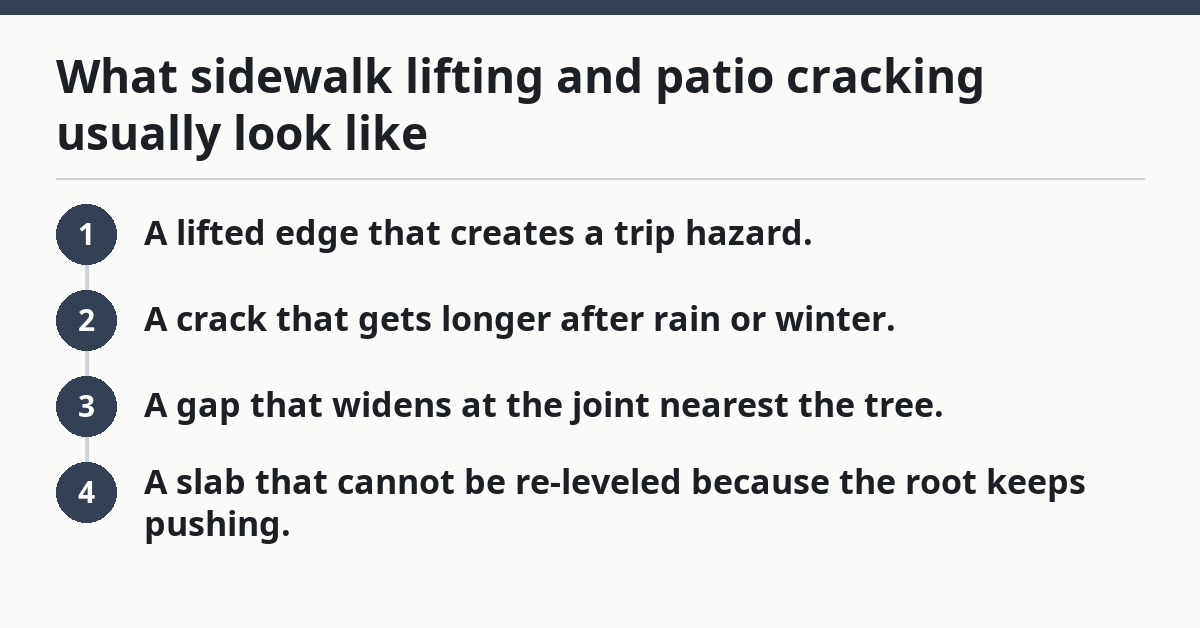
What sidewalk lifting and patio cracking usually look like
Tree roots usually show themselves in one of three ways: heaving, cracking, or edge displacement. The pattern matters because each one points to a different kind of pressure under the slab.
Picture a sidewalk panel that tips up at one end by less than an inch. That may look small, but it can create a trip edge, catch snow shovels, and spread into a larger break when winter freeze-thaw hits. A patio slab may crack across the middle and stay almost level for a while, then one side begins to rise as the root expands or the soil shifts.
Common signs include:
- A raised joint between two slabs
- A crack that runs from a corner or seam
- One slab edge sitting higher than the next panel
- A panel that rocks slightly when stepped on
- Cracks that reopen after patching
The truth is, not every crack comes from roots. But root-driven damage often follows the shape of the root path. If the lift is near a tree and the affected slab is 3 to 5 feet from the trunk or planting strip, roots move higher on the suspect list. If the damage is all over the slab field with no nearby tree, the cause may be different.
Bad signs in a sidewalk or patio:
- A lifted edge that creates a trip hazard.
- A crack that gets longer after rain or winter.
- A gap that widens at the joint nearest the tree.
- A slab that cannot be re-leveled because the root keeps pushing.
Why New York soil and weather make root damage worse
Tree roots and concrete slabs in New York deal with a rough mix: compacted soil, salt, cold, and repeated wet-dry swings. That combination can turn a small root conflict into visible slab movement faster than in milder places.
The direct answer is that freeze-thaw cycles and urban soil conditions can make root-related slab damage easier to spot and harder to ignore. When soil freezes, expands, thaws, and settles, small gaps open under concrete. Roots can then occupy that space, hold moisture, or push into weakened edges.
Picture a front walk built over dense, disturbed fill soil. One winter, water works into a hairline crack, freezes, and widens it. By spring, a nearby root has more room to move, and the slab edge no longer sits flush. That is not the same as classic settlement, but it can look similar to a homeowner staring at a crooked panel.
A few New York-specific conditions matter:
- Cold weather can widen small flaws.
- Road salt can speed surface wear and joint damage.
- Urban fill soil often drains unevenly.
- Mature street trees are common near sidewalks and narrow front yards.
On a practical level, this means a slab near a tree in New York may fail faster than the same slab in a looser suburban setting. The soil under it already has less margin for movement. For more on weather effects, see the NY slab conditions and weather factors page and the NYC street tree guidance from the Parks Department.
How to judge whether roots are the likely cause
Tree roots are the likely cause when the slab damage tracks the tree, the root zone, and the slab edge all at once. That is the pattern I look for first when somebody asks about a lifted sidewalk or cracked patio.
The easiest way to sort it out is to work through the area in order. This is not a repair method; it is a quick check that helps you explain the problem to a contractor without guessing.
- Stand back and map the damage. Note which slab is moving, which edge is higher, and whether the crack follows a joint or cuts straight across the panel.
- Measure the distance from the tree trunk or planting strip to the damaged slab. A few feet matters more than most people expect.
- Look for root-related clues at the soil line: raised ground, roots exposed at the edge, or soil that seems packed up against one side of the slab.
- Check nearby slabs. If the movement is concentrated in one path, root pressure is more likely than general wear.
- Watch the area after a heavy rain or a freeze-thaw stretch. If the same edge keeps moving, the problem is active, not just cosmetic.
A bad fit for this check is a slab that has sunk evenly across its whole surface or one that sits in an area with no nearby tree. That kind of movement can point somewhere else. This page stays focused on root intrusion, not on settlement diagnosis, so if the pattern is unclear, consult a qualified contractor or arborist and use the NYC Parks tree service guidance as a starting point.
What a contractor should look for before any repair
A contractor should look at the slab, the tree, the soil, and the joint layout before recommending a fix. If someone wants to patch a root-damaged slab without checking those four things, the repair may fail fast.
The first sentence a homeowner should hear is this: the cause has to be identified before the slab is cut, lifted, or replaced. Cutting concrete around an active root without a plan can worsen the damage or shorten the life of the repair.
Ask for a simple, plain-English assessment of:
- Whether the movement is from root pressure or another cause
- Whether the slab can be cut and reset
- Whether the root is likely to keep pushing
- Whether nearby landscaping will be affected
Here’s the catch: root work and slab work often affect each other. If the tree is healthy and close to the slab, the contractor may need to choose between partial concrete repair, root pruning in limited areas, or full replacement with a better base. None of those options is free of trade-offs. A quick patch can be the cheapest today and the costliest next season.
You should also expect the contractor to explain what a bad job looks like. If the slab is reset without fixing the pressure point, the same joint can reopen. If the concrete is replaced without improving the base, the new slab may crack along the same line. For standards-based guidance, see the ANSI A300 tree care standards and the International Society of Arboriculture resources.
What to ask before you hire anyone
The right questions save money because they separate a real slab problem from a guess. A contractor who works around roots should be able to answer in plain terms, not just point at the concrete and say “it’s bad.”
Ask these questions:
- What makes you think this is root intrusion and not another soil problem?
- Will the repair address the root pressure, or only the broken concrete?
- What will happen to the tree and nearby soil during the work?
- What does success look like after one season, not just after one day?
- Do you expect the same slab to move again?
The best part is that good answers are usually short and specific. If somebody needs 20 minutes to avoid saying whether the root is still active, that is a warning sign.
A second useful question is about timing. In New York, some slab problems are easier to assess after winter or during a dry spell, when the movement is easier to see. That does not change the cause, but it can change how confident the diagnosis is. For a practical yard check, compare the slab against local tree guidance from the NYC Parks Department and the U.S. Forest Service.
How this differs from simple wear or soil settling
Tree root intrusion usually leaves a pattern; normal wear and simple settlement usually leave a different one. That distinction matters because the wrong fix wastes money and leaves the slab unstable.
A root-damaged sidewalk or patio often shows localized lift near a tree, a crack that follows the pressure path, or a joint that closes up on one side and opens on the other. A slab that settles for other reasons may sink more broadly, with less obvious root involvement. This page does not try to diagnose settlement, but the shape of the damage tells you a lot, and if the cause is unclear you should consult a professional before deciding on repair.
Three signs point more toward roots:
- The problem sits next to a tree or planting strip.
- The slab edge rises instead of simply dropping.
- The damage seems to follow the same line each season.
One sign points away from roots: damage spread evenly across the slab field with no nearby tree influence. In that case, soil support, drainage, or base failure may be the larger issue.
The practical takeaway is simple. If the slab is moving near a tree in New York, root intrusion belongs near the top of the list. If the slab is sinking, the answer may be different, and that needs its own look. For more background, see the NYC Parks street tree guidance and the USDA Forest Service urban tree resources.
Key Takeaways
- Tree roots can push concrete up, crack it, and tilt it, especially near sidewalks and patios.
- The risk rises when a slab sits close to a mature tree, compacted soil, or a weak base.
- In New York, freeze-thaw cycles and urban soil conditions can make the damage show up faster.
- The shape of the crack or lift matters more than the crack itself.
- A repair that ignores the root pressure is a short-term fix, not a real solution.
FAQ
Can roots cause settlement as well as heaving?
Tree roots are more likely to cause heaving than true settlement. Heaving happens when roots push the slab up or shift the soil under an edge, while settlement usually means the ground underneath has lost support and dropped. The two can look similar at first, so the slope and crack pattern matter.
Which trees are most likely to affect slabs?
Trees with aggressive, shallow root systems are the ones most likely to affect slabs. Large, mature trees planted close to a sidewalk or patio are the biggest risk, especially when the soil is tight and the concrete is thin. The species matters, but the distance and site conditions matter too.
How close is too close for tree roots near concrete?
Too close is any distance where roots can reach the slab edge and keep pressing against it. For many problem cases, that means a tree planted only a few feet from a sidewalk or patio, especially in compacted New York soil. The exact risk depends on tree size, root spread, and slab construction.
Drafted with AI; not yet reviewed by a person.