What Warranties Usually Exclude in Concrete Slab Lifting Agreements

Last updated: November 20, 2026
Key Takeaways
- A slab lifting warranty usually leaves out what keeps moving after repair, especially drainage, soil change, and new structural movement.
- A slab lifting warranty usually does not cover problems tied to conditions outside the lifting work, especially water, soil movement, and new loading.
- A slab lifting warranty is easiest to read when you trace what is covered, what is excluded, and what counts as a claim.
- Pre-existing cracking usually means the crack was already there when the lift was sold, and the warranty may exclude it even if the slab is part of the same repair.
Concrete slab lifting warranties usually exclude pre-existing damage, drainage problems, new settlement, and movement caused by soil or structure changes. In What Warranties Usually Exclude in Concrete Slab Lifting Agreements, the exclusions matter more than the promise because they tell you what the contractor won’t fix later. This guide breaks down the warranty language, the common carve-outs, and the red flags that change coverage.
What a slab lifting warranty usually leaves out
A slab lifting warranty usually leaves out the things that keep moving after the repair, especially drainage, soil change, and new structural movement. That means the lifted slab may be covered only for the work performed, not for what happens if the ground keeps washing out or the building shifts again.
Picture this: you’re comparing two proposals, and both say “warranty included.” One covers the injected material; the other sounds broader, but the exclusions section quietly removes the issues that cause most callbacks. That is the part to read first.
The truth is, a warranty in this trade often protects the installer’s repair, not the entire slab system. A 10-year promise can still exclude the exact conditions that make concrete move again.
Common exclusions usually include:
- Existing cracks that were already there before the lift
- Void repair limits when the soil under the slab keeps eroding
- Drainage defects from gutters, downspouts, grading, or broken pipes
- New damage from traffic, added loads, or nearby construction
- Temperature-related surface cracking that is cosmetic only
If you want a broader buying picture, the hub on [estimating, pricing, and buying decisions — The Complete Guide] can help with the bigger decision before you sign anything. For warranty terms, the U.S. Federal Trade Commission explains that written warranties should be clear about what is covered and what is excluded. See the FTC’s guidance on warranties and service contracts.
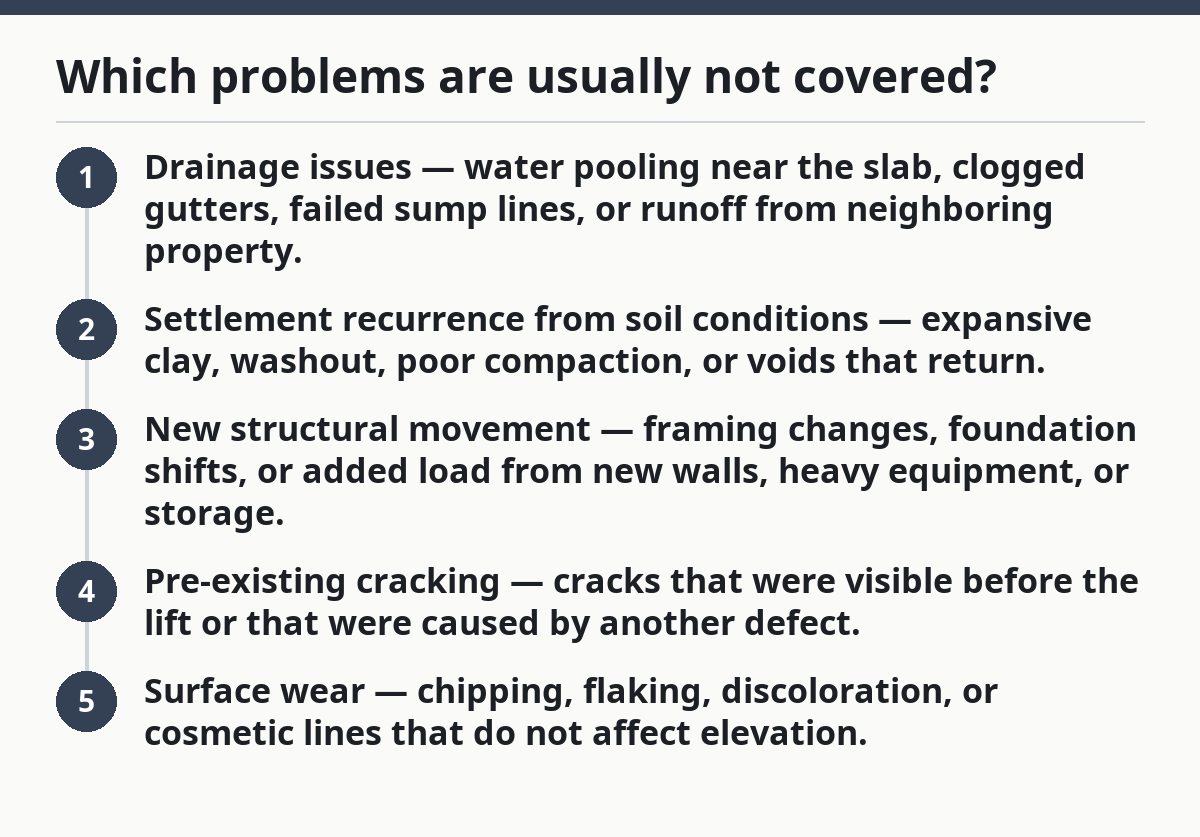
Which problems are usually not covered?
A slab lifting warranty usually does not cover problems tied to conditions outside the lifting work, especially water, soil movement, and new loading. Those are the three most common reasons a slab moves again after the repair.
Picture this: you fix a sunken walkway, then the downspout keeps dumping water beside it through the next storm season. The slab moves again, and the warranty letter points straight to drainage. That is not a surprise to the contractor.
Here’s the catch: many exclusions are written to separate the repair from the cause of the failure. If the cause stays in place, the warranty often stops short.
Typical exclusions include:
- Drainage issues — water pooling near the slab, clogged gutters, failed sump lines, or runoff from neighboring property.
- Settlement recurrence from soil conditions — expansive clay, washout, poor compaction, or voids that return.
- New structural movement — framing changes, foundation shifts, or added load from new walls, heavy equipment, or storage.
- Pre-existing cracking — cracks that were visible before the lift or that were caused by another defect.
- Surface wear — chipping, flaking, discoloration, or cosmetic lines that do not affect elevation.
A plain-English rule helps: if the problem is “the ground moved again,” the warranty often says no. If the problem is “the contractor’s lift failed to hold under normal conditions,” coverage is more likely to be in play. The wording decides the line between those two things.
How to read slab lifting warranty exclusions line by line
A slab lifting warranty reads best when you trace three items in the contract: what is covered, what is excluded, and what counts as a claim. Those three sections decide whether the paper is useful or just decorative.
Picture this: you’re at the kitchen table with the estimate, and the language keeps switching from “slab” to “area” to “repair zone.” That kind of drift is where exclusions hide. A clean warranty uses plain boundaries and names the work area in concrete terms.
Use this check in order:
- Find the coverage trigger. Look for the exact phrase that starts the promise, such as “material and workmanship” or “lifted sections only.” That tells you what the contractor actually stands behind.
- Mark every exclusion. Circle anything mentioning drainage, soil, settlement, drainage, structural movement, cracks, or weather. Those words usually narrow the promise fast.
- Check the time language. Some warranties run for 1 year, 5 years, or longer, but the period means little if the exclusions are broad.
- Look for conditions the owner must keep. If the warranty requires working gutters, positive grading, or no added load, that is a maintenance condition, not a casual suggestion.
- Confirm the claim process. A warranty that requires written notice, access to the slab, or proof of maintenance can be harder to use if you miss the deadline.
One contract habit saves trouble: ask whether the warranty covers the same area or the same symptom. Those are not the same thing. A crack near the lift might be covered if it’s tied to workmanship, but excluded if it comes from later settlement or water.
What pre-existing cracking means in a warranty
Pre-existing cracking usually means the crack was already there when the lift was sold, and the warranty may exclude it even if the slab is part of the same repair. That matters because slab lifting can stabilize elevation without erasing every line in the concrete.
Picture this: you point to a visible crack near the garage slab and assume the warranty will cover it if it opens later. The contractor may say the crack pre-dated the work, so the warranty only applies to the lift, not the crack itself.
That distinction is normal. A lift corrects level; it does not always return the slab to a newly poured condition. A 3-foot crack, a hairline crack, and a crack with displacement are not treated the same way in the contract, so consult a professional and review the written terms carefully.
Watch for these phrases:
- “Existing cracks are excluded”
- “Cosmetic cracking not covered”
- “Crack repair separate from lift warranty”
- “No coverage for movement at repaired control joints”
The practical risk is simple. If you skip documenting crack locations before the job, the dispute later becomes one person’s memory against another’s paperwork. Photos with a date stamp, a marked sketch, or a written note in the work order can settle that before the concrete is even pumped.
This is one of the places where a generic article gets the story wrong. It sometimes treats all cracks as proof of failure. In real warranty language, the crack may be evidence of an older problem, a new problem, or nothing more than a surface mark, so consult a professional and rely on the contract.
Does a warranty cover new soil movement?
A slab lifting warranty usually does not cover new soil movement unless the contract says it does in plain terms. New movement is often treated as a fresh cause, not a defect in the original lift, so consult a professional and read the claim language carefully.
Picture this: your patio looked good after the repair, then a season of heavy rain or a broken sprinkler line changes the ground under one corner. The slab shifts again. That is exactly the kind of event many exclusions are built to avoid.
The best way to read this clause is to separate repeat settlement from new settlement. Repeat settlement suggests the original fix didn’t hold. New settlement suggests the site changed after the repair because of water, grading, tree roots, plumbing leaks, or nearby digging.
Common language that limits coverage includes:
- “Movement due to site conditions”
- “Soil changes outside contractor control”
- “Damage from drainage, irrigation, or plumbing leaks”
- “Settlement caused by new construction or excavation”
If the contract names drainage, take it seriously. Water is the most common reason a repaired slab moves again, and a warranty may place that risk on the owner if the source is outside the work area.
On the flip side, some agreements do cover a return visit if the same repaired section drops because the lift material failed under normal use. That is a narrower promise, and the exact wording matters more than the sales pitch. According to the International Association of Certified Home Inspectors, drainage and grading problems are common contributors to concrete movement.
Transferability and other limits that can shrink the promise
A slab lifting warranty often becomes weaker when the property changes hands, the slab is altered, or the owner skips maintenance conditions. Transferability is one of the first things to check, because a warranty that dies with the first owner may be worthless to a buyer.
Picture this: you sell the house, the new owner notices the same slab edge settling, and the contractor says the warranty was never transferable. That is a common limit, and it should be spelled out in the paper before the job starts.
Look for these restrictions:
- Transfer fee or written transfer requirement
- One-time transfer only
- Proof of maintenance before transfer
- No transfer after sale date
- Coverage voided by alteration of the slab or adjacent structure
There are two other limits that matter just as much. First, many warranties exclude work done by other contractors after the lift. Second, many exclude damage from loads or changes that were not part of the original use, such as a heavier vehicle, new storage, or added equipment.
A warranty can also be limited to the specific slab panel that was lifted. If a neighboring panel settles, that may be a separate claim. That detail sounds small until you need a repair and discover the promise only applied to one section, not the whole driveway.
The right question is not “Is there a warranty?” It is “What exact part of the slab, for how long, under what conditions, and for whom?”
What to ask before you rely on the warranty
A slab lifting warranty is only useful if the exclusions are narrow enough that the promise still means something. If the answer to every likely failure is already excluded, the warranty is little more than a receipt.
Picture this: you’re reading the contract in a 15-minute window before signing, and you want the parts that really matter. Ask about the things that usually cause a second repair, not the parts that sound nice in the pitch.
Use these questions:
- Does the warranty cover settlement recurrence in the same area?
- Are drainage problems excluded even if they are minor?
- Are pre-existing cracks excluded by name?
- What counts as new structural movement?
- Is the warranty transferable, and if so, under what steps?
- Does the warranty cover the material, the labor, or both?
A useful contract usually gives you one thing in writing: the repair scope. A weak one gives you broad words and narrow exceptions. That difference shows up when a slab starts to move again after a wet month or a freeze-thaw season.
If the proposal is vague, ask for the exclusions to be listed in the same document as the warranty term. A separate brochure is easier to lose and easier to dispute. The contract should stand on its own.
For a deeper comparison of pricing and purchase choices, the hub page on [estimating, pricing, and buying decisions — The Complete Guide] is the better next stop. The FTC also advises consumers to keep the warranty document and the purchase record together in case a claim is needed later.
What is usually not covered by a concrete leveling warranty?
A concrete leveling warranty usually does not cover drainage problems, pre-existing cracks, or new movement caused by soil changes after the repair. It often excludes cosmetic flaws, added loads, and damage from plumbing leaks or nearby construction. The exact wording matters, but those are the exclusions that show up most often in slab lifting agreements.
Does a warranty cover new soil movement?
A warranty usually does not cover new soil movement unless the contract says it does in plain language. If the slab shifts because the ground changed after the repair, many agreements treat that as a new condition rather than a failed lift. Water, grading, and excavation are common causes of that exclusion.
Drafted with AI; not yet reviewed by a person.