Last updated: November 20, 2026
Quick Answer: In the topic of How to Tell If a Concrete Slab Is a Good Candidate for a Simple Lift or Needs Structural Repair, a slab is usually a simple-lift candidate when the settlement is only surface-level and the concrete is still sound; if you see spalling, exposed rebar, or soil failure, structural repair is more likely.
A concrete slab with surface settling only is often a lift candidate, but spalling, exposed rebar, and soil failure usually point to structural repair instead.
This guide shows the signs that separate a simple lift from a deeper fix, so you know what to ask before you call a contractor.
Key Takeaways
- A lift can help when the slab is still sound and the problem is mainly uneven support.
- Edge breakage, wide cracks, and exposed steel usually mean the slab has lost strength.
- Soft, washed-out, or pumping soil can make lifting a short-lived fix.
- A slab that rocks, drops in one corner, or keeps moving after rain needs more than a fill-and-raise job.
- The repair choice depends on the slab’s condition, not just how far it has sunk.
What a simple lift can fix, and what it cannot
Picture this: you’re looking at a driveway, sidewalk, patio, or garage slab that sits lower on one side, and you want the fastest fix that will actually hold. A simple lift works best when the concrete is still structurally intact and the problem is mainly loss of support under the slab.
That usually means the slab is a good candidate when the surface is intact, the cracks are narrow, the edges still line up, and the concrete is not breaking apart. If the slab has spalling, crumbling corners, or steel showing through, lifting alone can hide the height problem but leave the failure in place.
In simple terms, lift the slab when it has settled; repair the slab when it has failed. A lift can restore grade. It cannot rebuild concrete that has already lost its strength. Concrete repair guides from organizations like the Portland Cement Association and the American Concrete Institute discuss this same split between support loss and material failure. For related background, see concrete slab repair options and slab lifting methods. The American Concrete Institute’s concrete repair guidance and the PCA’s repair resources are useful starting points too.
- Good lift candidate: level difference with solid concrete.
- Bad lift candidate: broken concrete, loose chunks, exposed rebar.
- Borderline case: a slab with one cracked section and stable soil below.
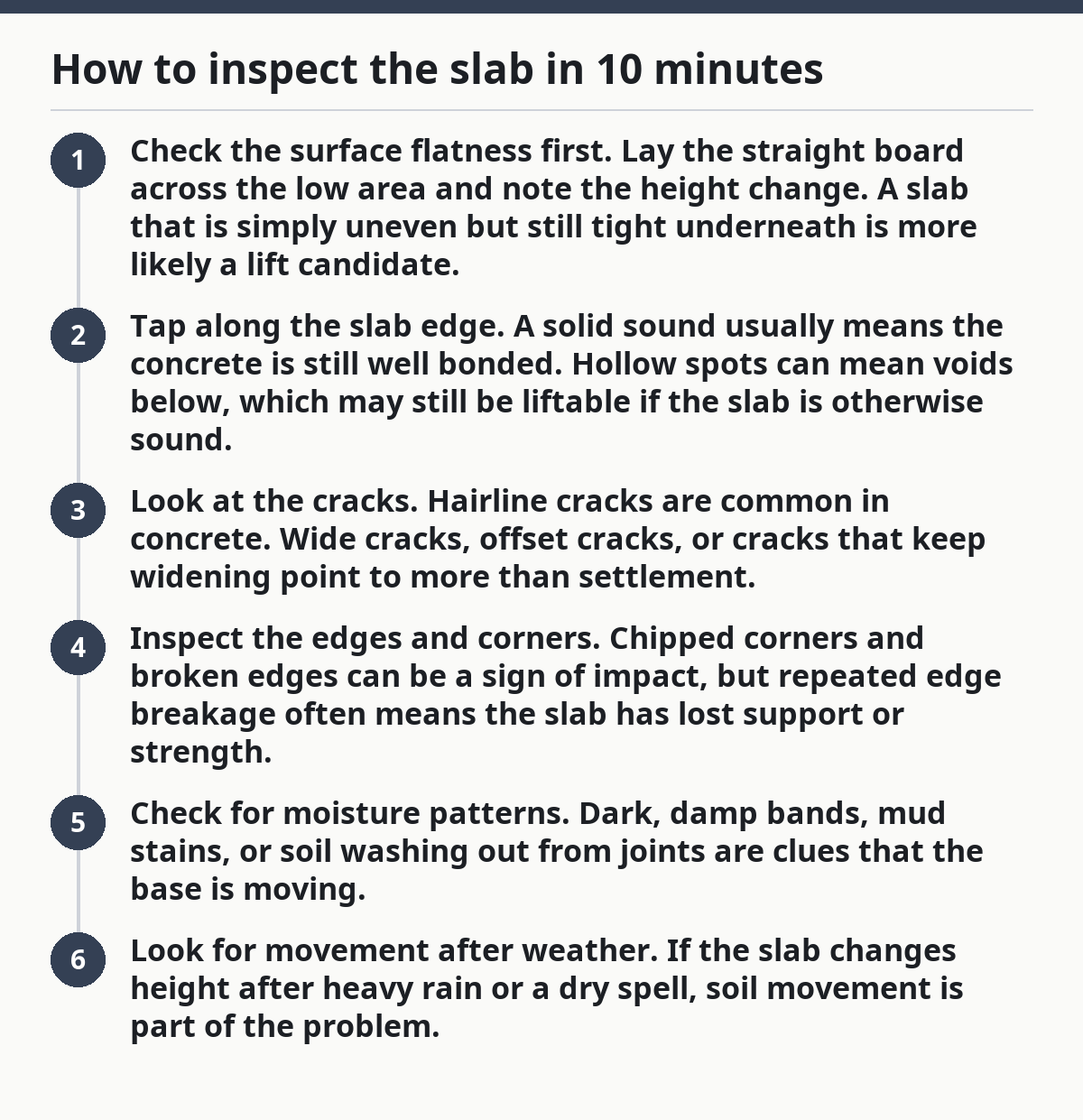
How to inspect the slab in 10 minutes
You can sort many slabs with a fast, careful check before anyone quotes the job. Start with a flashlight, a tape measure, and a straight board or level about 4 feet long. Look at the slab dry, then again after rain if possible.
The goal is not to diagnose everything on sight. The goal is to tell whether you’re seeing a support problem, a concrete problem, or both. If the damage is unclear, consult a qualified concrete repair professional and refer to manufacturer or industry guidance such as the American Concrete Institute’s repair documents.
- Check the surface flatness first. Lay the straight board across the low area and note the height change. A slab that is simply uneven but still tight underneath is more likely a lift candidate.
- Tap along the slab edge. A solid sound usually means the concrete is still well bonded. Hollow spots can mean voids below, which may still be liftable if the slab is otherwise sound.
- Look at the cracks. Hairline cracks are common in concrete. Wide cracks, offset cracks, or cracks that keep widening point to more than settlement.
- Inspect the edges and corners. Chipped corners and broken edges can be a sign of impact, but repeated edge breakage often means the slab has lost support or strength.
- Check for moisture patterns. Dark, damp bands, mud stains, or soil washing out from joints are clues that the base is moving.
- Look for movement after weather. If the slab changes height after heavy rain or a dry spell, soil movement is part of the problem.
If the slab passes most of these checks, it may be a decent candidate for a simple lift. If it fails two or more, especially with visible damage, the scope is probably larger than leveling.
What edge breakage and spalling are telling you
Edge breakage and spalling are signs that the concrete itself is starting to fail, not just the soil under it. That is the detail many generic articles miss. A slab can be sunken and still repairable by lifting. Once the edges are breaking off or the top layer is flaking away, the concrete has started to give up.
Spalling often shows up as chipped patches, rough exposed aggregate, or thin layers peeling from the face of the slab. Edge breakage shows up as missing corners, broken steps at joints, or sections that crumble when touched. Either one can come from freeze-thaw cycles, water intrusion, or old poor finishing, but the result is the same: the slab has less usable material left.
That matters because a lift only changes elevation. It does not restore thickness, bond, or surface strength. If a slab has a 1-inch or 2-inch lip at a broken edge, a simple lift may line it up, but the weak edge can keep breaking under wheel loads or foot traffic.
Here’s the catch:
- Small chips only: often still liftable.
- Repeated edge loss: usually a repair job.
- Spalling with soft concrete: not a lift-only job.
- Large broken areas near joints: often need section repair or replacement of the damaged area.
If you see spalling near a garage door, driveway apron, or walkway joint, ask what repair method will protect the edge after the slab is raised. Otherwise the same failure can return in a few seasons.
Is exposed rebar a line you should not cross?
Yes, exposed rebar usually means the slab needs structural repair, not just a simple lift. Rebar showing at the surface means the concrete cover has broken down enough that the steel is no longer protected the way it was meant to be.
Once steel is exposed, moisture and air can reach it. That can lead to corrosion, which expands the bar and cracks the surrounding concrete further. Even if the slab is raised to the right height, the damaged zone around the steel can keep spreading.
A slab with exposed rebar can still be saved in some cases, but the repair scope changes. The contractor may need to remove loose concrete, clean or treat the steel, rebuild the damaged section, and then deal with the grade problem; consult a qualified professional before assuming the slab can be lifted. That is a different job from a basic lift, and the American Concrete Institute and PCI resources on repair and corrosion are relevant starting points.
Watch for these warning signs:
- rust stains running from a crack or edge
- concrete split along the line of the steel
- flaking or hollow-sounding areas around the exposed bar
- repeated breakage at the same spot after past patching
A good rule: if you can see rebar, you are no longer looking at a simple surface problem. On a slab that carries vehicles or supports a step, that matters even more because load transfer depends on intact concrete around the steel.
How soil failure changes the repair choice
Soil failure can make a lift fail quickly, which is why the ground under the slab matters as much as the concrete itself. If the base has washed out, shrunk, or never been compacted well, the slab may settle again even after it is lifted.
Look for soil clues around the slab edges and joints. Mud pumping, voids at the perimeter, erosion channels, and soil that feels soft or wet after several dry days all point to support loss. In some areas, expansive clay makes this worse because the soil swells when wet and shrinks when dry. That movement can open gaps under the slab and keep changing its level. The USDA NRCS explains how expansive soils move with moisture, and the U.S. Army Corps of Engineers also discusses soil and drainage effects on foundation performance.
A simple lift can still make sense if the slab is otherwise sound and the support loss is limited. But if the soil is unstable, the fix may need base repair, drainage correction, or section replacement along with the lift. Otherwise you are just resetting the slab over the same bad ground.
The truth is, soil failure is the reason many “quick fixes” don’t last. A slab that drops every spring or after every storm is telling you the problem is not just height. It is support.
- Soil looks firm and dry: better lift candidate.
- Soil is soft, washed out, or muddy: repair scope grows.
- Slab keeps settling in the same area: suspect base failure.
- Drainage water runs toward the slab: expect repeat movement unless the water issue is addressed.
When a simple lift is the wrong scope entirely
Picture a garage slab with a low corner, one long crack, flaking edges, and rust at the crack line. That slab is not asking for a cosmetic fix; it is telling you the structure has been compromised. In cases like that, the right move is usually structural repair, not a simple lift.
The warning signs stack up fast:
- Wide or offset cracks. If one side of the crack is higher than the other, the slab has moved and opened.
- Multiple broken edges. That means the concrete is losing strength at the perimeter.
- Visible rebar or rust stains. Steel damage raises the repair level.
- Soft or empty sounding areas. Voids plus damaged concrete often need more than leveling.
- Repeated movement. If the slab settles after each wet season, the ground condition is still active.
A simple lift is the wrong scope when the slab cannot carry load safely even after it is raised. A patch over broken concrete can hide the problem for a while, but it does not fix the structure. That is why a careful contractor should talk about the slab’s condition, the soil, and the drainage before naming a method.
For a fuller breakdown of repair methods, see the hub on repair methods and process — The Complete Guide, plus structural concrete repair and foundation drainage.
What to ask a contractor before you approve the job
Ask the questions that force the scope into the open, not the ones that just invite a price. A good contractor should be able to explain why the slab is liftable, repairable, or beyond a simple lift in plain language.
Start with these:
- What makes you think this slab is a lift candidate?
- Do you see any spalling, edge loss, or exposed rebar?
- Is the soil or base still stable enough to support the slab after the lift?
- Will lifting alone solve the problem, or is there structural damage that needs repair first?
- What signs would make you change the plan once the slab is opened up?
You should also ask how long the job will take and what can change the scope. A simple lift can be a short job, but repair work takes longer because damaged concrete may need to be cut, patched, or rebuilt. The timeline changes again if drainage or soil correction is part of the job.
The cost depends on the size of the slab, how much damage is present, how hard it is to access, and whether the fix includes base work or crack repair. A slab with clean settlement is usually simpler than a slab with spalling, broken edges, and soil voids. If a contractor gives one price without asking about those conditions, that is a red flag. For price context, see concrete leveling cost and concrete crack repair cost.
How to separate a lift candidate from a repair candidate
A slab is a good candidate for a simple lift when the concrete is still strong, the damage is mostly elevation loss, and the soil issue looks stable enough to stay put. It needs structural repair when the slab shows breakage, spalling, exposed rebar, or soil failure that will keep driving movement.
That is the real test. Not how low the slab sits, but whether the slab still has the strength and support to keep doing its job after it is raised.
How do i know if lifting is enough?
A lift is usually enough when the slab is still solid, the cracks are small, and the problem looks like settling rather than breakage. If the edges are intact and the soil beneath seems stable, a lift can restore height without deeper work. If the slab keeps moving or the concrete is breaking apart, the fix is bigger than leveling. For a step-by-step check, compare this guide with how concrete leveling works.
What signs mean the slab is too damaged to lift?
A slab is too damaged to lift when you see exposed rebar, heavy spalling, broken edges, or wide cracks with offset sections. Those signs mean the concrete has lost strength, not just position. Soil washout or repeated settling after weather can also make a lift a short-lived fix, even if the slab looks only partly damaged.
Drafted with AI; not yet reviewed by a person.