Can a Slab Be Lifted After It Has Been Partly Replaced Before?

Last updated: November 21, 2026
Quick Answer: yes, a slab can often be lifted after it has been partly replaced, but the patch, the seam, and the lift path usually decide whether it is a 1-step job or a more cautious one. The cold joint between old and new concrete can open, the patch slab can move at a different rate, and a concrete lifting crew may need to isolate the replacement section or avoid forcing it as part of the lift. For background on repair planning, see the American Concrete Institute, the Portland Cement Association, and related concrete slab repair alternatives and slab leveling methods.
Key takeaways
- A partly replaced slab is not an automatic no, but it is not a standard lift either.
- The seam between the older slab section and the replacement section is the main weak spot.
- Mixed-age concrete can move unevenly, so the lift plan has to account for that movement difference.
- A bad outcome usually shows up at the patch boundary first: a crack, a lip, or a hollow edge.
- If the lift plan ignores the cold joint, the repair can shift from a level fix to a broken patch.
Can a slab with a patch be lifted at all?
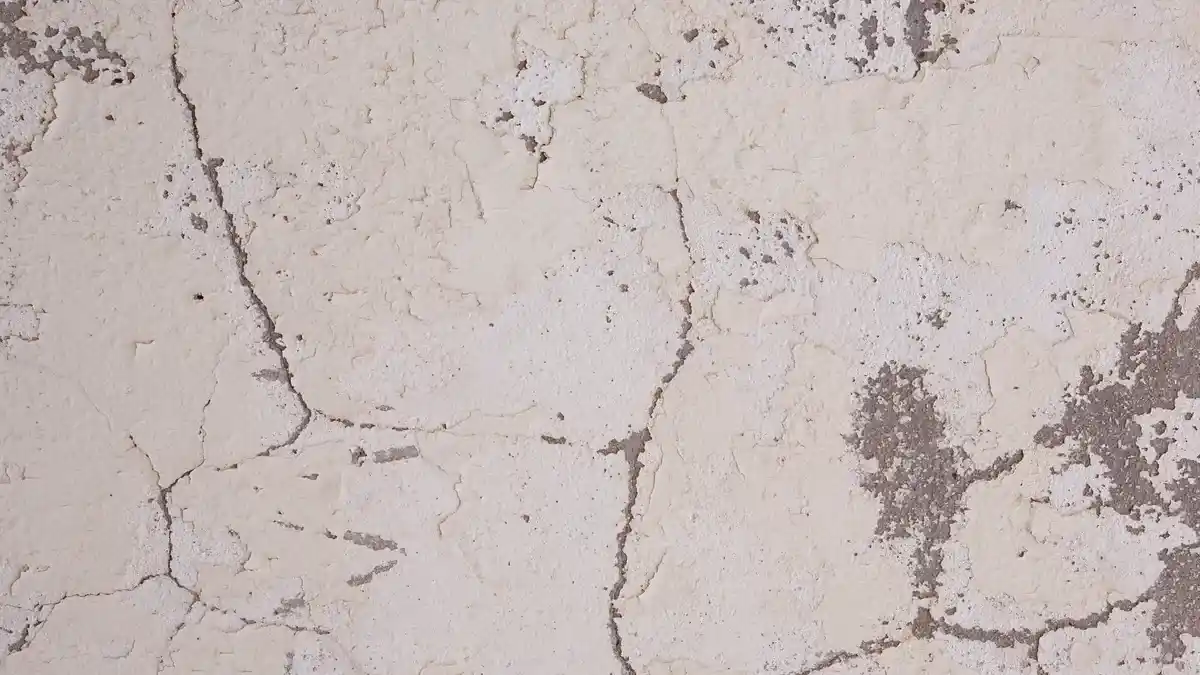
A slab with a patch can often be lifted, but only if the replacement section can handle the movement the lift creates. The real issue is not the word “partly replaced”; it is whether the old slab, the patch slab, and the base below them are behaving like one piece or like two different ones.
A cold joint is the line where new concrete meets older concrete. That line is not the same as monolithic concrete, and it can act like a hinge under pressure. If the old slab section has settled and the replacement section has not, a lift that pushes both areas the same way can crack the seam or pop the patch loose.
That is why a simple yes-or-no answer is not enough. A slab with mixed-age concrete may still be a candidate for lifting, but the repair method has to match the patch boundaries and the movement already present. In a building with tight access, such as many New York basements or first-floor spaces, the lift path and the edge conditions matter even more because there is less room to correct a bad move once it starts.
The wrong choice here is a blanket approach that treats the replacement section like original slab; a contractor should check the seam first and follow the lift plan that fits the actual conditions. That can turn a repair into a new break along the cold joint.
What changes after a replacement section is added?
A replacement section changes the slab because it creates different curing ages, different stiffness, and often a different bond at the edge. The older slab section and the new pour may not respond the same way when lifted, loaded, or exposed to moisture changes.
This is where mixed-age concrete becomes the real problem. The older section may have already shrunk, settled, or cracked in a pattern the new section has not yet reached. A concrete overlay or patch slab can also behave differently if it was placed to cover a damaged area rather than rebuild the whole panel. According to ACI repair guidance, matching the repair method to the existing substrate is part of the planning step, not an afterthought.
The patch boundary is usually the first place to inspect. A clean seam does not guarantee strength, and a rough seam does not guarantee failure. What matters is how much movement has already happened and whether the repair section was tied into the surrounding slab or left as a separate island.
The practical rule is simple: the more the replacement section stands apart from the original slab, the less safe it is to assume a standard lift will work. That is especially true when the repaired area is small, because a small patch can be pushed faster than the larger slab around it. A movement difference of even a little can be enough to show up as a visible step at the edge. For more on slab movement and repair limits, see the concrete slab repair guide and foundation settlement basics.
How a contractor should judge the lift plan
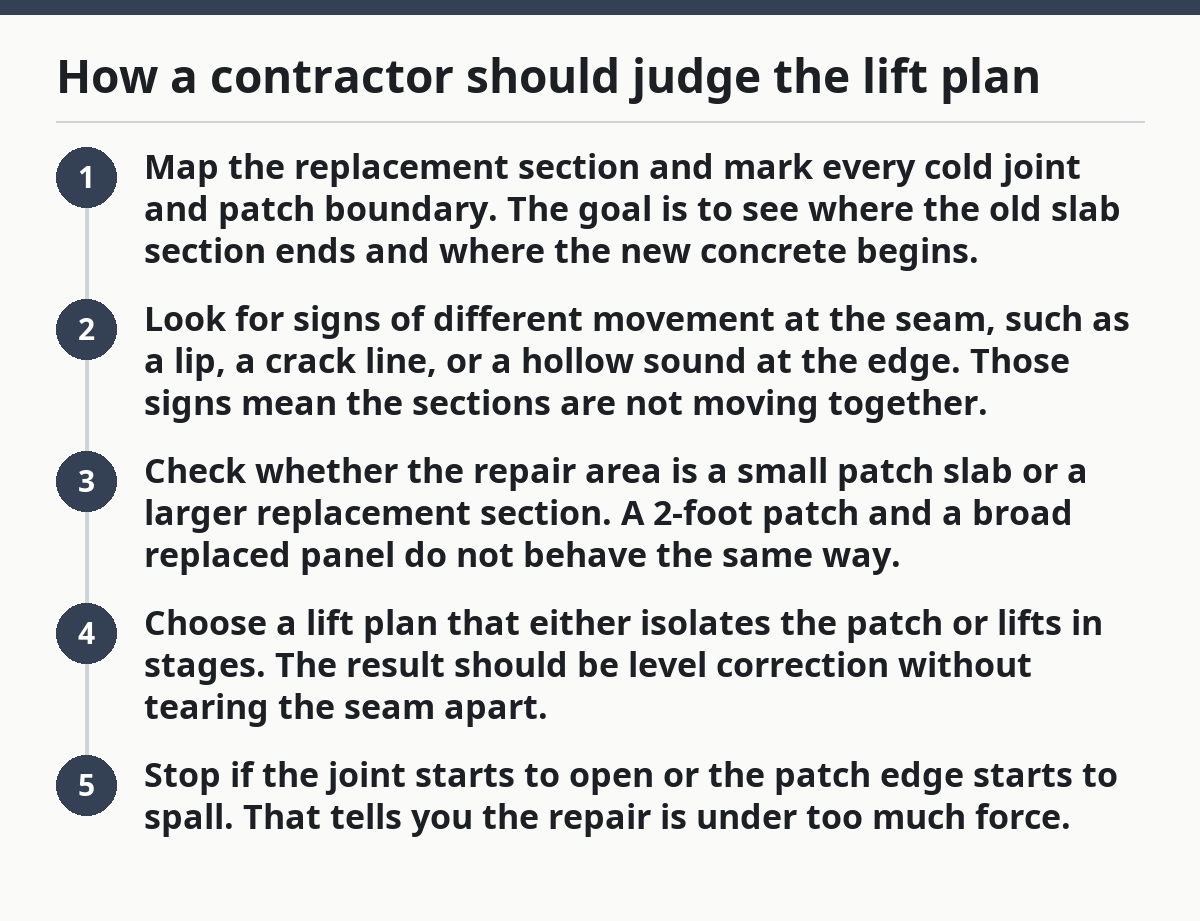
A contractor should judge the lift plan by the seam, the size of the patch, and the amount of movement already present, not by the fact that the slab was replaced. The first job is to decide whether the patch can move with the older slab section or needs to be treated as its own piece, and a qualified contractor or engineer should confirm that before lifting starts.
Here is the basic decision path a repair crew should follow:
- Map the replacement section and mark every cold joint and patch boundary. The goal is to see where the old slab section ends and where the new concrete begins.
- Look for signs of different movement at the seam, such as a lip, a crack line, or a hollow sound at the edge. Those signs mean the sections are not moving together.
- Check whether the repair area is a small patch slab or a larger replacement section. A 2-foot patch and a broad replaced panel do not behave the same way.
- Choose a lift plan that either isolates the patch or lifts in stages. The result should be level correction without tearing the seam apart.
- Stop if the joint starts to open or the patch edge starts to spall. That tells you the repair is under too much force.
The best plan for one slab may be wrong for the one next door, so the repair should be matched to that slab’s seam and support conditions. In New York buildings, where older slab sections and later repairs often sit side by side, that difference matters because access, slab thickness, and adjacent finishes can change what counts as a safe lift.
A contractor who skips the seam check is gambling with the patch. That gamble can cost more than the lift itself because a broken replacement section may need removal and repouring.
What are the signs the patch may fail during lifting?
The patch may fail during lifting if the seam opens, the edge chips, or the surface takes a sharp step instead of rising evenly. These are warning signs that the old slab and replacement section are not sharing the load.
A common mistake is to chase level at the center while ignoring the perimeter. If the lift starts to raise one area faster than the rest, the cold joint can split before the whole slab reaches grade. Another mistake is forcing a concrete lifting method onto a patch that was never bonded well in the first place. That can cost the repair crew the patch and leave the slab more uneven than before.
These are the most common bad-job signs:
- a visible crack that tracks along the cold joint
- a lip or ridge at the patch boundary after the lift
- fresh spalling at the edge of the replacement section
- a hollow sound where the patch should be tight
- a slab surface that looks level in one spot and still dropped in another
A good lift should not create a new defect at the repaired edge. If the patch starts breaking while the slab is rising, the issue is not finish work; it is repair compatibility.
For a homeowner or building manager, the cost of ignoring those signs is simple: the slab may need another repair, and the fresh patch may no longer be usable as part of the lift.
When should the repair be isolated instead of lifted together?
The repair should be isolated instead of lifted together when the replacement section clearly moves differently from the older slab section. That is often the safer choice when the seam is already cracked, the patch is small, or the edge is too weak to take pressure.
Isolation means the repair crew treats the patch slab as separate from the lift path, and a contractor or engineer should decide whether that separation is appropriate for the specific slab. That can mean lifting the surrounding slab in one step and leaving the patch alone, or repairing the patch after the main slab is level. It is not the fastest method, but it reduces the chance of tearing the cold joint apart.
This choice is often better when the replacement section was placed as a fix for a localized problem, not as part of a full slab replacement. A concrete overlay or patch that sits on top of a damaged base can also deserve isolation, because the top layer may not have the same support as the surrounding panel.
The trade-off is obvious: isolation can leave a small transition that still needs finish work. But that is better than forcing a repaired edge to carry the wrong load. If the patch sits beside an older slab section that has already settled, trying to move both as one can make the mismatch worse.
A contractor should be ready to say no to a combined lift when the joint looks fragile. That is not a failed repair plan; it is a sign the plan was adjusted before the slab broke.
What should you ask before hiring someone for this job?
You should ask how the contractor plans to treat the cold joint, the patch boundary, and the movement difference between the old and new concrete. Those three questions tell you more than a generic promise to “level the slab.”
Ask for a plain answer on whether the replacement section will be lifted with the rest of the slab or isolated. Ask what visible signs would make them stop before the seam fails. Ask how they would handle a patch slab that is already slightly proud or slightly low compared with the surrounding floor.
It also helps to ask what finish result you should expect at the boundary. A good answer will mention the transition, not just the center of the slab. If the contractor cannot explain how the repair will avoid opening the cold joint, that is a warning sign.
For a job in a building with older concrete and later patch work, the price is usually shaped by access, the size of the repaired section, and how much correction the seam needs. A small patch with a clean boundary is one thing; a wider replacement section with damaged edges is another. The time on site can change too, because a careful lift around mixed-age concrete takes longer than a straightforward lift of one uniform slab. ACI repair documents and PCA guidance both point to condition-based planning rather than a one-price-fits-all approach.
For more on the wider repair choices that sit around this question, see the hub on concrete slab repair alternatives and slab lifting methods.
How do old and new concrete move differently?
Old and new concrete can move differently because they do not have the same age, shrinkage history, or bond quality at the seam. The older slab section may already have settled or cracked, while the replacement section is still reacting to curing and edge support.
That difference is why mixed-age concrete creates special repair problems. Even if both sections look flat today, they may not respond the same way when pressure is applied during lifting. A cold joint can transfer some force and reject the rest, which is how a patch boundary ends up showing a crack line after the repair.
New concrete is not automatically weaker, but it is different. If it was poured to patch a damaged area, it may have been shaped to fit the opening rather than to behave like the original slab. That matters when the lift method depends on the slab moving as one plane.
This is also why a generic “lift it and see” approach is risky. A slab with one pour is one problem. A slab with a replacement section is two problems sharing one surface.
Does a patch change the lifting method?
Yes, a patch usually changes the lifting method because the repair has to respect the cold joint. The lift may need to be smaller, staged, or isolated so the replacement section does not split from the older slab section.
A plain lift might work on a uniform slab, but a patched area often needs a more cautious plan. The seam can fail before the slab reaches level, especially if the patch is small or the bond is weak. That is why the method has to match the patch, not just the floor around it.
Can old and new concrete move differently?
Yes, old and new concrete can move differently because they have different ages, shrink histories, and support at the edge. The older slab section may already be stable in one direction while the replacement section still reacts to the base below it.
That difference can show up as a lip, a crack, or a hollow sound at the cold joint. If the lift plan ignores that movement difference, the repair can make the seam worse instead of better.
Should patched sections be isolated from lifting?
Patched sections should often be isolated when the seam is weak or the movement difference is obvious. That lowers the chance of tearing the patch boundary during the lift.
However, isolation is not a universal rule. A larger replacement section with a solid bond may still be lifted with the surrounding slab if the contractor plans the force carefully and watches the joint during the job.
FAQ
Does a patch change the lifting method?
Yes, a patch usually changes the lifting method. A contractor has to account for the cold joint, the size of the replacement section, and whether the old slab section and the new concrete are moving together. In mixed-age concrete, a standard lift can damage the seam if the force is not controlled.
Can old and new concrete move differently?
Yes, old and new concrete can move differently. The older slab section has had more time to settle and shrink, while the replacement section may react differently at the patch boundary. That movement difference is one reason a partly replaced slab needs a more careful repair plan than a single-age slab.
Should patched sections be isolated from lifting?
Often, yes, especially when the patch slab is small or the seam already shows damage. Isolation can keep the lift from opening the cold joint or cracking the edge of the replacement section. A contractor may still lift the whole slab together if the bond is sound and the movement is even, but that choice should be explained before work starts.
Drafted with AI; not yet reviewed by a person.