Last updated: November 21, 2026
Slab lifting is usually the better first choice for sunken concrete when the slab is still in decent shape; slab replacement is better when the concrete is broken, badly washed out, or too far gone to save. For most driveways, walks, patios, and some New York building areas, lifting costs less disruption and gets the surface usable sooner, while replacement makes sense when the slab has failed structurally.
Key takeaways
- Slab lifting keeps the existing concrete and fixes the support under it, so it is often the faster, less disruptive repair.
- Replacement makes more sense when the slab is cracked apart, crumbling, or badly out of level over a large area.
- In New York buildings, tight access, old fill, basement moisture, and freeze-thaw conditions can change the best fix.
- The right call depends less on the dip itself and more on the slab’s condition, the soil below it, and how long you need the repair to last.
- A bad repair often shows up as patchwork cracking, new sinking, or a surface that still drains the wrong way.
What is the real difference here?
Slab lifting fixes the support under the concrete; slab replacement removes the old slab and pours a new one. That one difference drives cost, time, mess, and how much of the original material stays in place.
Lifting is used when a slab has settled but is still mostly intact. The void below gets filled, and the slab is brought back toward level instead of being torn out. Replacement is a bigger reset: the old section comes out, the base is rebuilt, and new concrete goes in.
For a reader trying to decide who to call, the key question is not “Is the slab sunken?” It is “Is the slab salvageable?” The American Concrete Institute and the Portland Cement Association both stress that concrete performance depends on the slab condition and the base under it, not just the visible top surface. If the slab itself is broken beyond repair, lifting can only hide the problem for a while.
When does slab lifting make more sense?
Slab lifting wins when the concrete is still solid and the main problem is settlement. That is the common case for a driveway corner, a sidewalk panel, a stoop edge, or a patio section that dropped because the soil under it moved.
Lifting is usually the smarter call when the surface is still in one piece, the cracks are limited, and the height difference is the main complaint. It also fits jobs where access is tight, which matters in many New York homes, row houses, and small commercial sites. A repair crew can often work with less demolition and less downtime than a full tear-out.
The weakness is simple: lifting cannot fix concrete that has already failed. If the slab has broad cracking, crumbling edges, or missing chunks, the lifted result may still look rough and may not hold up well. A slab that sank because of washed-out soil, a leaking downspout, or ongoing drainage trouble can also sink again unless the water problem gets fixed first.
This option is not for someone who wants a brand-new finish or needs a fresh decorative surface. It is a repair, not a makeover. It is the right call when function matters more than a perfect new appearance.
When is slab replacement the better call?

Replacement wins when the concrete is damaged enough that lifting would only buy a short delay. That includes slabs with severe cracking, crumbling corners, broken sections, or areas where the base has failed badly enough that a lift would not restore stable support.
Replacement also makes more sense when the slope is wrong in a way that affects drainage. If water runs toward a building, basement stairwell, garage, or entry, the shape of the slab may need to be rebuilt, not merely raised. New York weather makes that more serious because freeze-thaw cycles can punish weak concrete and open existing cracks.
The drawback is the disruption. Replacement means more labor, more debris, and more time before the area is usable again. It also means more finished concrete has to be poured and cured, which can matter on a tight site with little room for staging.
This option is not ideal when the slab is mostly sound and only a few inches off grade. In that case, replacement can be more work than the problem deserves. It is also a poor match when a building owner needs the fastest practical fix for a trip hazard or a small access path.
Which one is better for your situation?
Slab lifting is better for sound concrete with settlement; replacement is better for damaged concrete with structural failure. The decision usually comes down to condition, access, and how much future movement is expected.
| Criteria | Slab lifting | Slab replacement | Winner for this condition |
|---|---|---|---|
| Concrete condition | Best when slab is intact | Best when slab is cracked or broken | Lifting for solid slabs |
| Disruption | Less demolition and mess | More demolition and cleanup | Lifting for occupied sites |
| Time to reopen area | Usually faster | Usually slower | Lifting for urgent use |
| Surface appearance | Keeps old finish and marks | New surface can look cleaner | Replacement for cosmetic reset |
| Drainage correction | Limited change in shape | Better for redesigning slope | Replacement for bad drainage |
| Underlying soil issue | Helps if settlement is modest | Better if base failure is severe | Replacement for major base failure |
| Tight access | Often easier in narrow spaces | More space needed for removal and pour | Lifting for cramped sites |
| Long-term reset | Good when the slab is still healthy | Better when the slab has aged out | Replacement for worn-out slabs |
| Cost pressure | Usually lower overall burden | Usually higher overall burden | Lifting for budget-sensitive repairs |
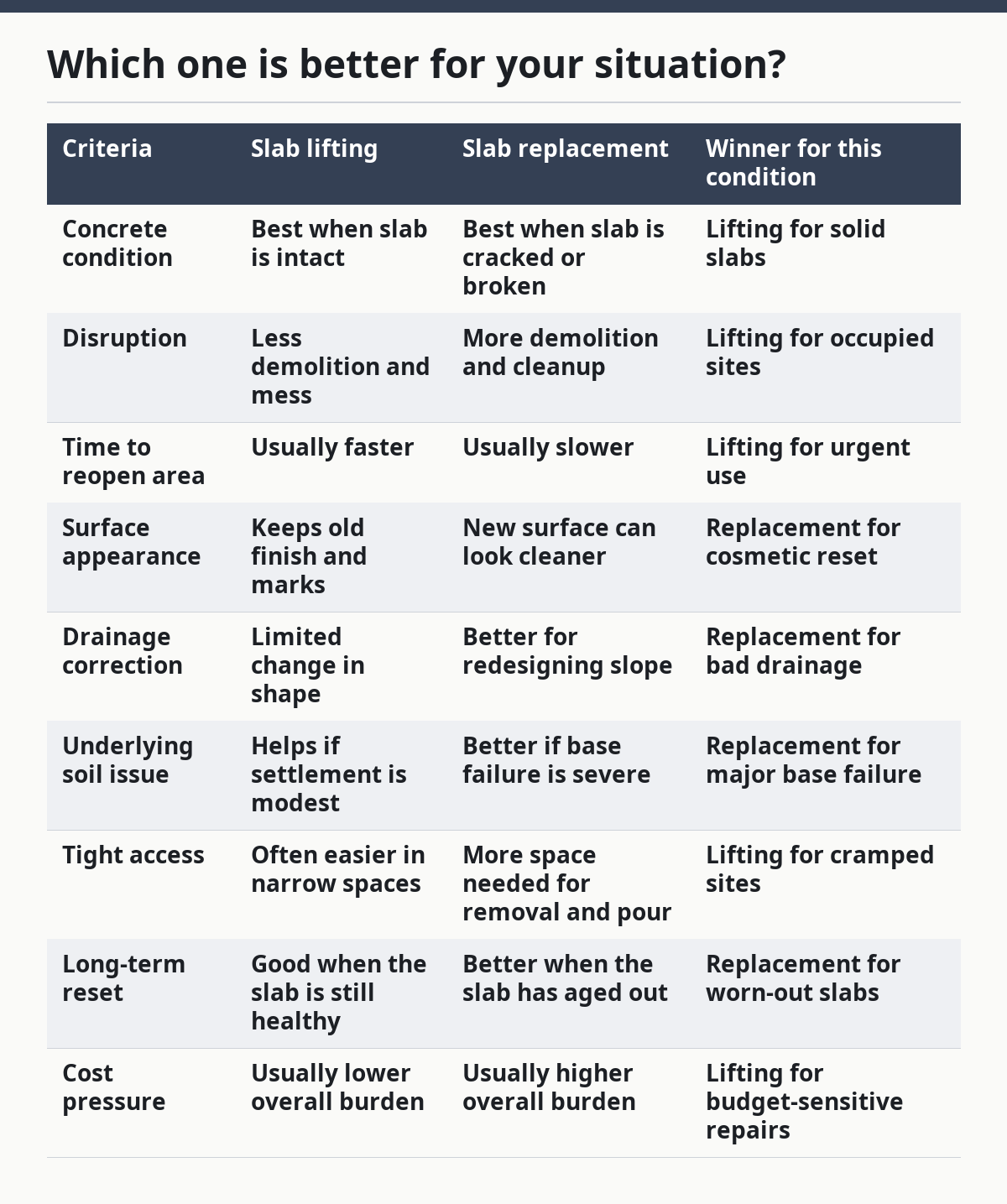
A practical way to read that table: if the slab is basically good concrete that slipped, lift it. If the slab is failing as concrete, replace it. In a place like New York, where access can be tight and labor time matters, that split often decides the job.
The best contractors should also talk about the cause, not just the symptom. A leak, poor grading, clogged drainage, or weak fill under the slab can make either repair fail early if it is ignored.
What makes New York building types different?
New York building types change the answer because access, age, and soil history matter more than they do on a wide suburban lot. Brownstones, row houses, walk-ups, prewar multifamily buildings, and older commercial properties often have limited access for equipment and less forgiveness around the edges of the slab.
In many of those buildings, a sunken sidewalk panel or courtyard slab is not just a surface issue. It may sit next to masonry walls, utility lines, cellar openings, or a drainage path that already has little margin. A lift can be the right fix if the panel is sound, but a replacement may be safer when the slab meets a stair, a loading area, or a building entrance that cannot tolerate another settlement cycle.
Local ground conditions matter too. Fill placed long ago, disturbed soil from utility work, and water moving from downspouts or leaks can all create repeat settlement. That is why a contractor should talk about base failure, moisture, and grading, not just the visible dip.
For more technical background on concrete performance, the Portland Cement Association and the American Concrete Institute are the kinds of organizations that publish standards and guidance worth checking. If a contractor’s explanation ignores the base and drainage, that is a warning sign.
What should you ask before you hire someone?
Ask whether the slab is still structurally sound, because that answer tells you whether lifting is even a fair option. Ask what caused the settlement, because fixing the wrong thing can leave you with the same dip again.
A good first conversation should also cover access, edge conditions, and how the repair will affect drainage. For a New York building, ask whether there is room for equipment, whether nearby masonry or utilities are at risk, and whether the repair will change the way water moves along the property line.
Ask for the difference between lifting and replacement in plain language, not just a price. If a contractor only talks about the surface and never mentions the base, the fill, or water control, that is a bad sign. Also ask how long the area will be out of service; that matters as much as the repair method on a busy property.
A useful final question is what a failed job looks like. The answer should include warning signs such as new cracking, a return of the slope, or water pooling where it should not. That kind of answer is often more honest than a sales pitch.
What does a bad job look like?
A bad job shows up fast: the slab keeps sinking, the repair edge cracks, or water still runs the wrong way. If the surface looks level for a short time but the ground underneath was never fixed, the repair is only hiding the problem.
In lifting work, the biggest red flags are a slab that feels hollow, a repair that leaves the panel rocking, or a patch that does not match the surrounding grade. In replacement work, bad signs include poor drainage, visible edge separation, or fresh cracking from a weak base.
For a property owner, the most useful clue is whether the cause was solved. If the contractor never addressed soil support, moisture control, or drainage, the work may look fine for a season and then fail again.
Which one should you choose?
Choose slab lifting if the concrete is mostly intact, the drop is caused by settlement, and you want the least disruption. Choose slab replacement if the slab is broken, the slope is badly wrong, or the base failure is too severe for a lift to hold.
Neither is the right choice if the slab keeps moving because of an active leak, major drainage problem, or unstable ground that has not been corrected. In that case, the repair comes after the cause is fixed, not before.
What if the answer changes?
The verdict flips when the slab has wide cracking, missing pieces, or a surface finish you want to replace anyway. It also flips when the site needs a new slope for drainage or when the old slab sits over a base that has clearly failed.
Another exception is a property with repeated settlement from water. If the soil is still getting wet from runoff, plumbing, or poor grading, a lift may only be temporary. In that case, replacement plus drainage correction can be the safer long-term choice.
A third exception is a slab tied to a building entry or another feature where height matters more than appearance. If a small mismatch could create a trip hazard or water issue at a doorway, a full rebuild may be worth the extra work.
FAQ
How do I know if my sunken concrete can be lifted?
If the slab is still in one piece and the cracking is limited, lifting is often possible. If the concrete is broken apart, crumbling, or missing chunks, replacement is usually the safer fix.
Is slab lifting only for small jobs?
No. It is often used for sidewalks, driveways, patios, stoops, and other slabs that settled but stayed mostly intact. The limit is not size alone; it is whether the slab and base can still support a lift.
What makes replacement worth the extra disruption?
Replacement is worth it when the slab is too damaged to trust or when the slope must be changed. It is also the better call if the base has failed badly enough that raising the old slab would not hold.
Can a lifted slab sink again?
Yes, if the soil below it is still moving or the water problem was never fixed. A lift addresses settlement, but it does not stop ongoing drainage or foundation-related movement by itself.
What should I ask before I approve the work?
Ask what caused the sinking, whether the slab is structurally sound, and whether the repair will change drainage. Also ask how long the area will be out of use and what signs would mean the repair is failing.
Drafted with AI; not yet reviewed by a person.