Last updated: November 20, 2026
Key Takeaways
- A concrete leveling warranty usually covers the repair itself, not every future slab movement.
- It covers settling again only when the contract says recurring settlement is included.
- Labor pays for the return visit; material pays for the product, and they are separate.
- Common exclusions include water, soil movement, roots, and added loads.
A concrete leveling warranty may cover settling again, but only if the warranty language says it covers re-settlement after repair. This concrete leveling warranty guide breaks down what that usually means, where labor coverage and material coverage differ, and which exclusions usually shut a claim down.
What a concrete leveling warranty usually covers
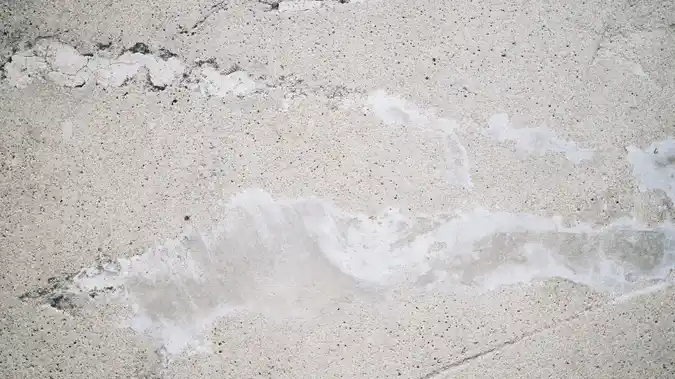
A concrete leveling warranty usually covers the repair itself, not every future movement of the slab. That means the promise often applies if the lifted area settles again because the repair failed, but not if the ground keeps moving for a new reason.
To see how that works in practice, picture this: you’ve got a porch slab that was raised last spring, and by fall one corner drops again. The question isn’t just “is there a warranty?” It’s “what did the warranty actually promise in the first place?”
Most warranty language falls into three buckets:
- Labor coverage: the contractor comes back and redoes the work, usually at no labor charge.
- Material coverage: the product used for lifting or filling is covered if it breaks down.
- Workmanship coverage: the repair is covered if the installation was done wrong.
A lot of homeowners expect “lifetime warranty” to mean “any settling ever.” It usually does not. If the slab sinks again because a downspout dumps water near the edge, that can be outside the promise even when the first repair was done correctly.
The clearest clue is often the phrase settlement recurrence. If the document names re-settling, resinking, or “return of voids,” that is the language you want to see. If it only says cracks, finish damage, or cosmetic defects, you may have a very narrow claim.
Does the warranty cover settling again, or only the first repair?
A concrete leveling warranty covers settling again only when the contract says recurring settlement is included. If the paper is vague, the answer often comes down to cause, not just timing.
Here’s the catch: two warranties can sound alike and still pay for very different problems. One may cover a settled slab for 1 year after the job; another may cover the product for the life of the slab but exclude soil movement, drainage, or tree roots.
Common language you might see includes:
- “Covers re-settling due to material failure”
- “Covers settlement caused by installation defects”
- “Excludes movement from soil conditions beyond contractor control”
- “Labor included for the first return visit only”
That last line matters. If the company covers material but not labor, the fix may not be free even when the claim is approved. On a small sidewalk panel, that might feel minor. On a long driveway run, it can change the whole value of the warranty.
The truth is, a warranty that sounds generous can still be narrow in practice. If the slab settled again because the subgrade was never compacted properly, that leans toward workmanship. If the same corner settled because a washout opened under the slab after a heavy storm, the contractor may point to an exclusion. For a broader cost context, see our guide on How Much Does Concrete Slab Lifting Cost in New York?.
What labor coverage and material coverage really mean
Because labor coverage pays for the return visit while material coverage pays for the product, the split matters: a claim can be “covered” and still leave you with a bill.
Picture this: the contractor injected polyurethane or used a slurry lift on a driveway panel, and the slab drops again after a season of freeze-thaw. If the warranty covers the material for 5 years but labor only for 90 days, the math changes fast.
Here’s how the split usually works:
| Coverage type | What it pays for | Common limits |
|---|---|---|
| Labor | Crew time to re-level the slab | May expire sooner than material coverage |
| Material | Product failure or breakdown | Often tied to the original installer |
| Workmanship | Errors in placement or lift pattern | Can be excluded if site conditions changed |
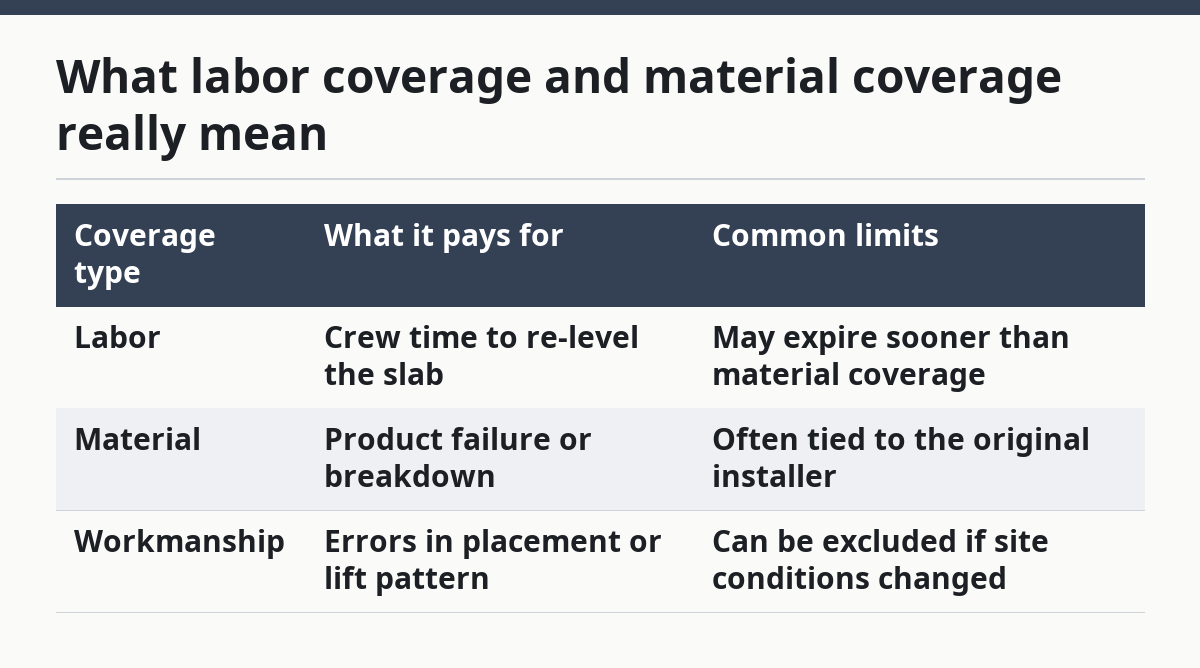
A lot of people assume labor is automatic. It isn’t. Some warranties cover the second visit only if the original repair failed under the same conditions, and some require the owner to pay setup charges, access fees, or any extra work beyond the original scope. See our related page on concrete slab lifting for the repair process itself.
Material coverage also has a boundary. If the foam stays intact but the soil under it shifts, the product may not be the problem. That is why you need the exact wording on material coverage and not just a verbal promise.
One thing to watch for: some warranties are transferable to a new homeowner, but only for the remainder of the term and only with written proof. If you bought the house after the repair, ask for the original invoice, the warranty sheet, and any transfer form before you assume you’re covered.
Which exclusions most often stop a settling claim?
The most common exclusions are water, soil movement, roots, and added loads. Those are the four words that can turn a simple re-settlement claim into a denial.
Picture this: your sidewalk was leveled in April, then a gutter leaks all summer and water pools beside the slab. By winter, one panel drops again. The contractor may say the warranty does not cover drainage problems, even if the first lift held perfectly for months.
Watch for these exclusions:
- Poor drainage or downspouts
- Tree roots or stump decay
- New cracking from frost or erosion
- Vehicles or equipment heavier than the slab was meant to carry
- Work done by another contractor after the leveling job
- Cosmetic issues that do not affect elevation
A bad warranty is often not silent; it is just narrow. It may cover the slab “provided no other party disturbs the area.” That sounds fair until a sewer repair, landscaping job, or trench cuts through the same section. Then the claim can be denied because the slab changed after the original work.
On the flip side, a strong warranty will say what happens if the slab settles again for reasons tied to the repair itself. That wording often points to a return visit, not a cash refund. If you want a refund promise, read the contract closely; many leveling warranties do not offer one.
Because those exclusions are so common, they are often the first things to check before you sign. A lot of denials can be avoided before the job starts, if the contractor writes down the drainage, access, and soil notes that matter.
How to check a warranty before you sign
You should check the warranty by reading the trigger, the term, the exclusions, and the remedy before any work begins. That takes 10 minutes and can save a very long argument later.
Use this quick procedure:
- Find the exact promise about settlement recurrence. Look for words like re-settle, sink again, or return of voids so you know what event is covered.
- Check the term length. A **1-year** promise and a lifetime promise are not the same thing, even if both sound confident on the phone.
- Separate labor coverage from material coverage. If one is shorter, note who pays for the return trip and any setup time.
- Read the exclusions line by line. Drainage, roots, frost, and later construction often remove the claim entirely.
- Ask who decides whether the slab failed again. The answer may be a site visit, photos, or a written inspection, not just your call.
- Get transfer rules in writing if you may sell the home. Some warranties need a form, an original invoice, or notice within a set period.
If the contractor won’t give the warranty in writing before payment, walk. A verbal warranty is hard to enforce and easy to forget after a 3-month season changes the slab again.
The most useful question is simple: “If this area settles again, what exactly do you do, and what do I pay?” That answer should mention labor, material, and any trip charges in plain English. For homeowners comparing companies, the concrete leveling overview can also help frame the scope before you sign.
What a bad warranty looks like in real life
A bad warranty is one that sounds broad but pays for almost nothing when the slab moves again. If it excludes the exact kind of failure you are worried about, it is mostly marketing.
Picture this: you’re staring at a lip at the edge of the garage slab, and the repair only lasted through one winter. The contractor says the work is “covered,” then points to a clause that excludes soil movement, water intrusion, and any change in grade.
Common red flags include:
- “At the company’s sole discretion”
- Coverage only for “manufacturer defects” when the repair depends on field conditions
- No term length anywhere on the page
- Transfer allowed only if the new owner pays a fee
- A claim process that requires impossible proof, like original grade readings you never received
That kind of language shifts the risk back to you. You pay for the lift, then pay again if the slab settles for a reason the warranty quietly excludes. That is not the same as coverage.
The practical test is this: if the slab settled again next month, could you point to one paragraph and know whether the contractor owes you a return visit? If the answer is no, the warranty is too fuzzy to trust.
A better document names the covered condition, the response, and the limit. It may still exclude drainage or tree root damage, but at least it tells you that in plain terms. If you need to compare product methods, see our polyjacking page for the underlying repair type.
Questions to ask before you rely on the warranty
You should ask about claim timing, proof, and transfer before you count on any coverage. Those three details decide whether a future settlement recurrence turns into a clean fix or a fight.
Ask these exact questions:
- If this slab settles again, is the return visit covered in full or only the material?
- Do you cover labor coverage for the second trip, or is there a service charge?
- Which exclusions apply if the same section moves after heavy rain, frost, or root growth?
- Is the warranty transferable to a buyer, and does that need a form within 30 days of sale?
- What proof do you need from me if I file a claim?
A contractor who answers plainly is easier to work with than one who hides behind “it depends.” The point is not to win a debate. The point is to know what happens if the slab drops again after the repair.
If you live in a place with freeze-thaw swings, poor drainage, or heavy clay soil, get the answer in writing. Those conditions change settlement risk, and they often show up later, after the job is long paid for. For guidance on industry standards, the Concrete Polishing Association of America and American Concrete Institute both publish widely used concrete references.
Does a leveling warranty cover cracking?
A leveling warranty may cover cracking only if the crack is tied to the leveling work and the warranty says so. Most warranties do not automatically cover every crack that appears later.
A small crack can show up from normal slab movement, seasonal change, or preexisting stress. If the document only promises elevation correction, then cracking may be excluded even when the slab stays at the right height.
Are warranties transferable to a new homeowner?
Some concrete leveling warranties are transferable to a new homeowner, but many are not automatic. Transfer rules often require the original paperwork, a written request, and proof that the transfer happened within the stated term.
A transfer may also preserve only the remaining coverage, not a fresh full warranty. That matters if the slab was repaired 2 years ago and the warranty term is short. Read the transfer clause before you buy or sell, and compare it with the original warranty terms.
What voids a concrete leveling warranty?
A concrete leveling warranty is often voided by drainage problems, new construction, root damage, or work done by someone else after the repair. Those are the usual reasons a settled slab claim gets denied.
Missing paperwork can void it too. If the contract requires the original invoice, a signed warranty card, or a transfer form and you cannot produce it, the contractor may refuse the claim even if the slab moved again.
Drafted with AI; not yet reviewed by a person.