Last updated: November 20, 2026
Quick Answer
Repeated wet spots most often point to a slab problem under the floor when the same area gets damp after rain, snowmelt, or drainage changes. A repeat spot that stays wet for 24 hours or longer deserves a closer look. This guide to When Repeated Wet Spots Point to a Slab Problem shows what those patterns mean and when they point to support trouble below the slab.
Repeated wet spots on concrete suggest a slab problem underneath when the moisture keeps coming back after dry weather, shifts to the same place, or shows up with drainage trouble around the slab. This guide shows what those patterns mean and when they point to support trouble below the slab.
Repeated wet spots: what they usually mean
Repeated wet spots often mean water is getting trapped under or beside the slab, not just splashed on top. That matters because drainage, a leaking pipe, or saturated soil can all leave the same stain pattern for a while.
Picture this: you keep finding damp circles near the same wall or corner, even after a dry week. The top of the slab may look fine, but the ground below can stay wet long after the surface dries. That’s the pattern to watch.
A slab problem becomes more likely when the spot:
- comes back in the same place after drying
- grows after rain, snowmelt, or a hose run
- stays damp for 24 hours or longer
- shows up near a floor drain, exterior wall, or low point
- has no clear source on the surface
A single wet patch can be a spill or condensation. A repeat pattern is different. The ground underneath is telling you something.
Key Takeaways
- A one-off damp patch is not the same as a repeat wet spot.
- Timing matters: after rain points one way, after indoor water use points another.
- Soil, drains, and hidden leaks can all feed moisture under a slab.
- A wet spot that keeps returning in the same place deserves a closer look.
What makes a wet spot point to support trouble underneath?
A wet spot points to support trouble underneath when the moisture pattern lines up with how water moves through soil, not just with where water landed on the floor. If the ground under part of the slab stays soft or saturated, that area can lose support and keep collecting moisture.
Picture this: you notice a dark patch near one corner, then the same patch after a storm, then again after snow melts. That pattern is more suspicious than a random stain. It suggests water is entering the soil below or beside the slab and not draining away.
Here’s the catch: moisture alone does not prove a slab issue. A hidden plumbing leak can mimic the same look. But when the wet spot sits near a low exterior grade, a clogged gutter line, or a place that stays soggy for days, the slab and the ground under it move higher on the list.
Look for these clues:
- the spot appears after seasonal moisture changes, not after indoor spills
- the area feels cooler or more humid than nearby floor sections
- the spot returns along a line, edge, or corner rather than in the center of a room
- nearby soil outside stays wet, soft, or muddy after normal weather
A repeated wet spot is a clue, not a verdict. It tells you where to keep looking.
Is it drainage, a leak, or a void under the slab?
It is usually one of three things: bad drainage, a plumbing leak, or water moving into a void below the slab. The first two are more common, but the third matters when moisture keeps returning in one area and the ground below has lost contact with the slab.
Picture this: water on one side of the house is running the wrong way, down toward the slab instead of away from it. Or a slow leak is feeding the soil below for weeks. Either can leave a wet patch that comes and goes with weather and water use.
A simple way to sort the pattern is to ask where the water is most likely coming from:
- Drainage clues: gutters overflowing, downspouts dumping near the wall, negative grade, standing water outside after rain
- Leak signs: wet spots after using sinks, tubs, toilets, or laundry; higher water bill; wetness that ignores weather
- Soil saturation: muddy perimeter soil, soft ground, water pooling near planter beds or patios
- Voids: a spot that seems to stay damp because water has room to collect beneath the slab instead of draining across it
The same wet patch can fit more than one cause. That’s why timing matters. If the spot shows up after a storm, start with drainage. If it shows up after water use inside, think leak. If it returns in a dry spell, the soil below may still be holding moisture or may have an empty pocket that traps it.
For a broader breakdown of settlement signs, the hub guide on concrete slab settlement diagnosis for New York homes — The Complete Guide fits next.
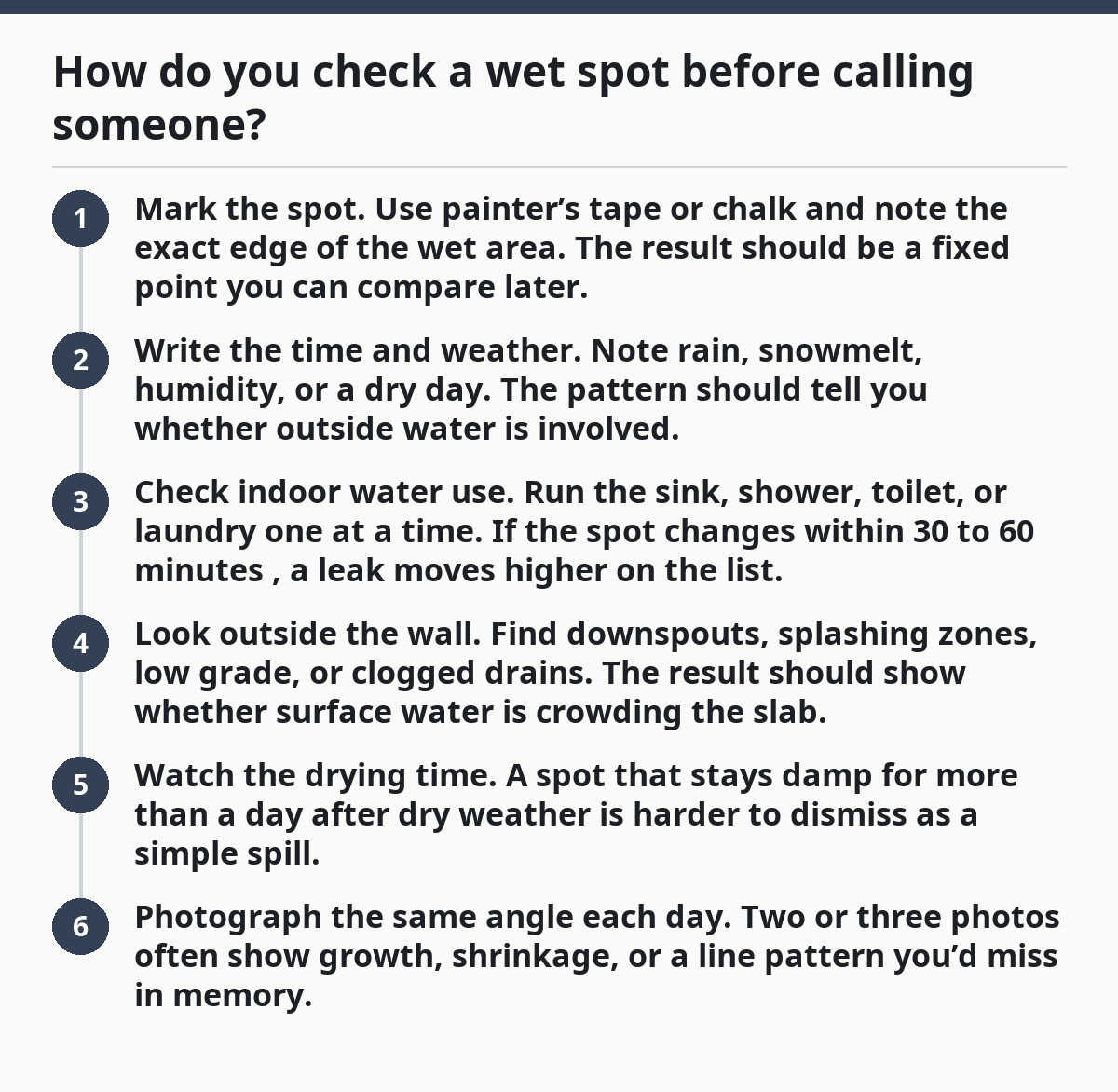
How do you check a wet spot before calling someone?
You check a wet spot by tracking when it appears, how fast it dries, and what water sources are closest to it. A 15-minute look is enough to start; a 2-day log is better. That gives a contractor something useful instead of a vague “it gets wet sometimes.”
Picture this: you want to know if the spot is a plumbing issue, a drainage issue, or something under the slab before you pay for a visit. A few simple notes can separate the obvious from the hidden.
Follow this order:
- Mark the spot. Use painter’s tape or chalk and note the exact edge of the wet area. The result should be a fixed point you can compare later.
- Write the time and weather. Note rain, snowmelt, humidity, or a dry day. The pattern should tell you whether outside water is involved.
- Check indoor water use. Run the sink, shower, toilet, or laundry one at a time. If the spot changes within 30 to 60 minutes, a leak moves higher on the list.
- Look outside the wall. Find downspouts, splashing zones, low grade, or clogged drains. The result should show whether surface water is crowding the slab.
- Watch the drying time. A spot that stays damp for more than a day after dry weather is harder to dismiss as a simple spill.
- Photograph the same angle each day. Two or three photos often show growth, shrinkage, or a line pattern you’d miss in memory.
Don’t flood the area or poke holes in the slab just to “see what happens.” That can muddy the evidence. The better move is to gather a clean pattern first.
What a contractor will want to know
A contractor will want timing, location, and what the wet spot does after rain or water use. That information cuts guesswork and helps them decide whether the slab, the drainage, or a hidden line needs attention first.
Picture this: you call for help, and the first question is not “Is the floor wet?” It’s “When does it happen, and what changed?” That’s because the same wet patch can come from three different systems.
Have this ready:
- the exact room and spot
- whether it’s near an exterior wall, drain, bathroom, kitchen, or laundry
- how long the moisture has repeated, in days, weeks, or months
- whether it follows rain, melting snow, or indoor water use
- whether the floor feels soft, cool, or oddly damp in one area
- any changes outside, like new landscaping, clogged gutters, or a patio that sheds water toward the house
Ask direct questions:
- What does this pattern suggest first: drainage, plumbing, or soil saturation?
- What tests do you use before opening the slab?
- If you suspect a hidden support problem, what evidence do you need before repair?
- How do you tell a wet spot from seasonal moisture versus an active leak?
A good contractor should talk in plain terms and point to the pattern, not just the stain. If the answer is immediately “You need major work” without looking at the water path, that’s a bad sign.
What a bad pattern looks like, and what it can cost you
A bad pattern looks like repeated dampness, a fixed location, and no clear explanation from weather or water use. The cost is usually delay: the longer wet soil sits under a slab, the harder it gets to sort out what is causing it.
Picture this: the spot keeps returning, but you keep hoping it is just humidity. Then the edge spreads, the floor feels different underfoot, and the source still isn’t clear. That is when the problem stops being cosmetic.
Common mistakes:
- Waiting for a crack to appear. Some moisture patterns show up before visible surface damage. That can waste weeks or months.
- Blaming every wet spot on a plumbing leak. That can send you down the wrong path and delay drainage work.
- Ignoring outdoor grade. Poor slope, clogged gutters, or short downspouts can keep feeding the same area.
- Treating seasonal wetness as normal every time. Seasonal moisture can be normal in some spots, but a repeat patch in one place still deserves a look. If it keeps returning, consult a qualified professional and review the pattern against local drainage conditions.
According to the U.S. Environmental Protection Agency, household leaks can waste nearly 10,000 gallons per year, so it pays to check whether the source is inside or outside the slab. The price of being wrong is usually extra inspections, repeat visits, or repairs aimed at the wrong source. A drainage fix won’t solve a pipe leak. A leak repair won’t solve water running back toward the slab. That’s why the pattern matters more than the stain itself. For indoor leak tracking, see the EPA’s guidance on fixing leaks around the home. For exterior water control, the U.S. Department of Energy recommends keeping water away from the foundation with proper grading and drainage.
If you live in a wet or freeze-thaw area, seasonal moisture can change the picture fast. In New York, snowmelt and heavy rain can keep soil wet longer than you expect, so the same spot may need a closer look after storms and thaw cycles. For foundation moisture basics, the American Society of Home Inspectors and NYS Homes and Community Renewal both point homeowners toward checking drainage first.
When repeated wet spots do and don’t point to slab trouble
Repeated wet spots point to slab trouble when the moisture keeps returning in the same place, tracks with drainage or saturated soil, and shows no clear indoor source. They do not point to slab trouble when the spot is clearly from a spill, a one-time leak, or condensation that disappears with a simple fix.
Picture this: you’ve seen the same damp patch three or four times, and each time it shows up after rain or after the yard stays wet. That pattern is the main clue. A slab problem becomes more likely when the ground below is staying wet, shifting, or holding water instead of draining it away.
Here’s the short version:
- Probably slab-related: repeat wet spot in the same place, linked to storms, poor grading, or soggy soil
- Probably not slab-related: one-time spill, obvious appliance leak, surface condensation, or a spot that never returns
- Needs more checking: repeated dampness with no obvious source, especially near exterior walls or low areas
The best next move is to document the pattern and get the right person to look at drainage, soil, and the slab together. That keeps the diagnosis focused and avoids chasing the wrong fix.
Can moisture under concrete cause settling?
Yes, moisture under concrete can contribute to settling when it softens the soil or washes support away over time. The effect is usually slower than a sudden break, and it often shows up first as repeat wet spots, a low area, or a place that stays damp after dry weather. If you see that pattern, a professional should check the source.
Do wet spots always mean a plumbing leak?
Wet spots do not always mean a plumbing leak. Drainage problems, seasonal moisture, saturated soil, and water collecting under or beside the slab can all create the same look. A leak is more likely when the spot changes after indoor water use, but weather-linked wetness usually points elsewhere first.
Drafted with AI; not yet reviewed by a person.