Last updated: November 20, 2026
Quick Answer: To compare two concrete slab lifting estimates side by side, line up the same slab area, materials, warranty, site assumptions, and payment terms first. That is the fastest way to see which quote is really the better fit. For homeowners, the clearest estimate is usually the safer one to sign.
Key Takeaways
- One estimate is shorter; the price gap is what makes comparison hard.
- The fuller estimate gives you real details; the thinner one hides too much.
- The longer estimate may fit the job better if the site needs more work.
- The smartest choice matches slab conditions, spells out the work, and leaves the least room for surprise.
Concrete slab lifting estimates are easiest to compare when you line up the scope of work, the materials, the warranty, the site assumptions, and the payment terms side by side.
The better estimate is the one that matches your slab’s problem with fewer gaps and fewer vague lines.
The table below and the steps after it will show what to check, what to ignore, and which differences actually change the job. For a broader buying framework, see the estimating and pricing hub and foundation repair costs guide.
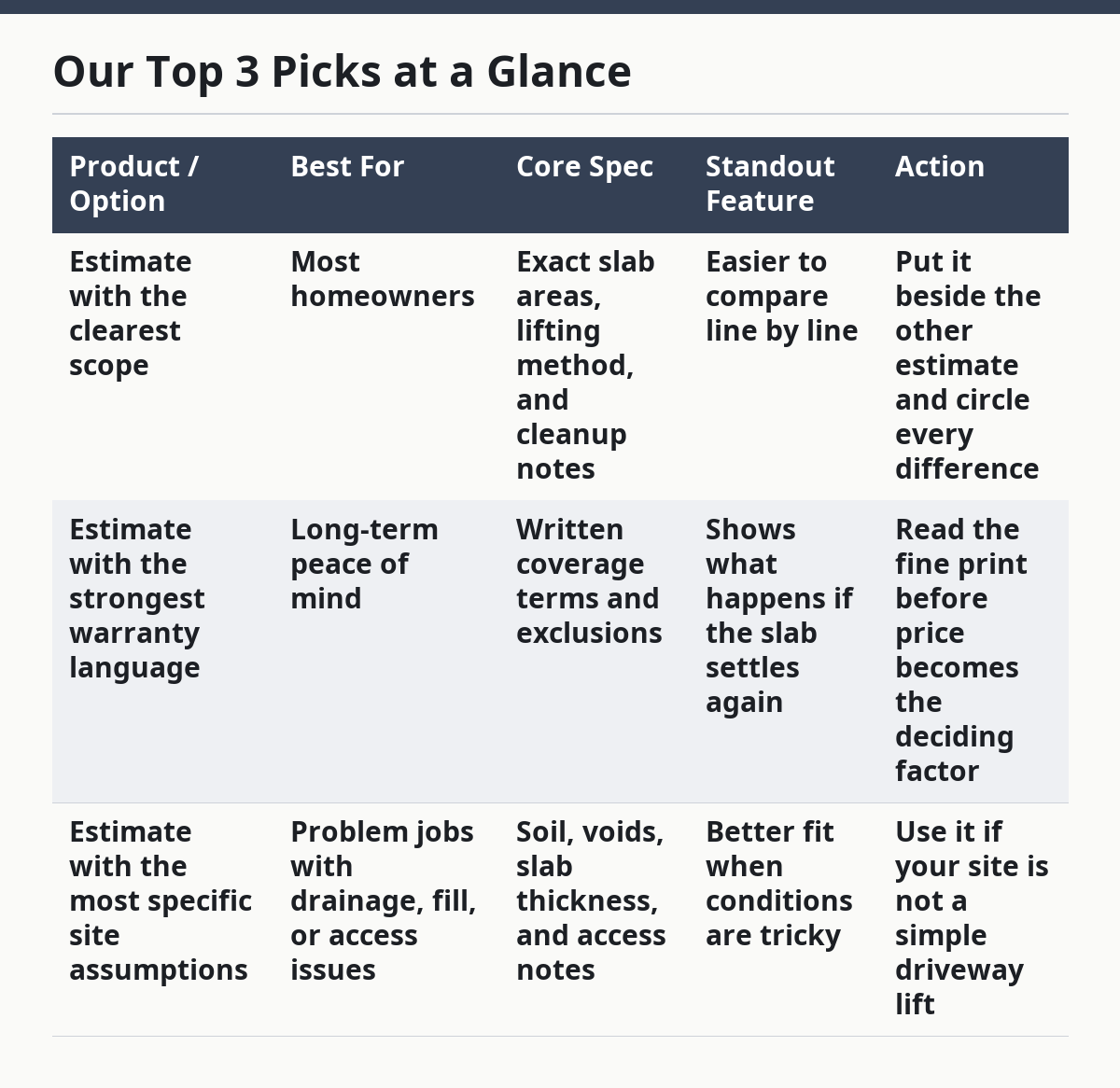
Our Top 3 Picks at a Glance
| Product / Option | Best For | Core Spec | Standout Feature | Action |
|---|---|---|---|---|
| Estimate with the clearest scope | Most homeowners | Exact slab areas, lifting method, and cleanup notes | Easier to compare line by line | Put it beside the other estimate and circle every difference |
| Estimate with the strongest warranty language | Long-term peace of mind | Written coverage terms and exclusions | Shows what happens if the slab settles again | Read the fine print before price becomes the deciding factor |
| Estimate with the most specific site assumptions | Problem jobs with drainage, fill, or access issues | Soil, voids, slab thickness, and access notes | Better fit when conditions are tricky | Use it if your site is not a simple driveway lift |
How do I compare two concrete slab lifting estimates side by side?
To compare two concrete slab lifting estimates side by side, start with the same slab area, the same lift method, and the same finish work so you are not comparing two different jobs.
Picture this: you have two slab lifting estimates on the table, and both sound reasonable at first glance. One is shorter, one is longer, and the price gap makes you hesitate.
-
Put both estimates on one page.
Use a pen, a phone note, or a printed sheet with two columns. The goal is simple: you should be able to scan both in under 5 minutes and spot where one contractor is being more specific. -
Match the scope of work first.
Look for the slab location, square footage if listed, the lifting method, and whether the estimate includes joint repair, crack filling, or cleanup. If one quote lifts a driveway apron and the other only mentions “front slab,” that is not an equal comparison. -
Check the materials listed.
Some jobs use polyurethane foam, some use grout, and some use other lift materials. If the material is not named, the estimate is thinner than it should be, because material choice affects weight support, void fill, and cleanup. -
Read the warranty language line by line.
A warranty that names the covered work, the time period, and the exclusions is more useful than a one-line promise. If one estimate says “workmanship warranty” and the other says exactly what settlement is covered, the second one is easier to judge. -
Mark the site assumptions.
Look for assumptions about soil condition, voids under the slab, slab thickness, drainage, access for equipment, and whether the slab is cracked or broken before the lift starts. If a contractor assumes “normal conditions” and your site has washout or poor drainage, the price may change later. -
Compare payment terms and timing.
A deposit, a progress payment, or payment on completion all change your risk. If one estimate asks for full payment before the work starts and the other asks for payment after final walk-through, that difference matters more than a small price gap. -
Check what happens if the job changes.
Ask whether extra lift points, deeper voids, or broken concrete are billed as change orders. You want to know what a surprise adds to the bill before the truck is in the driveway. -
Decide which estimate is clearer, not just cheaper.
The better estimate usually has fewer blank spots, fewer vague phrases, and fewer assumptions hidden inside the price. Cheap is not the same as complete. Not even close.
What worked: both estimates describe the same slab area, use the same materials, and say who is responsible for cleanup, repair, and payment terms.
What did not work: one estimate hides scope in loose language or leaves out site assumptions, which makes the final bill harder to predict.
What should I compare in the scope of work?
The scope of work is the first thing to compare because it tells you whether the contractor is quoting the same job. Picture this: both estimates show a price, but only one says exactly what part of the slab gets lifted and what happens after the lift. That difference is where most comparison mistakes start.
A complete comparison starts with the slab itself. Look for the exact area to be lifted, such as a sidewalk panel, garage slab edge, patio section, or driveway apron. If one estimate names the slab location and the other says only “leveling work,” the second one gives you less to compare.
Then look for the work around the lift. Some estimates include drilling, lifting, patching holes, sealing joints, and cleanup. Others stop at the lift itself. A $0 difference on paper can still hide a real difference in post-work repair if one contractor expects you to handle the cosmetic finish.
Use this short checklist when reading the scope:
- Exact slab area named
- Lift method named
- Crack repair or patching listed, if included
- Cleanup listed
- Exclusions listed
A vague scope often leads to surprise charges later. A tighter scope gives you a better read on the real job, even if the price is a little higher. Here’s the catch: a lower quote with a thin scope can cost more after add-ons.
Which estimate has better materials and method details?
The materials and method matter because they change the lift result, the cleanup, and how the slab is supported after the job. Picture this: one estimate says “slab lifting,” and the other says polyurethane injection, grout, or another named method. The second one gives you something real to compare, while the first one leaves too much hidden under one line.
Do not compare only the price. Compare what is being put under the slab and how it gets there. A contractor who names the material is giving you a clue about the equipment, the holes drilled, the cure time, and the likely finish; if you are unsure what that means for your slab, consult a professional and check guidance from the U.S. EPA on concrete and construction dust basics. If the material is not listed, you cannot tell whether the estimate covers the same type of work.
Look for these specifics:
- Material type named
- Whether void filling is included
- Whether drilling holes are patched
- Whether the method is suited to the slab type
- Whether the estimate says how the surface will be left
A good estimate also explains limits. For example, a lift method may be fine for a settled patio but not for a slab that has major breakage or severe soil washout. That is a real trade-off, not a sales pitch. Specific method details make it easier to spot a contractor who is guessing.
If one estimate gives a named method and the other gives only a lump sum, the named-method estimate is easier to verify. It may not be cheaper, but it is usually easier to judge.
How do warranty language and payment terms change the deal?
Warranty and payment terms decide what happens after the lift, so they belong in the first comparison pass. Picture this: two slab lifting estimates are only $150 apart, but one has a thin warranty and the other spells out coverage in plain language. That small gap can hide a big difference in risk.
Start with warranty language. You want to know what is covered, for how long, and under what conditions. If the estimate says the work is warranted but does not say what counts as failure, the promise is weak. If it lists settlement return, material failure, or workmanship limits, you can compare it more honestly.
Then compare payment terms:
- Is a deposit required?
- Is payment due on completion?
- Is there a staged payment?
- Are credit card or check terms different?
- Is the estimate tied to a signed approval?
A deposit is not automatically bad. A large upfront payment with vague scope is the problem. If one contractor wants most of the money before work starts, and the other expects payment after the slab is checked, that changes the balance of risk.
On the flip side, a very short payment window can matter just as much as a warranty gap.
If the warranty is strong but the payment term is aggressive, ask yourself which one protects you more if the job goes sideways. Usually, the answer is the part that keeps more money in your hand until the work is done.
For warranty language on home improvement jobs, the FTC’s advice on hiring contractors is a useful reference point, and the Consumer Financial Protection Bureau is another credible source for payment and contract caution.
What site assumptions should I look for before I choose?
Site assumptions tell you what the contractor thinks is true before the work starts. Picture this: one contractor assumes easy access, dry soil, and a slab in fair shape, while the other writes those details into the estimate. That difference can decide whether the final bill stays close to the quote.
This is where many slab lifting estimates split apart. A contractor may assume standard conditions and quote a lower number. Another may account for poor access, wet soil, thick concrete, or a badly settled edge. Both can be honest. The question is whether the estimate matches your site.
Watch for these common assumptions:
- Soil is stable
- Voids are limited
- Equipment can reach the slab
- The slab is not broken beyond repair
- Drainage problems are not part of the job
- Existing cracks will not require extra repair
If your site has a steep driveway, soft ground, standing water, or a slab that has already cracked apart, the more detailed estimate usually fits better. A short estimate can look cheap because it leaves the hard parts out. That is a bad deal if those hard parts are already in your yard.
This is also where a contractor’s judgment shows. If the estimate names the problem under the slab, it is easier to see whether the quoted method fits the conditions. If it does not, ask for a revision before you compare price again. For drainage or soil-related issues, [MSN? no] [local building code guidance] and USGS ground and soil resources can help you understand why conditions differ from one site to another.
What red flags tell me one estimate is weaker?
The biggest red flag is a price with no explanation of what that price covers. Picture this: one estimate looks clean, but it uses broad phrases and leaves out the parts that usually create disputes. The other is longer because it has to be.
A weak estimate usually has one or more of these problems:
- No named slab area
- No lifting method
- No material listed
- No warranty language
- No site assumptions
- No payment schedule
- No note on cleanup or patching
That kind of estimate makes it hard to compare anything except the total. And the total can mislead you if one contractor expects extra charges later. If you have to keep calling to decode every line, the estimate is not doing enough work.
Another warning sign is a quote that sounds confident but stays vague. “We’ll handle it” is not a comparison tool. “Lift the settled front walk slab, fill voids, patch drill holes, and seal joints if needed” is. Specific language lets you see where the money is going.
If one estimate is missing two or three of the items above, I would not call it fully comparable. It may still be a fair price, but it is not a strong side-by-side candidate.
What is the smartest final choice for my situation?
The smartest choice is the estimate that matches your slab conditions, spells out the work, and leaves the least room for surprise. Picture this: you have compared both slab lifting estimates, and now you need a final answer without turning the decision into a month-long project. If you want the lowest risk, choose the estimate with the clearest scope and the least vague language.
Here is the simple verdict by reader type:
- Choose the more complete estimate if your slab has drainage trouble, soft soil, obvious settlement, or access limits.
- Choose the stronger warranty if the price gap is small and you plan to stay in the home for years.
- Choose the clearer payment terms if one contractor wants money long before the work is done.
- Choose the lower price only if both estimates match on scope, materials, warranty, and assumptions.
A good side-by-side comparison is less about hunting for the cheapest number and more about finding the quote that tells the full story. If one estimate is easier to explain to a neighbor in 30 seconds, that is usually the better one.
For a related next step, see the home repair estimate comparison guide and concrete repair planning checklist. This guide fits into the larger estimating, pricing, and buying decisions hub, where the rest of the decision process lives. Here, the job is narrower: compare the estimates you already have and spot the one that is actually safer to sign.
What should I compare in two concrete leveling quotes?
Compare the scope of work, materials, warranty, site assumptions, and payment terms first. Those are the parts that change the real cost and the risk, even when the total price looks close.
Then look for missing details. If one quote names the slab area, the lift method, and cleanup, while the other stays vague, the fuller quote is easier to trust. The goal is to compare the same job, not just the same number.
How do I know which estimate is more complete?
The more complete estimate names the slab area, the lifting method, the material, the warranty, and the site assumptions. It also says what is excluded, who handles cleanup, and when payment is due.
If you can read one estimate and still have two or three unanswered questions, it is probably weaker. A strong estimate leaves fewer blanks and fewer reasons for a surprise change order later.
Drafted with AI; not yet reviewed by a person.