Last updated: November 20, 2026
Quick Answer: in most cases, heaving means the slab rises and settlement means it drops; a homeowner can often tell the difference with a 2-foot level, a tape measure, and a 10-foot straightedge. This guide shows How to Identify Heaving vs Settlement in a Concrete Slab and what each pattern usually points to. The table and steps below help a homeowner in New York and elsewhere, where rules and causes can vary by jurisdiction; this is general information, not legal advice, and a qualified lawyer should be consulted if you need legal guidance.
Key Takeaways
- Heaving means the slab is being pushed up. Settlement means the slab has lost support and dropped.
- The clues include edge height, crack direction, door or trim gaps, and whether the surface slopes toward or away from a spot.
- Freeze-thaw cycles, soil expansion, and tree roots can push a slab upward; soft or washed-out soil usually lets it sink.
- A slab can show both patterns at once, especially near joints or around a tree.
- If you want the bigger picture, the hub on [concrete slab settlement diagnosis for New York homes — The Complete Guide] can sit beside this page.
Heaving vs settlement: the one-table test
Picture this: you’re standing in a garage, looking at one corner of a slab that seems higher than the rest, and the crack line doesn’t look like a simple break. Upward movement is heaving; downward movement is settlement. The job here is to read the shape of the slab, not guess from one crack alone.
| Clue | Heaving | Settlement | What it usually suggests |
|---|---|---|---|
| Surface direction | One area sits higher than nearby slab | One area sits lower than nearby slab | Upward push vs loss of support |
| Crack behavior | Cracks can be pushed tighter, with edges standing proud | Cracks often open or form a lip where one side drops | Soil movement or support loss |
| Edge near wall | Slab may press against a wall or base trim | Gap may appear between slab and wall or trim | Expansion below vs void below |
| Door behavior | Doors may rub because the slab has risen | Doors may drag because framing or slab has dropped nearby | Movement affecting alignment |
| Likely cause | Freeze-thaw effects, root pressure, soil expansion | Poor compaction, erosion, washout, soft subgrade | Different ground problems |
| Feel underfoot | A hump or ridge | A dip or hollow | Raised vs sunken slab |
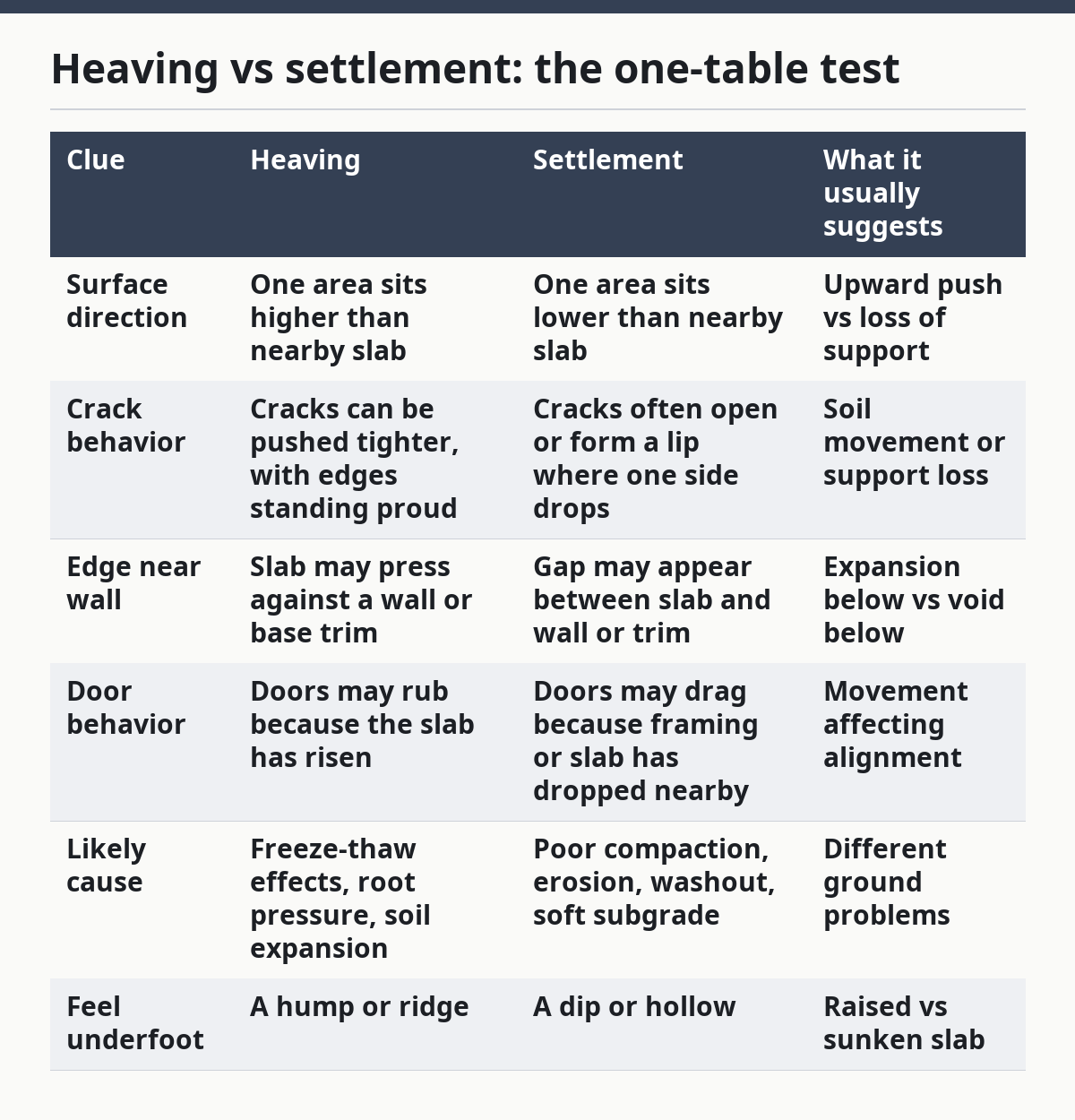
The truth is, one crack can fool you. A 10-foot straightedge, a 2-foot level, and a tape measure tell the story better than a quick glance. If the slab edge is 1/4 inch or more higher on one side, that points toward heaving; if it is lower, settlement is the better fit.
What do heaving and settlement look like in a slab?
Picture this: you walk the slab line slowly, checking the same edge in daylight and then again when shadows change. Heaving looks like a rise; settlement looks like a drop. That sounds simple, but the difference shows up in the shape of the slab, the crack lips, and how the joint meets the wall.
Heaving often makes a slab feel like a ramp or a hump. One panel can tilt up at a joint, and the high side may press hard against a garage wall, curb, or step. Settlement does the opposite. The surface dips, and the low side can leave a visible gap, sometimes just a few millimeters, between the slab and nearby trim or foundation details.
A few field terms help here. Differential movement means one part of the slab moves more than another part. Slab curl means the edges or corners lift or drop a little from drying or temperature changes, and that is not the same thing as structural heaving or settlement. Curling is usually a surface or edge issue; heaving and settlement are broader ground-support problems.
Use the shape, not the crack alone:
- A crack with one side higher than the other leans toward settlement on the lower side.
- A crack with one side squeezed up and tight against the other leans toward heaving.
- A wide, open crack can happen in both cases, so don’t stop there.
- A straight slab edge that bows upward in the middle is often heaving.
- A slab that forms a shallow bowl is often settlement.
How to check a concrete slab step by step
Picture this: you have a 2-foot level, a tape measure, chalk, and a notebook, and you want a clean answer in 20 minutes, not a guess. Measure the height change, then map the pattern. The sequence matters because one reading by itself can lie.
- Start at one fixed reference point. Pick a nearby wall, step, or garage threshold that will not move. Mark it with chalk and note the date. If your reference shifts, the rest of the readings lose meaning.
- Lay a straightedge across the suspect area. Use a 6-foot board, level, or straightedge if you have one. Verify whether the middle, one edge, or a corner sits above the line. A hump points toward heaving; a dip points toward settlement.
- Measure the difference at the joint. Put a tape measure or ruler at the crack or control joint and note the lip height on both sides. A visible offset around 1/8 inch is worth tracking; a larger offset is harder to dismiss. If the higher side is the same side every time, that matters.
- Walk the perimeter and look for pressure marks. Check base trim, brick, door bottoms, and expansion joints. Heaving often shows rubbing, compression, or tight contact. Settlement more often leaves a gap, a sag, or a door that no longer clears evenly.
- Trace the crack direction. Draw the crack on paper or snap a clear photo with a coin or tape measure beside it. If the crack opens wider near the low spot, settlement is more likely. If the crack looks pinched or folded upward, heaving moves up the list.
- Check for moisture or soil clues. Look for wet spots, poor drainage, downspout discharge, tree roots, or lifted mulch. Expansion from wet soil and root pressure can drive heaving. Soft, eroded, or washed-out soil usually points toward settlement.
- Repeat the check after 24 to 48 hours. A moving slab usually won’t jump overnight, but a second reading helps separate a one-time visual illusion from a real pattern. If the same spot keeps reading high or low, the pattern is real.
- Compare the high and low sides to nearby features. If the slab is pushing against a wall, curb, or stair, that supports heaving. If it has dropped away from those features, that supports settlement. A pattern tied to the surrounding structure is more reliable than a single crack photo.
If the area works like a bowl, you’re likely looking at settlement. If it works like a ridge, heaving is the better read. The result is clearest when you can describe it plainly: “the northeast corner is 3/16 inch higher than the adjacent panel,” or “the center dropped away from the threshold.”
Why the slab moved that way
Picture this: you’ve ruled out a simple surface crack, and now you want the cause before anyone starts talking about patching. Heaving comes from upward pressure; settlement comes from lost support. The cause matters because the repair path changes with it.
Heaving often traces back to freeze-thaw cycle effects, soil expansion, or tree roots. Water in the ground freezes, expands, and can push the slab upward. Clay-rich soil can swell when it gets wet and lift concrete. Roots can also exert pressure from below or from the side, especially near older slabs and planted edges.
Settlement usually points the other way. Soil may have been compacted poorly, washed out by drainage, or softened by repeated wetting and drying. Once the support under the slab gives way, the concrete drops into the void. A slab over fill dirt, a trench backfill, or a place that sheds water badly is more likely to settle than to heave.
The quick read is this:
- Upward pressure from soil, frost, or roots suggests heaving.
- Loss of support under the slab suggests settlement.
- Both can happen on one slab if different areas are affected by different ground conditions.
If the slab is in New York, local freeze-thaw conditions can matter, but the on-site pattern still tells you more than the climate alone. That is one reason the slab movement diagnosis page is more useful than a one-line “it must be frost” answer. For background on freeze-thaw action in concrete, the Portland Cement Association explains how freezing water can damage or lift concrete in cold climates, and USDA guidance on tree roots explains why roots can affect nearby surfaces and structures.
When the usual rule does not fit
Picture this: the slab has a high corner, a low middle, and one crack that crosses both. Mixed movement is real, and it changes the diagnosis. A slab does not have to choose one type of movement for its whole life.
Some common edge cases need a different reading:
- A slab can heave at one edge and settle at another. That usually means the ground conditions are different from one side to the other.
- A small surface lip can be curling, not heaving. Curling happens at edges and corners; it does not always mean the base soil is pushing up.
- A crack can look like settlement when it is really shrinkage. Shrinkage cracks are common and often thin, straight, and not tied to a height change.
- A thin overlay can hide the real slope. The top layer may look flat while the slab underneath has already moved.
- A slab next to a tree can show both root pressure and washout. One side may lift while another side drops.
A mixed case is usually easiest to handle by dividing the slab into zones and measuring each one separately. Use the same straightedge and take note of the 2 feet nearest the wall, the center, and the outer edge. If one zone rises while another sinks, you are not dealing with a single simple defect.
Common mistakes people make when reading slab movement
Picture this: you’ve got a photo on your phone, one crack line in front of you, and a strong guess already in your head. The wrong read usually starts with one clue taken out of context. A slab diagnosis needs the whole shape.
- Looking only at the crack. A crack by itself does not prove heaving or settlement. The consequence is a bad label. The fix is to measure height difference across the crack.
- Confusing curl with heave. Edge curl can look dramatic but stay local. The consequence is overcalling a minor edge lift as ground pressure. The fix is to check whether the whole panel has risen.
- Ignoring nearby drainage. Water can be the cause even when the crack looks dry. The consequence is missing the source. The fix is to check downspouts, grading, and wet spots within a few feet of the slab.
- Forgetting the opposite side of the slab. One bad corner can hide a second problem elsewhere. The consequence is a partial diagnosis. The fix is to walk the whole slab and measure at each joint.
- Using only your eye in flat light. Even a 1/8-inch offset can disappear in the wrong light. The consequence is underreading movement. The fix is to use a straightedge or level.
- Treating every raised slab as tree-root damage. Roots can cause heaving, but not every rise comes from roots. The consequence is a wrong cause. The fix is to look for root exposure, nearby trees, and the pattern of lift, and consult a qualified professional if the cause is unclear.
If you remember one thing, make it this: height change beats guesswork. A simple level reading tells you more than a dozen opinions.
When to stop and bring in qualified help
Picture this: you have a slab that keeps moving, the crack is widening, and the door now scrapes hard enough to leave marks. Stop the DIY diagnosis when the pattern stops being simple. On a legal question, that means moving from general information to a qualified local lawyer if you need advice for a specific dispute; on the slab itself, it means you may need a structural or foundation professional rather than another guess.
Movement is changing week to week: Ongoing movement means the ground condition may still be active — stop relying on one-time photos and get a qualified inspection plan.
One side is lifting while another side is dropping: Mixed movement means there may be more than one cause — document both areas separately before anyone talks repair.
The slab is pressing hard against a wall, post, or step: Compression can damage adjacent parts — stop forcing doors or joints and have the layout checked.
Water is pooling near the slab after rain: Drainage may be driving the movement — fix the water problem first or the movement can keep coming back.
Tree roots are visible near the edge: Root pressure can keep lifting the slab — don’t assume patching will solve a live pressure source.
You cannot tell which side is high after measuring: If the readings disagree, the issue may be curl, overlay, or mixed movement — use a better straightedge and, if needed, a site visit.
In a simple case, a homeowner can identify the direction of movement. In a messy case, the honest answer is “not enough information yet.” That is not failure. It is better than naming heaving when the slab is settling, or settling when the soil is actually pushing up.
How long the diagnosis takes and what a clear answer looks like
Picture this: you set aside half an hour, work through the slab once, then come back the next day with fresh eyes. A good diagnosis is a map, not a hunch. You should finish with a clear note on whether the slab rises, drops, or does both.
For a typical homeowner check, 20 to 30 minutes is enough to gather the first readings, and 24 to 48 hours gives you a useful second look. That is usually enough time to decide whether the movement pattern is consistent. If the slab is active, the same high or low spot should show up again.
A clear answer usually includes:
- the highest and lowest points,
- the size of the offset in inches,
- the crack locations,
- the nearby drain or root clues, and
- whether the movement matches heaving, settlement, or both.
If you can say, “the northeast corner is 3/16 inch higher than the panel beside it,” you have a usable diagnosis. If you can only say, “something looks off,” you need another round of measuring before any repair talk.
Drafted with AI; not yet reviewed by a person.