
Last updated: November 20, 2026
Quick Answer: Downspout placement affects a concrete slab most when roof runoff lands beside the slab edge and keeps the soil wet; moving the discharge point even a few feet farther away can help, but the right distance depends on slope, soil, and roof load. Downspout placement affects a concrete slab by concentrating roof runoff where the slab edge meets the soil. This article on How Downspout Placement Affects Water Around a Concrete Slab explains what placement does, what to change, and what a bad setup looks like.
Key Takeaways
- Roof water does the damage when it lands right next to the slab, not when it moves away quickly.
- A splash block helps only when it sends water onto a slope that keeps moving.
- An extension pipe is the cleaner fix when the discharge point is too close to the slab.
- Wet soil at the slab edge is the problem zone; that is where erosion and soft support start.
- If the grade falls back toward the slab, even a good downspout can make the water problem worse.
Downspout discharge is the real issue beside a slab
Downspout discharge affects a concrete slab by placing a concentrated stream of roof runoff where the slab edge meets the soil. If that water drops within a few feet of the slab, the ground there stays wet longer, and the edge of the slab sits next to weaker support.
Picture this: you’re watching rain pour off a roof and land in one narrow strip beside a sidewalk, patio, or garage slab. That strip soaks first, drains last, and takes the force of each storm in the same spot. Repeated wetting can create slab-edge saturation.
A slab does not usually fail because of one rainfall. It gets stressed when the same discharge point keeps feeding the same patch of soil. That is why a downspout on one corner can matter more than a long roof edge with no discharge control. The water exits fast, hits the ground hard, and often cuts a small channel. After a few storms, that channel can direct even more water toward the slab.
The roof area matters too. A larger roof section sends more water to one outlet, so a single downspout can handle a lot of runoff in a short burst. If that outlet is too close to the slab, the soil beside the concrete takes a beating every time it rains.
What to look for near the slab:
- Dark, damp soil that stays wet after the rest of the yard dries
- A narrow wash line running from the downspout toward the slab
- Fine soil or mulch pushed against the concrete
- Puddling at the slab edge after a storm
The problem is not the presence of water. It is the concentration. When roof runoff is spread out, the soil can absorb and shed it. When the discharge is focused, the slab edge pays the price.
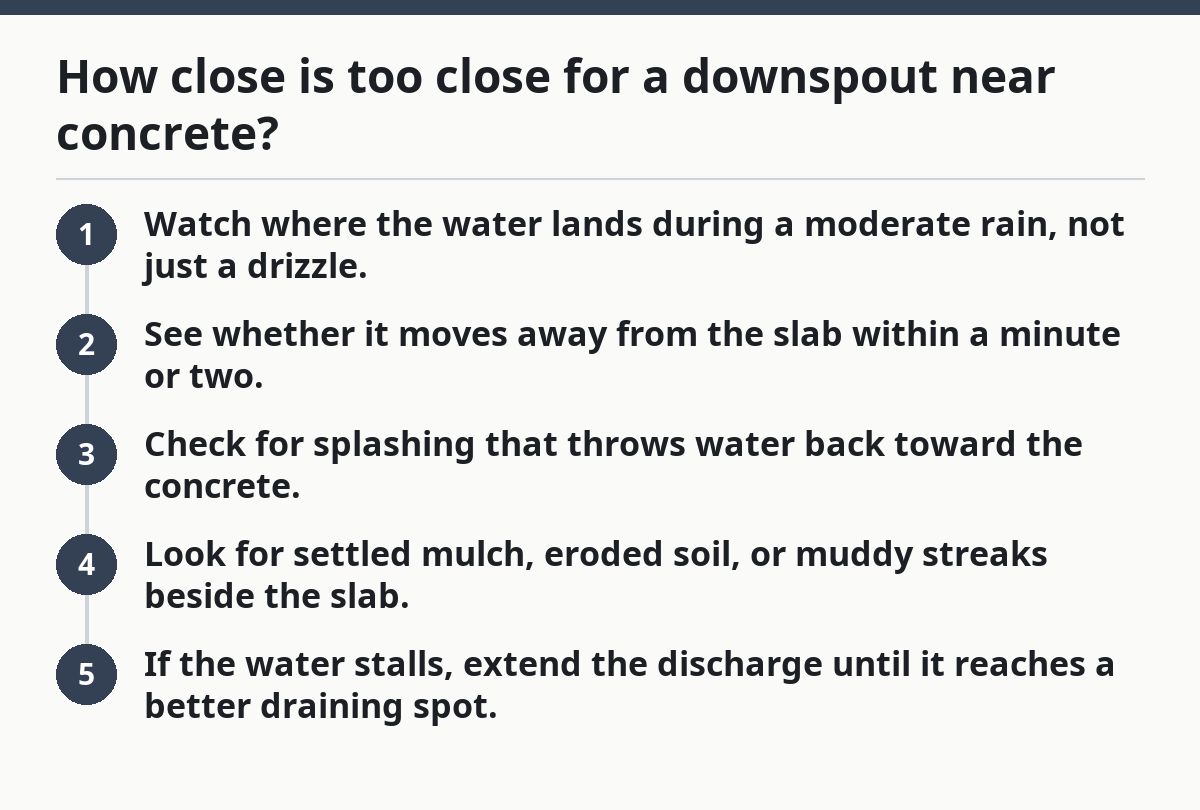
How close is too close for a downspout near concrete?
A downspout is too close when its discharge leaves water sitting beside the slab instead of moving it away from the slab. The safe distance depends on slope, soil, and how much roof area feeds that outlet, but the rule is simple: if water lands near the edge and does not keep traveling, the placement is wrong.
Picture this: you’re standing by the corner of a garage slab during a storm, and the downspout dumps water onto flat ground. If the soil is already damp or the yard falls toward the slab, the runoff has nowhere useful to go. Flat ground turns a small discharge into a slab problem.
The number matters less than what the ground does after the water lands. A short discharge to a sloped area can work. A longer discharge to a low spot can still fail.
Use this simple check:
- Watch where the water lands during a moderate rain, not just a drizzle.
- See whether it moves away from the slab within a minute or two.
- Check for splashing that throws water back toward the concrete.
- Look for settled mulch, eroded soil, or muddy streaks beside the slab.
- If the water stalls, extend the discharge until it reaches a better draining spot.
A bad placement often shows the same signs after each storm: wet perimeter soil, a soft shoulder at the edge, and water stains that mark the splash zone. A better placement moves the discharge beyond that zone so the slab edge stays dry.
If the lot slopes toward the house, even a decent downspout position can still feed water to the slab. On the flip side, if the yard falls away from the slab, a shorter extension may be enough. The terrain decides the result.
Splash blocks help, but only in the right setting
A splash block helps when it spreads roof runoff out and pushes it onto ground that slopes away from the slab. It does not fix a downspout that ends beside flat soil or a low spot.
Picture this: you place a molded splash block under the elbow, and the water shoots onto a short concrete pad. If that pad ends at level soil, the runoff slows down and soaks right there. That is a weak fix, not a drainage plan.
A splash block is cheap to install and easy to replace, which is why it shows up so often. It also has limits. It works best for moderate roof runoff, short discharge runs, and yards with enough fall to carry water away. It struggles when the roof dumps a lot of water at once or when the soil near the slab is already compacted.
Common mistakes with splash blocks:
- Setting the block flush against the slab, which sends splash back to the edge
- Ending the block on flat ground, where water just pools
- Using one block where a longer extension pipe is needed
- Letting the block tilt back toward the slab after the soil settles
The cost of a weak splash block setup is not just standing water. It is repeated wetting at the slab edge, which can soften the supporting soil and leave a muddy line that keeps returning. If the block keeps washing out the same strip of soil, it is doing almost nothing.
A better use of a splash block is to pair it with grading that falls away from the slab. Then the block becomes a guide, not the whole solution. For many slabs, that is enough only when the roof section is small and the drainage path is already decent.
When an extension pipe works better than a splash block
An extension pipe works better than a splash block when the downspout needs to carry roof runoff well away from the slab before it is released. It is the cleaner option when the discharge point has to move several feet, cross a walkway, or avoid a low spot beside the concrete.
Picture this: you’re trying to protect a patio slab, but the downspout empties near the edge and the ground there stays soggy. A short splash block just changes where the water lands. An extension pipe changes where the water goes.
That difference matters. An extension pipe reduces concentration at the slab edge by moving the discharge point farther out. It is especially useful where the roof drains a large section, where the soil is slow to absorb water, or where the slab edge already shows signs of saturation.
A good extension does three things at once: it carries the water, it lowers splash at the outlet, and it keeps the discharge point off the slab perimeter. A loose, crushed, or pitched-wrong pipe can back up and overflow beside the slab.
What makes an extension pipe work:
- A firm connection at the downspout elbow
- Enough length to clear the slab perimeter
- A discharge point that lands on ground that drains away
- A path that does not trap debris or create a hidden clog
The trade-off is clear. A longer extension is more visible and can be in the way of mowing or walking. It is still usually better than letting roof runoff dump next to the slab. If the yard cannot accept the pipe cleanly, that tells you the drainage plan needs more than a quick add-on.
This is the point where a proper layout matters. The pipe should solve the water path, not just hide it. Otherwise, you are still feeding the same wet strip beside the concrete.
A simple way to judge the right downspout placement
The right downspout placement sends water away from the slab, keeps the edge soil from staying wet, and fits the slope of the yard. That is the goal; the steps below show how to check it without guessing.
Picture this: you’re standing at the slab after rain and trying to decide whether the downspout is a nuisance or the main cause. You do not need fancy tools to spot the pattern. You need to trace the water path.
-
Stand where the downspout discharges and watch the first minute of flow.
If the water lands within a few feet of the slab, note where it spreads and whether it heads back toward the concrete. -
Check the slope beside the slab.
If the soil falls toward the slab, even a short discharge may fail. If it falls away, a shorter extension may be enough. -
Look at the soil line along the slab edge.
Saturated soil, sediment lines, or a muddy lip all mean the discharge is too concentrated in that spot. -
Compare the roof load from that downspout with the ground it drains to.
A large roof section usually needs a longer discharge path than a small porch roof. -
Choose the fix that moves water beyond the wet zone.
That may be a splash block on a good slope, or an extension pipe when you need more distance.
A misplaced downspout often creates a repeatable pattern: wet edge, soft soil, then surface movement or cracking symptoms. The slab is reacting to what the soil is doing beside it. A quick visual check after rain tells you more than a dry-day inspection.
For a broader look at slab drainage, the hub page on Drainage and water management for slab performance can help frame the rest of the site’s guidance.
What a bad job looks like around a concrete slab
A bad downspout setup leaves obvious clues around the slab within a few storms, and most of them start at the soil line. You will usually see water running straight off the roof and landing where the slab meets the ground, then hear it splash or watch it pool in the same place.
Picture this: you keep seeing the same wet corner, the same eroded strip, and the same stain line on the concrete. That is not random. It is a placement problem.
A poor setup usually shows at least one of these:
- The downspout ends right next to the slab
- The splash block or pipe points toward the slab instead of away from it
- Water ponds beside the concrete for more than a short drain-down
- Soil has washed out from under mulch or around the edge
- The discharge path crosses back toward the slab after a small dip
The cost of ignoring that pattern is not just cosmetics. Wet perimeter soil can stay loose, settle unevenly, and create conditions that invite slab-edge movement. Even when the slab itself looks fine, the support around it may be changing.
The fix is not always expensive, but the wrong fix can waste money fast. Adding a splash block where an extension pipe belongs does not solve concentration. Extending a pipe into a low area does not solve drainage either. The placement has to match the ground.
If the slab is already showing movement, a drainage adjustment may still help stop the water source. It will not erase every symptom by itself. Moving runoff away before the soil at the edge gets soaked again gives the slab a better chance of staying supported.
What to ask a contractor before you change the downspout
A contractor should explain where the water will go, how far it will travel, and what happens during a heavy storm. If they cannot answer those three things clearly, the plan is not ready.
Picture this: you want a cleaner setup, but you do not want a fix that just moves the problem 6 feet over. Ask about the whole path from roof edge to discharge point. That path is the job.
Use these questions:
- Where will the water leave the downspout, and where will it end up?
- Will a splash block be enough, or does this slope need an extension pipe?
- Does the discharge point fall away from the slab, or will it collect water?
- What will keep the pipe from clogging, shifting, or draining back toward the slab?
- If the grade is wrong, what part of the setup changes the grade or the outlet location?
A good contractor will talk about slope, soil, and runoff concentration, not just about attaching parts. That matters because the same downspout can behave differently on clay, sand, or compacted fill. Near a concrete slab, the edge condition is what counts.
This is also where local conditions change the answer. A yard with shallow soil and poor drainage needs a different layout than one with fast-draining ground. If the lot already holds water after rain, the discharge point may need more separation from the slab than a simple splash block can provide.
The right goal is plain: keep roof runoff from soaking the slab edge. If the plan does that, the slab has a much better chance of staying supported the way it should.
How far should downspouts drain from concrete?
Downspouts should drain far enough from concrete that water does not soak the slab edge or sit beside it. The exact distance depends on slope, soil, and roof load, so there is no single number that fits every yard. The useful test is simple: if the discharge point leaves the ground wet next to the slab after a storm, it is too close.
Can downspouts cause slab settlement?
Yes, downspouts can contribute to slab settlement when they repeatedly saturate the soil beside the slab. The problem is not the pipe itself; it is the water concentrated in one place. Over time, that wet soil can lose strength or wash away, which can leave the slab edge with less support.
What is one good way to move roof water away from a slab?
One good way to move roof water away from a slab is to send it far enough from the edge that it no longer wets the perimeter soil. For many setups, that means an extension pipe instead of just a splash block. The right answer depends on slope and soil, but the discharge point should end where water keeps moving away from the slab, not back toward it.
Drafted with AI; not yet reviewed by a person.