
Last updated: November 20, 2026
Key Takeaways
- Best when the slab is sound, the voids are local, and you want faster return to service with less digging.
- If washout, drainage, or unstable fill is still active, the slab may keep moving after a lift.
- Slab lifting fits best when the concrete is still worth saving and the problem is height, not collapse.
- Polyurethane foam is usually the better modern option because it is lighter, uses smaller holes, and often returns the slab to service faster.
Slab lifting problems usually come down to one choice: fix the settled concrete now, or spend money on the wrong method and still have the slab moving. The right call depends on whether the slab is still structurally sound, how much it has moved, and whether water or voids are still active. The steps below will help me sort that out before I hire anyone. This Pre-purchase decision support for slab lifting — The Complete Guide is meant to help readers compare options before they pay for work.
I write about slab repair, concrete movement, and site conditions from the contractor-side of the trade, so I know where the fast sales pitch goes wrong. In practice, slab lifting is usually decided by three things: condition, cause, and cost.
Our Top 3 Picks at a Glance
#1 Best Overall: Injection lifting with polyurethane foam
Polyurethane foam is best when the slab is sound, the voids are local, and I want fast return to service with less digging.
#2 Best Budget Pick: Mudjacking
Mudjacking is best when the slab is thick enough, access is open, and the project can tolerate more mess and cure time; I still recommend consulting a professional before choosing it.
#3 Best Heavy-Duty / Upgrade Pick: Slab replacement
Slab replacement is best when the concrete is broken, the base has failed badly, or the slab movement is part of a larger drainage problem.
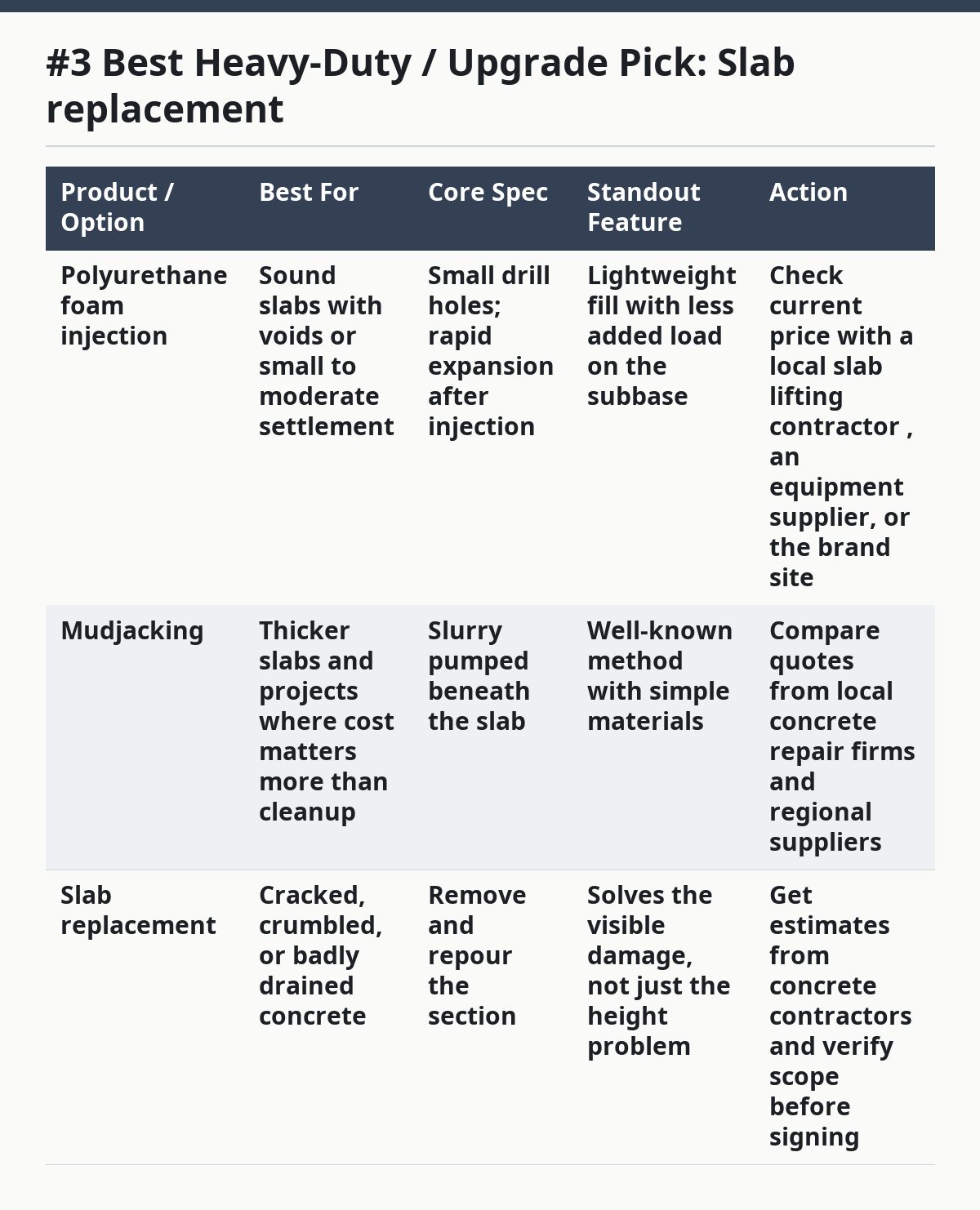
| Product / Option | Best For | Core Spec | Standout Feature | Action |
|---|---|---|---|---|
| Polyurethane foam injection | Sound slabs with voids or small to moderate settlement | Small drill holes; rapid expansion after injection | Lightweight fill with less added load on the subbase | Check current price with a local slab lifting contractor, an equipment supplier, or the brand site |
| Mudjacking | Thicker slabs and projects where cost matters more than cleanup | Slurry pumped beneath the slab | Well-known method with simple materials | Compare quotes from local concrete repair firms and regional suppliers |
| Slab replacement | Cracked, crumbled, or badly drained concrete | Remove and repour the section | Solves the visible damage, not just the height problem | Get estimates from concrete contractors and verify scope before signing |
What decision matters before you spend a dollar?
The decision is not “Which lift method is cheapest?” It is “Is this slab worth lifting at all, and if so, which method fits the damage?” That question saves far more money than chasing a low bid with the wrong fix.
A slab that has sunk because of a washed-out base, broken drainage, or unstable fill can keep moving after any lift. If the cause is still active, the repair is temporary. That is why the first pass is inspection, not pricing.
Before I call anyone, I check these four things:
- Is the slab cracked, or just out of level?
- Is the movement localized at one edge, or spread across the panel?
- Is there standing water, downspout discharge, or poor slope nearby?
- Does the slab still sound solid when tapped, or does it feel hollow?
Here’s the catch: not every dip needs lifting.
A thin cosmetic unevenness near a garage threshold may be tolerable if trip risk is low and the slab is stable.
How do I know if slab lifting is the right fix?
Slab lifting is the right fix when the concrete is still worth saving and the problem is height, not collapse. If the panel is intact, the base has voids or minor settlement, and water can be managed, lifting usually makes sense.
Picture this: you’re standing at the edge of a driveway or patio, and one corner has dropped an inch or two. The concrete is still in one piece, the crack lines are clean, and the area below has not crumbled into mud. That’s the kind of job where lifting can work.
The best candidates usually share three signs:
- The slab is not shattered into many pieces.
- The settlement is moderate, not catastrophic.
- The cause looks local, like erosion, washout, or poorly compacted fill.
A bad candidate looks different. Multiple wide cracks, spalling, heaving from frost, or a base that keeps pumping water all point away from simple lifting. In those cases, replacement often beats repair because the slab itself has lost too much integrity.
A quick field check helps:
- Look for joints that still align.
- Watch for water paths from roof runoff.
- Check if doors, garage tracks, or steps are binding because of the height change.
- Note whether the slump happened after a heavy rain, a downspout change, or utility work.
Don’t pay for lifting if the base problem is still active. That includes poor drainage, a leaking line, or erosion under the slab. According to the U.S. Environmental Protection Agency, drainage and runoff control are part of managing water near structures, not just concrete itself.
Polyurethane foam vs. mudjacking: which one actually fits the job?
Polyurethane foam wins for most modern slab lifting jobs because it is lighter, needs smaller holes, and usually gets the slab back in service faster. Mudjacking still has a place when the slab is thicker, the access is easy, and the job is mostly about price.
Picture this: you’ve got a settled walkway, a garage apron, or a front stoop, and you need the height corrected without tearing out the whole area. Now you’re choosing between a foam system that expands beneath the slab and a slurry that fills the void with heavier material. The method changes the risk, the mess, and the long-term fit.
Poly foam is a good match when:
- The slab is sound but hollow underneath.
- You want smaller drill holes.
- Added weight on soft soil is a concern.
- You need a faster return to use.
Mudjacking is a better fit when:
- The slab is thick and strong.
- The project is straightforward and open.
- You can live with larger holes and more cleanup.
- A lower-cost approach matters more than finesse.
The truth is, foam is not magic. It can still fail if the drainage issue stays unresolved, and some jobs need repeated attention if the soil keeps settling. Mudjacking is not old-fashioned junk either; it can be the smarter call on heavy concrete where lightweight fill would be unnecessary. For a deeper comparison, see the polyurethane foam injection guide and mudjacking basics.
The Honest Side-by-Side
Polyurethane foam usually wins on precision and speed, while mudjacking wins on simplicity and familiarity. The better choice depends on slab condition, soil behavior, and how much disturbance you can tolerate.
Picture this: you’ve narrowed it to two contractors, each pushing a different method and each making the other sound outdated. The real job here is to compare what changes for you on the ground, not just what sounds better in a sales pitch.
| Criteria | Polyurethane Foam | Mudjacking | Winner for [condition] |
|---|---|---|---|
| Hole size | Smaller injection holes | Larger pump holes | Foam, when you want less visible patching |
| Added weight | Very light | Heavier slurry | Foam, on weak or soft subgrades |
| Cure or return time | Usually faster | Slower than foam in many jobs | Foam, when downtime matters |
| Cleanup | Usually less messy | More slurry cleanup | Foam, for finished surfaces |
| Up-front simplicity | Requires specialized equipment | More familiar to many crews | Mudjacking, for basic local work |
| Fit for thick slabs | Can work, but not always the first choice | Often well-suited | Mudjacking, for heavy slabs |
| Void-filling behavior | Expands into cavities | Fills with cementitious slurry | Foam, for small voids and tighter control |
| Overlift risk | Present if injection is poorly controlled | Present if pumping is poorly judged | Neither; skill matters more than method |
| Long-term success | Depends on drainage and soil stability | Depends on drainage and soil stability | Tie, if water is not fixed |
| Visual finish | Smaller holes and less patching | Bigger holes and visible patch work | Foam, for visible front-of-house areas |
Here’s the catch: the table does not decide the whole job. Drainage, base condition, and slab thickness still outrank the method.
Poly foam is strongest where the slab is shallow enough to lift cleanly and where I want a tidy finish near a driveway edge, patio, or entry walk. Mudjacking is stronger where the slab is heavy, the surface is not a cosmetic showcase, and the crew needs a more traditional method that handles larger fills.
A bad foam job usually comes from rushing injection points or ignoring underlying washout. A bad mudjacking job usually comes from overloading weak soil or leaving too much patch visible in a front-facing area. Both can work. Neither forgives a lazy diagnosis. According to the American Concrete Institute, slab performance depends on both the concrete and the supporting base, so the base matters as much as the lift.
What should I ask a contractor before I hire them?
You should ask how they diagnose the cause, how they decide between lifting and replacement, and what they do if the slab keeps moving after the repair. Those answers matter more than the sales pitch, so I would consult a professional who can explain the site conditions clearly.
Picture this: you’re on the phone with a contractor, and the estimate sounds clean. But you still don’t know whether they checked for washout, whether they plan to seal joints, or whether they even think the slab can be saved. That’s where the real decision lives.
Ask these questions before you sign:
- How do you decide between foam, mudjacking, and replacement?
- Will you inspect drainage and runoff near the slab?
- What happens if the slab settles again after the lift?
- Do you patch the injection holes, and how visible will they be?
- Can you explain why your method fits my slab thickness?
A good contractor should be able to explain the condition in plain language. They should point to the crack pattern, the edge settlement, the water path, or the void pattern. If they jump straight to a method without a diagnosis, that is a warning sign.
Ask for the repair plan, not just the lift. The plan should mention runoff control, joint sealing, and what to do if the base keeps eroding. If anything in that plan is unclear, I would consult a professional before signing.
The best part is that this is where I filter out the sales-only crews. A contractor who can’t explain the cause usually can’t fix the cause.
When does slab replacement beat lifting?
Slab replacement beats lifting when the concrete is too damaged to trust, or when the base failure is so bad that a lift would only hide the problem for a while. If the slab is broken, crumbling, or badly undermined, replacement is often the safer spend.
Picture this: you walk up to a slab and see more than one large crack, broken corners, surface scaling, and a section that sounds hollow from one end to the other. You can lift it, maybe, but the slab itself is already failing. That is not a good candidate for a cosmetic fix.
Replacement usually makes more sense when:
- The slab has widespread cracking.
- The concrete has lost strength from freeze-thaw damage or spalling.
- The base is so poor that the repair would need major rebuild work anyway.
- The height issue is tied to bad grading that will need correction first.
On the flip side, replacement is more disruptive. It means removal, haul-off, new base prep, and new concrete. That takes more time and usually costs more labor than lifting. But it gives you a fresh slab with a chance to fix the base and drainage properly.
A common mistake is paying to lift a slab that should have been rebuilt. That mistake shows up later as another settlement, another crack, or an ugly patch line that never disappears. If the slab is structurally tired, lift money is wasted money.
What makes a slab lifting estimate trustworthy?
A trustworthy estimate names the method, the area, the likely cause, and the limits of the repair. It does not pretend every slab can be restored the same way.
Picture this: two bids arrive on the same day. One says “lift driveway.” The other says “lift front slab, seal joints, and recommend downspout extension because water is pooling near the edge.” The second one gives you something to judge. The first one just gives you a number to chase.
A solid estimate should include:
- The method: foam, mudjacking, or replacement
- The section being treated
- The visible damage they saw
- Any hole patching or cleanup
- Whether drainage changes are part of the scope
- What is excluded from the job
One thing a generic article gets wrong is pretending all price quotes are equally useful. They are not. A short quote that omits the cause is often the one that leaves out the most expensive part of the fix.
If you get a vague bid, ask for a revised scope. The number matters less than the repair logic. A cheaper quote that ignores drainage is not a bargain.
Which option should I choose for my situation?
Choose polyurethane foam if the slab is still sound, you want smaller holes, and the job needs less disturbance. Choose mudjacking if the slab is thick, the project is straightforward, and the heavier fill suits the structure. Neither if the concrete is broken badly enough that replacement is the real answer.
Picture this: you’ve done the walk-through, and the slab is not a mystery anymore. You know whether the issue is a small void, a heavy panel, or a damaged section that needs new concrete. That is enough information to make the call.
Use this rule:
- Foam for tidy, lighter, precision-minded lifting.
- Mudjacking for thicker slabs and simple, open access.
- Replacement for slabs that are cracked, crumbling, or repeatedly failing.
A lot of buyers get stuck because they want the cheapest fix and the longest life at the same time. That wish is normal. It is also where bad choices start. For more buying context, compare this page with the foundation repair guide and concrete crack repair overview.
What should make me walk away from slab lifting entirely?
You should walk away from slab lifting when the ground is unstable, the concrete is broken beyond repair, or the source of movement is still active. In those cases, the lift is only a delay.
Picture this: a patio edge keeps dropping after rain, a downspout empties beside the slab, or a crack reopens after a previous repair. That pattern says the ground is still moving. A new lift will not beat that.
Walk away if you see:
- Multiple failed lifts in the same spot
- Heavy breakup of the slab surface
- Persistent water at the slab edge
- Evidence of leaking utilities or severe washout
- Frost heave or drainage problems that have not been fixed
The limit is simple: no lift can outrun bad water management forever. Fix the runoff, fix the base, or replace the slab if the structure is done.
FAQ
How do I know whether foam or mudjacking is better?
Foam is better when you want lighter material, smaller holes, and a cleaner finish. Mudjacking is better when the slab is thicker and the job is less sensitive to cleanup. The right answer depends on the slab’s condition, not the sales pitch.
Is slab lifting a permanent fix?
It can last a long time, but it is not permanent if the soil keeps settling or water keeps washing out the base. The repair is only as good as the drainage and subgrade under it. If those stay bad, the slab can move again.
Can every cracked slab be lifted?
No. A cracked slab can sometimes be lifted if the concrete is still structurally sound, but widespread cracking, crumbling edges, or heavy spalling often push the job toward replacement. The crack pattern matters as much as the height problem.
Should I choose the cheapest estimate?
Not by default. The cheapest estimate can leave out drainage work, proper diagnosis, or enough material to correct the lift. A better bid explains the cause, the method, and what happens if the slab settles again.
What is the biggest mistake people make before buying slab lifting?
They hire for the height problem and ignore the cause. If water is still pooling, running off the wrong way, or washing out the base, the repair may only hide the symptom. Fix the cause first or the slab may move again.
Drafted with AI; not yet reviewed by a person.