Last updated: November 20, 2026
Key Takeaways
- Match the wet spot with rain, location, and drying time to narrow the source.
- Surface water is most likely when the wet slab problem traces to something above ground.
- Groundwater is more likely when the slab stays damp after the surface dries.
- Watch one rain event and one dry spell, then compare where moisture starts and how it behaves.
Your slab is getting wet, and the source is usually surface water if the moisture follows rain or runoff, or groundwater if it stays wet after dry weather. In other words, How to Tell If a Slab Problem Is Coming from Surface Water or Groundwater comes down to timing and location. The clues below will help you sort the two out before you chase the wrong fix.
Quick answer: the pattern tells you where the water is coming from
Picture this: you’re looking at a damp edge along a concrete slab after a storm, and the same spot dries out in two days. That often points to surface water, not a deep slab defect. If the moisture keeps coming back for days with no rain, groundwater moves higher on the list.
The first clue is timing. Surface water shows up after roof runoff, splashing, clogged downspouts, or poor grading. Groundwater usually shows a slower, stubborn pattern tied to wet seasons, a high water table, or seepage through soil that stays saturated. That difference matters because the fix can be a downspout extension or a drainage change, not a slab repair.
Key takeaway: rain-linked, edge-heavy wetness usually means surface runoff; persistent wetness after dry weather points more toward groundwater.
Here’s the catch:
- Surface water often leaves visible wet soil, splash marks, or puddles near the slab.
- Groundwater often shows as moisture coming from below or along a cold joint, with no obvious puddle outside.
- A slab can have both problems at once.
How can I tell if a slab problem is coming from surface water or groundwater?
You can tell by matching the wet spot to the weather, the location, and how fast it dries. If the damp area changes within 24 to 48 hours after rain, runoff is more likely. If it stays damp through a 3- to 7-day dry stretch, groundwater deserves a closer look.
Start with the easiest clues. Walk the slab after a hard rain and again after two dry days. Look for where the wetness starts, not just where it ends. The edge nearest a gutter overflow or a low yard slope often gives away surface water. A wet center area with no wet yard nearby is more suspicious for groundwater or a plumbing leak.
For example, mark the wet edge with chalk or tape after rain. The result should show whether the damp zone starts at the outside perimeter or under the slab. Then check the soil 3 to 6 feet from the slab. If the ground is soaked at the surface, runoff is in play. After that, watch the same spot during dry weather, because persistent moisture without rain pushes the case toward groundwater. Also note roof and gutter behavior. A downspout dumping water within a few feet of the slab can mimic a groundwater problem. Compare opposite sides of the slab too; one wet side often means drainage trouble, while uniform wetness can mean a broader moisture source.
A surface-water problem usually leaves a story you can see. A groundwater problem often does not.
What surface-water clues should I look for around the slab?
Surface water is the likely source when you can trace the wet slab problem back to something on top of the ground. Picture a yard after a 1-inch rain: water sheets off a driveway, gathers beside the slab, and soaks in near the edge. That pattern is classic runoff behavior.
Look for these signs first:
- Downspouts dumping close to the slab
- Roof valleys spilling onto one side
- Soil that slopes toward the slab over the first few feet
- Puddles that sit in place after rain
- Mud streaks, splash marks, or mulch moved by water
The strongest clue is location. Surface water usually shows up at the outside perimeter, at steps, at slab edges, or where the grade drops the wrong way. If a hose test sends water toward that side and the moisture appears soon after, you’ve probably found the path.
Therefore, if the wet spot gets worse during or right after rainfall, and the outside soil is also wet, think drainage first. That means looking at gutters, splash blocks, grading, and any low point that funnels water to the concrete slab.
One common mistake is blaming the slab before checking the yard. That costs time and money. A $20 to $50 downspout extension can solve a problem that looks like a major structural issue.
What groundwater clues should I look for below the slab?
Groundwater is the better bet when the slab stays damp even after the surface around it has dried out. Picture this: it rained last week, the yard looks fine today, and the slab edge still shows dark moisture lines. That kind of slow, lingering wetness points below the surface.
Groundwater clues are usually less obvious than runoff clues. Watch for:
- Moisture that returns in a wet season and fades in a dry season
- Dampness that starts at the slab edge but has no puddles nearby
- Seepage through cracks, joints, or the base of a wall
- White mineral deposits where water has dried repeatedly
- A cool, damp feel underfoot without any fresh rain
The big difference is source depth. Surface water enters from above or beside the slab. Groundwater pushes through soil from below or from saturated ground next to the slab. It often takes longer to appear and longer to disappear. That slow cycle is a clue, not a diagnosis by itself.
Do not confuse this with a one-time wet patch from a spill or plumbing line. Groundwater problems tend to repeat with the season, not with a single event. If the moisture is strongest after several rainy days and the yard never drains fully, that pattern is much more consistent with groundwater seepage.
On the other hand, groundwater can be hard to prove without seeing the broader site. That’s why the timing, the outside soil, and the wet spot’s location all matter together.
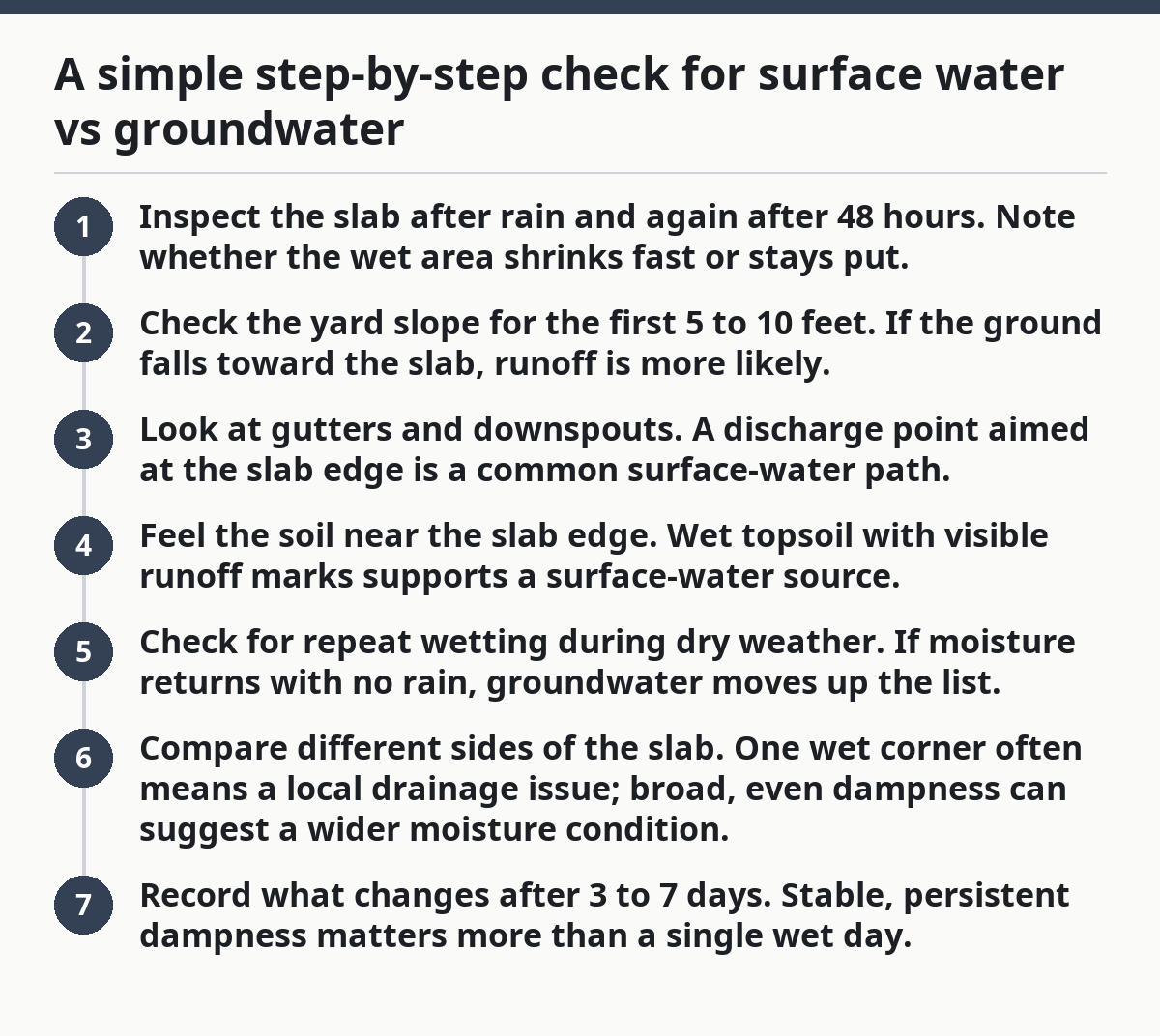
A simple step-by-step check for surface water vs groundwater
You can separate the two by watching the slab through one rain event and one dry spell, then comparing where the moisture starts and how it behaves. This takes less than a week in many cases.
- Inspect the slab after rain and again after 48 hours. Note whether the wet area shrinks fast or stays put.
- Check the yard slope for the first 5 to 10 feet. If the ground falls toward the slab, runoff is more likely.
- Look at gutters and downspouts. A discharge point aimed at the slab edge is a common surface-water path.
- Feel the soil near the slab edge. Wet topsoil with visible runoff marks supports a surface-water source.
- Check for repeat wetting during dry weather. If moisture returns with no rain, groundwater moves up the list.
- Compare different sides of the slab. One wet corner often means a local drainage issue; broad, even dampness can suggest a wider moisture condition.
- Record what changes after 3 to 7 days. Stable, persistent dampness matters more than a single wet day.
This process won’t tell you everything, but it will keep you from chasing the wrong fix first. That saves a lot of guesswork.
Sources that help frame the problem
The American Society of Civil Engineers and the Concrete Foundation Association both discuss drainage and moisture control around slabs and foundations in practical terms. The U.S. Environmental Protection Agency’s guidance on roof runoff and site drainage is also useful for spotting surface-water paths before they reach concrete. See the EPA’s roof drainage and runoff guidance, plus the CFA’s moisture-control resources, for related background on drainage and slab performance.
Mistakes that blur the source
You can miss the real source by looking at the slab alone. Picture a homeowner who seals a crack because the interior floor is damp, only to find the same wet line after the next storm. The problem was outside, not in the patch.
The most common mistakes are simple:
- Checking once, then stopping. One rain event is not enough.
- Ignoring the outside grade. A slab can look guilty while the yard is doing the damage.
- Calling every damp spot groundwater. Roof runoff often causes the same look.
- Treating mineral stains as proof of the source. Mineral stains suggest repeated wetting, but they do not by themselves prove where the water started; consult a qualified slab or drainage professional.
The cost of those mistakes is wasted repair work. A crack seal, coating, or interior patch may hide the symptom for a while, but it won’t stop water that keeps arriving from the same path. A better approach is to match the moisture pattern to a weather pattern first.
Here’s a practical rule: if the wet area lives at the outside edge and changes with rain, start with surface water fixes. If it survives dry weather and feels like it comes from below, study groundwater conditions and site drainage more closely. That split is not perfect, but it is a lot better than guessing.
When the pattern still does not make sense
You should bring in a qualified slab or drainage pro when the moisture pattern stays mixed after a full rain-and-dry cycle. Picture a slab that gets wet at the edge, shows minerals in the middle, and never gives you a clean pattern. That usually means more than one source may be involved.
This is the point where a site map, moisture readings, or a closer look at the drainage layout can help. A pro can sort out whether the main issue is runoff, seepage, or something else tied to the slab system. That matters because the wrong fix can hide the real path and make the wetness worse.
The truth is, some slabs sit in difficult ground conditions. Clay soils, a shallow water table, or bad grading can all create confusing moisture signs. If the source still looks unclear after several days of observation, don’t keep guessing at random. That wastes time and muddies the evidence.
For broader drainage fixes around slabs, the hub page on Drainage and water management for slab performance is the next step to read once you know which source is most likely.
How can I tell if a slab problem is coming from surface water or groundwater?
Start with timing, location, and drying speed. If the wet area appears after rain and dries within 1 to 2 days, surface water is more likely; if it stays damp through a longer dry stretch, groundwater moves higher on the list. The outside soil, gutter discharge, and slab edge tell most of the story.
Does groundwater affect slabs differently?
Yes. Groundwater usually works more slowly and more persistently than surface water. It tends to show up as seepage through soil or joints, and it often follows wet seasons rather than single storms. Surface water is easier to trace because you can usually see where it entered near the slab.
What clue shows water is below the slab?
A wet spot that stays active after the yard has dried is the clearest clue. If the moisture keeps returning without new rain, and it is strongest along joints or the slab edge, the source may be below or beside the slab rather than above it. Persistent mineral staining can support that pattern, but it does not prove it alone.
Drafted with AI; not yet reviewed by a person.