Last updated: November 20, 2026
Quick Answer: a concrete slab damage evaluation often starts with four checks — location, width, depth, and movement — and a first pass can take under 10 minutes with a tape measure, straightedge, flashlight, and phone camera. In this guide, Damage Evaluation for Concrete Slabs — The Complete Guide means reading the slab for structure, drainage, and soil movement, not just for appearance.
Concrete slab damage is usually judged by location, width, depth, and movement — not by the crack alone. The right call is whether the slab is still stable, still draining, and still safe to use.
This guide to Damage Evaluation for Concrete Slabs — The Complete Guide breaks down what damage means, what is normal, what is serious, and when to call a contractor.
A qualified concrete pro reads slabs for structure, drainage, and soil movement; that’s the lens I’m using here, not a cosmetic one.
Key Takeaways
- Not every crack means failure. Hairline shrinkage cracks can be normal in slabs that are otherwise flat and stable.
- The biggest warning signs are vertical displacement, widening cracks, settled corners, and spalling near joints or edges.
- Soil movement, poor drainage, and bad base prep cause more slab damage than the concrete mix itself.
- Repair choice depends on whether the slab is merely cracked, out of level, or actually breaking apart.
- A good evaluation looks at crack size, pattern, moisture, and movement over time, then matches the fix to the cause.
- If the slab is part of a driveway, garage, patio, or foundation system, the stakes change fast.
What damage means on a concrete slab
Damage means the slab has stopped acting like one piece of stable concrete. A crack alone may be harmless; a crack with height difference, crumbling edges, or active movement is a different problem.
Picture this: you’re standing in a garage and notice a line across the floor, a chipped edge near the door, and one side that feels a little higher underfoot. That mix of signs matters more than the line alone. Because of that, the first job in Damage Evaluation for Concrete Slabs — The Complete Guide is separating surface marks from active movement.
- Hairline cracks are often shrinkage cracks from curing.
- Wide cracks suggest movement, settlement, or load stress.
- Heaving means one side has lifted, often from soil expansion or frost.
- Spalling is surface breaking or flaking, usually from freeze-thaw, salt, or weak surface paste.
- Settlement means the slab has dropped because the soil below moved or compacted.
A slab can have one of these and still be usable. A slab with several is where the evaluation gets serious.
The first pass: what to look for in under 10 minutes
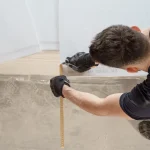
Start with the obvious signs before you think about repair methods. A tape measure, a straightedge, a flashlight, and a phone camera are enough for the first pass.
- Measure the crack width at a few points.
- Check whether the crack is straight, stepped, or branching.
- Look for vertical offset where one side sits higher than the other.
- Note whether water pools near the damage after rain or washing.
- Watch for rust stains, powdery concrete, or broken corners.
If the slab is indoors, look for doors that stick, trim gaps, or cabinet lines that no longer match the floor. Those clues often point to movement, not just surface cracking. For a broader home check, see the guide to foundation settlement signs and how to read slab cracks.
How to tell normal cracks from structural damage
Normal cracks are usually narrow, stable, and not tied to a change in height. Structural damage shows movement, widening, or loss of support. That is the difference that changes the job.
Picture this: you’re looking at a driveway crack that has stayed the same for two years. The slab may be fine. Now picture the same crack with one side 1/4 inch higher and a puddle sitting in the low spot after every storm. That is a different problem. In Damage Evaluation for Concrete Slabs — The Complete Guide, that 1/4 inch difference matters more than the crack line by itself.
Common crack types and what they usually mean
- Plastic shrinkage cracks form early, often in a random pattern near the surface.
- Drying shrinkage cracks run across slabs as the concrete loses moisture.
- Settlement cracks form where the ground below has compacted or washed out.
- Heave cracks happen when soil expands upward.
- Control joint cracks are often intentional and can be normal if they stay aligned.
A crack that follows a control joint is usually less worrying than one that cuts across the slab at an odd angle and keeps widening. The pattern tells part of the story.
Signs the slab is more than “just cracked”
Here’s the catch: the crack width alone does not tell you enough. A narrow crack with clear vertical movement can be worse than a wider crack that has stayed flat for years.
- Vertical displacement
- Edge breakup
- Repeated cracking nearby
- Water intrusion
- Visible rebar or mesh exposure
- Sound change underfoot when you tap or walk the area
If you see two or more of those, the slab needs a deeper look. That does not always mean replacement, but it does mean the damage is active or the support below is weak. The Concrete Network’s repair guidance and the Portland Cement Association both emphasize movement and support as key clues, not crack width alone. See also the concrete crack repair guide.
What causes slab damage in the first place?
Most slab damage starts below the slab, not in the visible surface. Poor drainage, weak soil, bad compaction, freeze-thaw cycles, and heavy loads all push concrete until it cracks or moves.
Picture this: you’re looking at a patio that drains toward the house, the soil stays damp, and the slab has started to tilt. The concrete is not the whole problem — the ground is. That is why a slab evaluation has to look beyond the top surface.
The most common causes
- Poor base prep: If the subgrade was soft or uneven, the slab can settle later.
- Water problems: Downspouts, grading, and broken drains can wash soil away.
- Freeze-thaw cycles: Water in and under the slab expands when it freezes.
- Tree roots: Roots can lift slabs or dry the soil and cause settlement.
- Heavy loads: Trucks, storage, hot tubs, or concentrated loads can overstress a slab.
- Shrinkage and curing issues: Fast drying or poor joint planning can create early cracks.
A generic article often blames “old concrete,” but age is only part of the picture. A 5-year-old slab over bad fill can fail before a 25-year-old slab on stable ground. The support system matters more than the calendar. For more context on soil and drainage, see drainage problems around concrete and soil movement under slabs.
Climate and site conditions change the answer
Where you are changes what damage means. In colder climates, freeze-thaw and deicing salts raise the risk of surface scaling and joint damage. In areas with expansive clay soils, seasonal swelling and shrinking often cause heaving and recurring cracks.
If the local ground has high clay content or strong freeze cycles, a slab evaluation should look hard at moisture control, drainage slope, and edge condition. Those local factors can turn a small crack into a repeating failure. The USDA Natural Resources Conservation Service and the Federal Highway Administration both note that soil and moisture conditions can drive movement and distress.
Why drainage gets blamed so often
Water is the simplest path to damage because it attacks the base in more than one way. It softens soil, washes fines out from under the slab, and makes freeze-thaw damage worse.
If the slab has damage near a downspout, driveway edge, or low spot, the drainage layout is part of the diagnosis. Fixing the concrete without fixing the water is how people pay twice. That is especially true in a guide like Damage Evaluation for Concrete Slabs — The Complete Guide, where the slab and the site have to be read together.
How contractors evaluate concrete slab damage
A good evaluation is not a quick glance and a repair quote. It is a comparison between the slab’s current condition and what it should look like if the base, joints, and drainage were doing their job.
Picture this: you’re meeting a contractor who points out a crack, checks the slope, looks at the edge, and asks where the water goes after rain. That’s a real evaluation. A quote based on one photo is not.
What a serious inspection should include
- Crack mapping across the full slab
- Measurement of crack width and vertical offset
- Joint condition check
- Drainage and slope review
- Edge and corner inspection
- Evidence of prior patching or slab lifting
- A look for moisture, rust, or surface scaling
In some cases, a contractor may use a level, a straightedge, or a moisture check. For larger jobs, they may also look at nearby settlement, retaining walls, or soil movement around the slab. According to the Concrete Network and the American Concrete Institute, those field checks help separate cosmetic damage from structural distress. If you want a related walkthrough, read how contractors inspect slab damage.
The questions you should ask before hiring anyone
Ask the contractor how they decide whether the slab needs repair, lifting, replacement, or monitoring. Ask what they think caused the damage and what proof supports that answer. Ask what happens if the slab keeps moving after the fix.
- What do you think caused the damage?
- Is the slab stable right now?
- Will repair stop movement, or only hide the symptoms?
- What are the limits of your fix?
- Does the area need drainage or soil correction first?
A contractor who can’t explain cause and consequence is a risk. A patch without a cause plan often fails. A stronger proposal will also explain whether the work follows slab repair standards or calls for a different fix.
Repair, lift, or replace: what the damage is telling you
Repair wins when the slab is mostly sound and the damage is local. Replacement wins when the slab has widespread movement, deep breakup, or repeated failure across large areas. Lifting sits in the middle when the slab has settled but is still structurally usable.
Picture this: you’re trying to decide whether a driveway section can be saved. If the concrete is sound but low, lifting may make sense. If it is broken into loose panels with bad base support, it probably won’t.
Common repair paths and what they fix
- Crack sealing: Best for stable cracks that need to keep out water and debris.
- Patching: Works for small surface losses and edge chips.
- Slab lifting or leveling: Used when the slab has settled but not failed.
- Partial replacement: Makes sense when one section is badly damaged.
- Full replacement: Chosen when the slab has broad structural failure or chronic movement.
The limits of each fix
Crack sealant does not restore lost support. Patching does not stop settlement. Lifting does not fix weak soil unless the underlying cause is addressed too. Replacement does not solve drainage by itself.
That is the part many people miss. A repair is only as good as the cause beneath it. If the soil, drainage, or load issue stays in place, the damage usually returns.
Cost factors that change the price
I won’t give a fake number here, because local prices move with labor, access, slab thickness, and repair method. What changes cost most is how much slab is affected, whether lifting is possible, how easy it is to reach, and whether base repair is needed.
A small crack seal is a different job from a settled garage slab that needs lifting and drainage correction. Ask for a written scope that separates diagnosis, repair, and any site work. That keeps the quote honest. For budgeting context, compare concrete crack repair costs with slab lifting costs.
When a slab needs immediate attention
Some damage can wait. Some cannot. If the slab is unsafe, rapidly moving, or tied to a structure, the clock starts now.
Picture this: you’re stepping over a crack at a garage entry and one side has risen enough to catch a tire or trip a foot. That’s not just wear and tear anymore.
Red flags that should move the job up
- A crack that keeps widening
- One side of the slab lifting or sinking
- Water entering a building through the slab edge
- Visible voids, gaps, or soil loss at the perimeter
- Breakup around load-bearing points
- Fresh cracking after a recent repair
If the slab supports a wall, column, steps, or a garage edge tied into the building, treat the problem more carefully. Structural load changes the risk. If in doubt, consult a licensed structural or geotechnical professional and review the guidance in foundation crack warning signs.
What not to do first
Do not cover the damage with a cosmetic patch and assume it is solved. Do not fill a moving crack without checking for support loss. Do not ignore drainage because “the slab has always looked like that.”
That kind of delay can turn a repairable slab into a replacement job. The safer move is to document the change, check the drainage, and get a professional opinion before the slab moves more.
What a bad repair looks like
A bad repair hides the symptom but leaves the cause alive. It often shows up as a patch that breaks out, a crack that telegraphs through again, or a lifted section that settles back down.
Picture this: you’re looking at a patched garage floor where the color changed but the edge still moves when you step on it. The surface looks better. The slab is still failing.
Signs the last fix was wrong
- Patch material separated from the concrete
- Crack reappeared in the same line
- New cracks formed beside the old one
- The slab moved again after rain or winter
- The repair stopped water nowhere useful
A real fix matches the failure mode. That means sealing stable cracks, lifting settled slabs, or rebuilding failed sections — not guessing from the top down. For examples of what works and what does not, see garage slab repair options and driveway slab replacement guide.
How to document damage before you call
Good documentation speeds up the contractor visit and helps separate cosmetic damage from active movement. It also gives you a record if the slab changes after a storm or season.
Picture this: you’re standing over the slab with your phone and a ruler, trying to remember where the crack started. A few clear photos make that easier.
Save these details
- The date you first noticed the damage
- Photos from several angles
- A ruler, coin, or tape measure for scale
- Notes on rain, frost, flooding, or nearby work
- Whether the slab has changed over time
If possible, take photos after wet weather and again in dry weather. Water often reveals the real path of the problem. Those two sets of photos can help a contractor judge whether the issue is active or stable.
What to ask before you approve a job
You want the answer to three things: what failed, why it failed, and why this fix is the right one. If a contractor can’t answer those in plain language, keep looking.
Picture this: you’re reviewing a proposal that says “repair slab damage” with no explanation of the cause. That is not enough detail for a job that may involve drainage, lifting, or replacement.
Ask these exact questions
- What evidence shows this is a structural problem, not just a surface crack?
- Will this repair address the cause, or only the visible damage?
- What happens if the slab keeps moving?
- Do you expect more work later, and what would trigger it?
- How long should the repair take, from prep to cure?
Those questions force the scope into the open. They also show whether the contractor understands slab behavior or is just selling a patch. For timing and material guidance, see concrete cure times and how long slab repair takes.
When to call for a second opinion
A second opinion is smart when the fix is expensive, the cause is unclear, or the slab supports part of the building. It is also smart if one contractor says “replace everything” and another says “just seal it” without explaining why.
Picture this: you’re holding two different quotes for the same cracked slab and the explanations don’t match. That gap is a reason to pause, not a reason to panic.
Signs you need another set of eyes
- The diagnosis changes with each contractor
- One quote ignores drainage or soil issues
- The slab has visible movement but only cosmetic repair is offered
- A major structural area is involved
- You’ve already paid for one repair and the problem returned
A second opinion is not overkill when the slab ties into a garage, entry, or foundation edge. It can keep you from buying the wrong fix. If needed, compare notes with a structural engineer consultation before authorizing work.
The verdict on damage evaluation
Choose repair when the slab is mostly sound, the crack is stable, and the damage is local. Choose lifting or partial replacement when the slab has settled but still has usable sections. Choose full replacement when the slab is breaking up, moving repeatedly, or failing across a wide area. Neither option is right if the contractor cannot explain the cause, the repair limit, and the drainage issue.
FAQ
How do I know if a concrete slab crack is serious?
A crack is serious when it has vertical movement, keeps widening, or comes with sinking, heaving, or edge breakup. A stable hairline crack with no height difference is often less urgent. The bigger warning is movement, not the line itself.
Can I just seal a cracked concrete slab?
You can seal a stable crack to keep water out, but sealing does not fix settlement or weak support. If the slab is moving, the crack will usually come back. Sealant is a surface fix, not a structural one.
What causes concrete slab settlement?
Settlement usually comes from soil that was not compacted well, soil that washed out, or water that softened the base. It can also happen after trenching, root activity, or poor drainage near the slab edge. The slab moves because the ground under it moved.
Is lifting always better than replacement?
No. Lifting works when the slab is sound enough to reuse and the drop is the main problem. If the concrete is broken apart, badly spalled, or moving for a deeper reason, lifting may not last. The right choice depends on the slab’s condition and the cause below it.
How long does a slab damage evaluation take?
A simple inspection can take less than an hour, while a larger site with drainage concerns can take longer. The time depends on slab size, access, and how much movement or cracking is visible. The quote should reflect what was checked, not just the time spent standing there.
Drafted with AI; not yet reviewed by a person.