Last updated: November 20, 2026
Key Takeaways
- Keep discharge far enough away that soil beside the slab dries between pump cycles.
- You usually do not need a lab test.
- A widening crack, dropping edge, or visible tilt can match the wet side of the house.
- Good questions show whether a contractor understands discharge, soil support, and slab behavior together.
Sump pump discharge can soften soil support beside a concrete slab and, over time, help create settlement, edge cracking, or a damp spot that keeps coming back. How Sump Pump Discharge Can Affect Nearby Concrete and Soil Support matters most when the line dumps water near the foundation perimeter instead of sending it to a safe water outlet. The steps below show what happens, what to look for, and where the trouble usually starts. For broader guidance on drainage and water management for slab performance, see the drainage and water management hub and foundation repair resources.
What the discharge line does to soil under concrete
Picture this: you’re looking at a dry basement floor and a clean slab outside, but the sump pump discharge line is sending water to one patch of ground every time the pump runs. That water can soak the soil, reduce support, and make the slab edge behave like it is sitting on a sponge.
The issue is not the pump itself. It’s the repeated wetting of the same soil zone, often within a few feet of the foundation perimeter. Clay soils hold water longer than sandy soils, so they stay soft after each cycle. Loose fill or poorly compacted backfill is even easier to wash or settle.
Here’s the catch: a slab does not usually fail because of one discharge event. It gets stressed by repetition. A line that drains every 5 minutes during a storm, or every day in a wet season, can keep one area saturated long enough to weaken soil support.
- Wet soil loses stiffness.
- Saturated backfill can shift or slump.
- Water moving through joints can carry fines away.
- A low outlet can create a muddy basin that never fully dries.
A better outlet, a longer run, or a different discharge path can stop the same spot from taking hit after hit. For a broader look at slab drainage issues, the hub page on drainage and water management for slab performance fits this topic well.
How far should pump discharge be from a slab?
The discharge should be far enough away that the soil next to the slab does not stay wet after each pump cycle. That distance depends on grade, soil type, slope, and where the water outlet ends up, but “right beside the wall” is the wrong answer almost every time.
Picture this: you’re standing at the end of the discharge line with a hose running through it after a storm. If the water lands on flat ground, it pools. If it lands on a slope that tilts toward the slab, it can flow back toward the foundation perimeter. If it disappears into a swampy patch, the line may be doing the damage for you.
A contractor should think about the whole path, not just the pipe end. That means the outlet point, the surface slope, and whether runoff has somewhere to go in the first 10 to 20 feet. On many homes, that is the difference between dry support and repeat wetting.
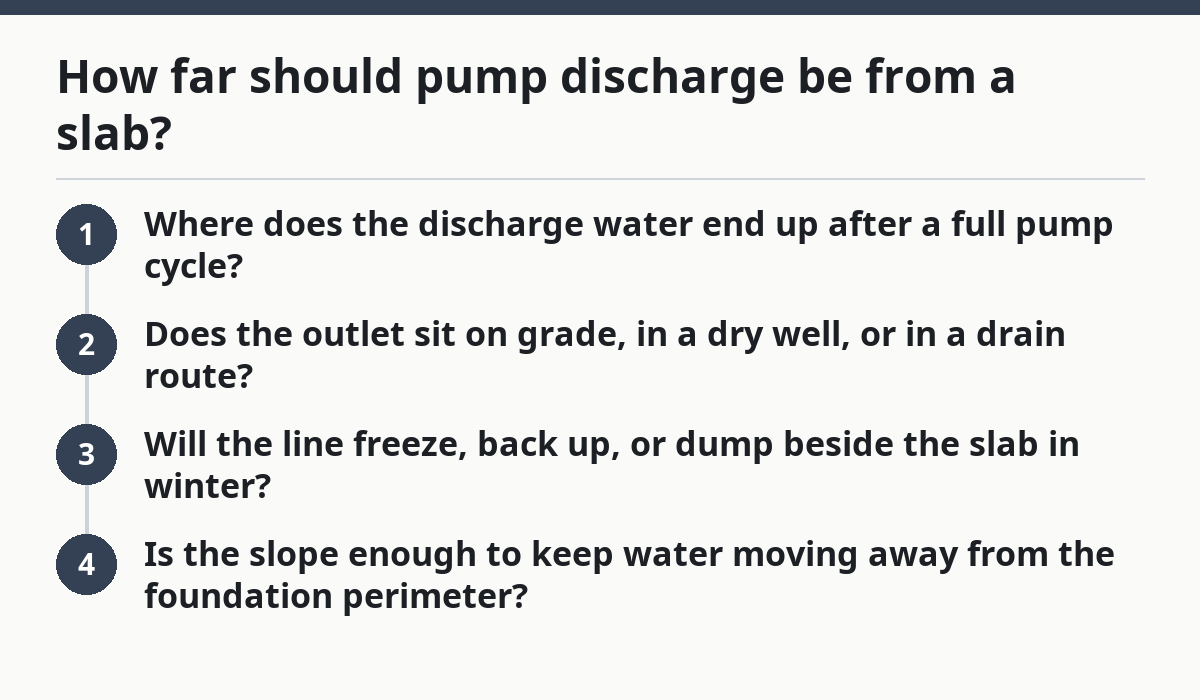
What to ask before you hire someone:
- Where does the discharge water end up after a full pump cycle?
- Does the outlet sit on grade, in a dry well, or in a drain route?
- Will the line freeze, back up, or dump beside the slab in winter?
- Is the slope enough to keep water moving away from the foundation perimeter?
If a contractor cannot explain that path in plain words, the design is not finished.
Signs the discharge is hurting soil support
Picture this: you’re walking the side of the house after a rain and the ground feels soft in one strip while the rest stays firm. That strip may be where the discharge line lands, and it can be the first clue that the soil support near the slab is changing.
The clearest signs are simple. Look for a wet patch that returns after the pump runs, hairline cracks that open at the slab edge, or a slight dip where the concrete meets the soil. Inside, a door that rubs, a trim gap, or a floor that sounds hollow near one edge can go with the same problem.
A few clues point more strongly to discharge water than to a random leak:
- A muddy circle near the outlet.
- Erosion channels running away from the pipe end.
- Moss or algae in one narrow band.
- A slab edge that stays dark after the rest dries.
- Soil that collapses when stepped on after the pump runs.
Ignoring those signs is not always dramatic at first. It can start as a maintenance issue, then turn into a more expensive slab repair if the same area keeps losing support. A spot that stays wet for months can also hide the real source, which is why drainage path matters more than surface cleanup.
A practical way to check discharge damage before it gets worse
Picture this: you’re trying to figure out whether the sump pump discharge is harmless or slowly undermining the slab. You do not need a lab test. You need a short walk, a hose-cycle check, and a look at where water actually sits after the pump stops.
Use this sequence:
- Watch one pump cycle and note where the water leaves the outlet, then see whether it spreads, pools, or runs back toward the slab.
- Walk the line after 10 to 15 minutes and press the soil with your boot; spongy ground means the area is not draining well enough.
- Check the slab edge for damp soil, erosion, or a narrow trench cut by moving water.
- Look for cracks at corners, joints, or edges that line up with the wet zone rather than the whole slab.
- Repeat the check after a heavy rain and again during a dry day; a real discharge problem shows a pattern, not a one-off puddle.
That little routine does two jobs. It tells you whether the outlet is too close, and it tells you whether the ground is taking on water faster than it can shed it. If the same area stays soft across multiple checks, the discharge path needs a change, not a patch of dirt.
A contractor may also probe the grade with a rod or dig a shallow test hole near the discharge point. That can show whether water is only on the surface or sinking into weak backfill.
What a bad discharge setup usually looks like
Picture this: you’re seeing a pump line that ends in a low corner, or under a shrub bed, or at a spot where the soil already stays damp. That setup can keep the area wet longer than the owner expects, and it often creates the same damage pattern over and over.
The worst setups have a few common traits. The outlet is too short, the end point is lower than the house foundation, or the line empties into soil that cannot absorb more water. A buried outlet that clogs with fines can be worse, because the water has nowhere to go and may come back toward the slab.
Common mistakes and what they cost:
- Dumping beside the wall: keeps the backfill saturated and can weaken support.
- Ending on flat soil: creates ponding that re-wets the same strip.
- Letting the line break or leak near the slab: sends water straight into the problem zone.
- Routing into clogged ground: hides the discharge until soil starts to move.
The fix is usually not glamorous. It may mean extending the discharge, changing the outlet location, or rebuilding the path so the water leaves the area fast. If the slab has already settled, the drainage fix still matters, but it may not straighten a floor that has moved.
On the flip side, a line that sends water to a better outlet can stop the soil from cycling between wet and dry in the same spot. That helps protect the slab edge and makes future settlement less likely.
When discharge problems become a slab repair issue
Picture this: you’re seeing more than damp soil now. The crack is widening, the edge is dropping, or the slab has a visible tilt that lines up with the wet side of the house. At that point, the discharge problem has moved from drainage to structure.
Not every crack means the pump caused it. Concrete shrinks, soils move, and old slabs age. The question is whether the discharge line is making the problem worse by keeping one side soft. If the damage keeps tracking the wet area, the water path is part of the repair plan.
A good contractor will separate three jobs: stop the water, check the soil support, and decide whether the slab needs lifting or repair. Fixing concrete before fixing discharge is a common mistake because the new repair can move again if the soil stays weak.
Ask for a plan that includes:
- A corrected discharge route.
- A check of the foundation perimeter for soft spots.
- A look at whether the slab needs patching, lifting, or only drainage work.
- A seasonal follow-up after one wet cycle.
This is not the place for guesswork. A cheap patch that ignores the water path can cost more later when the same edge moves again.
What to ask a contractor before you hire them
Picture this: you’re calling a drainage or foundation contractor and trying to sort out who can solve the actual problem, not just hide it. The right questions tell you whether they understand discharge, soil support, and slab behavior as one system.
Start with the water path. Ask where the line ends, how far it sits from the slab, and what happens during heavy rain or freeze-up. Then ask how they would stop repeat wetting at the foundation perimeter without creating a new puddle somewhere else.
A useful conversation usually includes these points:
- The current outlet location and why it is a problem.
- The soil type around the slab, if they can tell from a site look.
- Whether the discharge needs a surface route, buried line, or different outlet.
- What signs would tell you the soil support has already been weakened.
- How long the work should take on a normal residential setup.
If the answer is only “we’ll move the pipe,” that is not enough. The pipe move has to solve the slope, drainage path, and outlet placement together. That is the part many quick fixes miss.
For related drainage context, the hub on drainage and water management for slab performance covers the larger picture without turning this page into a copy of that one.
FAQ
Should a sump pump drain near concrete?
No, not if the discharge keeps the soil beside the slab wet. The outlet should send water far enough away that the ground near the concrete can dry between pump cycles. A short discharge path can keep the foundation perimeter damp and reduce soil support over time.
Can sump water cause settlement?
Yes, sump water can contribute to settlement when it repeatedly soaks the same soil zone. The risk is higher in clay, loose fill, or poorly compacted backfill because those soils change strength when wet. The pump does not cause the damage by itself; the repeated wetting does.
How far should pump discharge be from a slab?
Far enough that water does not pool or run back toward the slab after each cycle. The right distance depends on slope, soil, and outlet placement, so there is no single number that fits every house. A contractor should check the full path and make sure the foundation perimeter stays dry.
Drafted with AI; not yet reviewed by a person.