Cracked vs Sunken Concrete: When Leveling Is Enough and When It Is Not

Last updated: September 10, 2026
Key Takeaways
- A good candidate usually has a modest correction range, often under 2 inches, though that depends on the slab, access, and the extent of voiding.
- Cracked concrete and sunken concrete are not the same problem, and leveling only helps one of them.
- A cracked patio slab and a settled garage entrance are not equal problems.
- This applies to a homeowner or property manager looking at a driveway, sidewalk, patio, garage floor, or pool deck that is either cracked, sunken, or both.
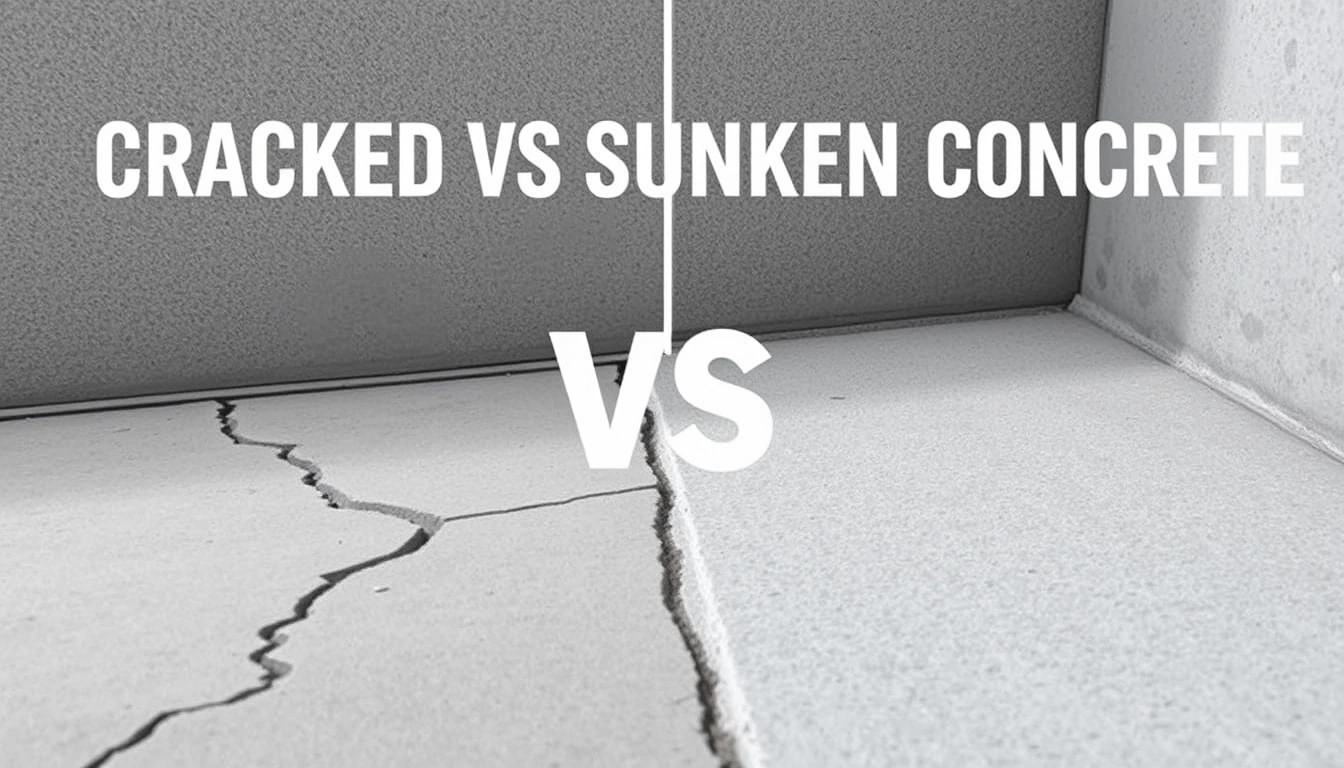
Cracked vs sunken concrete: when leveling is enough when it is not is really a question of support, movement, and safety. Two slabs can look similar from ten feet away; they are not the same underneath. If the slab has dropped but is still largely intact, leveling can be part of the fix. If the concrete is actively cracking because it keeps moving, lifting it alone leaves the core issue behind. Short version: one problem is height, the other is damage.
Because this is a health-and-safety issue around trip hazards and structural movement, speak with a qualified concrete or structural professional about your own situation before you decide on a repair. Common sense helps. Guesswork doesn’t.
What this question really means, and who this applies to
This applies to a homeowner or property manager looking at a driveway, sidewalk, patio, garage floor, or pool deck that is either cracked, sunken, or both. Cracked vs sunken concrete: when leveling is enough when it is not comes down to whether the slab lost support or lost integrity. I am assuming you can already tell the difference between a surface stain and a real change in height, and that you want to know whether slab leveling is a reasonable fix or just a temporary patch.
Slab leveling usually means lifting or filling beneath a settled concrete slab so the surface comes back closer to its original plane. In practice, that may involve mudjacking, which uses a cementitious slurry, or polyurethane foam injection. In 2024, those methods are commonly used to address voids and settlement in residential flatwork. They correct loss of support, not every crack that shows up.
A crack can be dormant, meaning it has stopped moving, or active, meaning it keeps widening or shifting with seasons and load. That split matters more than how ugly the line looks. Ugly and active are not the same thing.
I would not treat any of this as a DIY judgment call if the slab supports a garage column, a porch post, a retaining wall, or anything tied to the structure of the house; consult a qualified concrete or structural professional, especially where loads are involved. I would also stop short of DIY if the concrete has a wide displacement, a vertical step that keeps growing, or signs that the ground itself is moving. Soil washout, poor compaction, and drainage failures can turn a simple repair into a recurring one; the American Concrete Institute notes that support conditions and load paths matter in slab repair decisions. That part is easy to miss until the slab starts acting up again.
For flatwork with a nonstructural trip hazard, leveling can make sense. For concrete that is broken apart, tilted because of soil movement, or no longer sits on stable support, leveling alone is not the full answer. That is the question the rest of this article answers.
How do I tell cracked concrete from sunken concrete?
You tell them apart by looking for movement, height change, and the pattern of the damage. A crack is a split in the slab. Sunken concrete is a slab that has lost elevation relative to the adjacent surface, often by 1/4 inch, 1/2 inch, or more, though even a smaller offset can be a hazard if it catches a shoe or wheelchair wheel. Little lip, big problem.
Start with a straightedge or a long level, such as a 4-foot level, laid across the suspect area. If one side of the slab drops away while the concrete remains in one piece, that points to settlement. If the slab is still level but split, that points more toward cracking without settlement. If you see both, the crack may be where the slab settled and tore under stress.
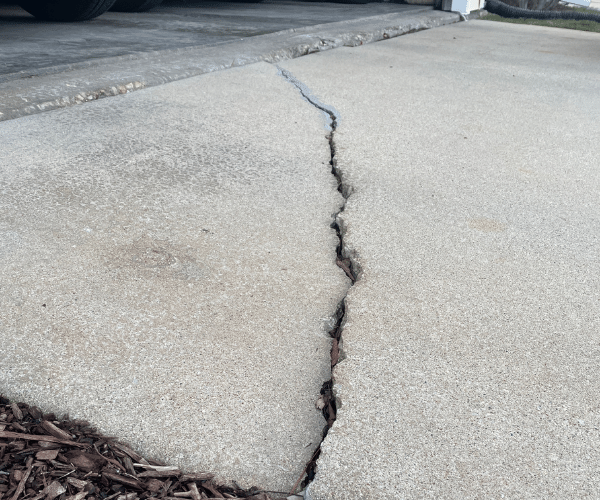
Look at the crack itself. Hairline cracks are narrow enough that you may barely fit a credit card edge into them. Wider cracks, especially those with one side higher than the other, suggest movement. A crack that branches, widens at one end, or has fresh dust on one side may still be active. A crack that is consistent in width and has no offset may be dormant, though dormant does not mean harmless.
The pattern matters too. A single diagonal crack in a driveway slab often reflects shrinkage or minor movement. A network of many intersecting cracks can point to broader slab distress or weak concrete. A sunken corner or edge often suggests loss of support near a joint or drainage path. If one area sounds hollow when tapped and the adjacent slab sounds solid, that can point to voids beneath the slab, but consult a qualified professional before treating that as proof.
A practical check: place a marble or a 2-foot level on the slab and see whether it rolls toward the low spot. Then measure the height difference at the joint or crack. If the offset is small and the slab appears otherwise intact, leveling may be enough. If the offset is paired with multiple cracks, broken edges, or widening movement after rain or frost, the slab may need more than leveling. That is the fork in the road.
When is leveling enough?
Leveling is enough when the concrete is structurally sound but has lost support. In plain terms, the slab is out of plane, yet the concrete itself still has enough integrity to be lifted or stabilized without major patching or replacement. That is usually the case with settled sidewalks, driveway panels, patio slabs, and some garage floor edges.
I would consider leveling a good fit when the following are true: the crack pattern is limited, the slab pieces still align reasonably well, the drop is localized rather than across the whole area, and the surrounding soil problem is manageable. A common example is a sidewalk panel that has settled 1/2 inch at one end because the subgrade compacted unevenly or water drained along one edge. Another is a patio slab that dipped near a downspout discharge. In those cases, the slab often needs support restored, not full replacement.
Why does leveling work there? Because the concrete has not necessarily failed, but the support underneath has. Raising the slab or filling the void can reduce the trip hazard and restore drainage away from the house. Still, leveling does not make old concrete young again. If the surface is badly scaled, spalled, or crumbling at the edges, you may fix the height and still be left with a poor wearing surface. Same elevation. Different story.
Leveling is not a cure for a bad base that keeps getting wet; if the soil keeps washing out because downspouts discharge nearby or because drainage slopes back toward the slab, the settlement can return, so consult a professional if the wet area is persistent. In the concrete trade, that is the difference between fixing a symptom and fixing the cause. I would choose leveling only when the slab’s breakage is secondary to the loss of support, not when the slab itself has failed.
A good candidate usually has a modest correction range, often under 2 inches, though that depends on the slab, access, and the extent of voiding. In practice, 1 inch to 2 inches is a common range for many residential lifts, while larger corrections can be possible with careful planning. Bigger lifts raise the risk of cracking the slab further or telegraphing existing damage. If the slab is already fractured into several loose pieces, leveling tends to be a short-lived answer. It can look fine on day one; later, not so much.
When is leveling not enough?
Leveling is not enough when the slab is broken, unstable, or moving for reasons that lifting cannot solve. In those cases, the better answer may be repair, partial replacement, drainage correction, or a structural evaluation.
- The crack has vertical displacement and keeps changing: This suggests active movement, not a one-time settlement — do not rely on leveling alone.
- The slab is broken into multiple sections: Separate pieces can move independently — replacement or sectional repair is often more appropriate.
- The concrete supports a load-bearing element: A porch column, stair landing, or garage support changes the stakes — get qualified help rather than a cosmetic lift.
- There is obvious soil erosion, washout, or a persistent wet area: The void will likely return unless the water problem is fixed — address drainage first.
- The slab has severe spalling, crumbling edges, or exposed aggregate over a wide area: The concrete itself is deteriorated — leveling may improve height, not durability.
- The slab has heaved rather than sunk: Upward movement often points to frost action or expansive soil — lifting is the wrong direction of fix.
These situations matter because leveling works on elevation, not on every failure mode. If the issue is expansive clay soil, frost heave, freeze-thaw damage, or structural settlement tied to a foundation, the visible low spot may be the least of your problems. A lifted slab can still crack again if the ground continues to move underneath it. The National Ready Mixed Concrete Association and the Portland Cement Association both emphasize matching repair to the underlying condition, not just the surface defect. That logic is hard to argue with.
I also would not treat “just fill the crack after leveling” as a complete repair when the crack is active; consult a qualified professional if the crack is widening or if the slab keeps moving. A crack filler may help keep debris out or improve appearance, but it does not stop movement. The result can be a slab that looks better for a season and then opens again along the same line. Pretty on top. Still broken.
If the offset is near the house and the slab pulls away from a foundation wall, I would take that more seriously than a patio dip in the middle of the yard. A gap can affect drainage, pests, and the path water takes against the foundation. That is one of the clearest cases where the job has moved beyond simple slab leveling.
How is a concrete leveling job actually decided?
A concrete leveling job is decided by checking support, crack behavior, drainage, and the amount of height change before anyone lifts anything. The order matters because a nice-looking slab can still be the wrong candidate for leveling.
- Map the low spot and the crack: Place a 4-foot level or straightedge across the slab in several directions and measure the height difference with a tape or ruler to the nearest 1/8 inch. Verify whether the displacement is localized or broad. A problem shows up if the low area changes slope over a long run or if the offset is larger than it first looked from one angle.
- Check whether the slab is still one piece: Trace the crack line and note whether the concrete on both sides moves together or independently. Verify the edges stay aligned under light foot pressure. A problem is a crack that opens or closes when stepped on, which suggests ongoing movement.
- Look for drainage clues: Follow where downspouts, grading, gutters, or runoff water go. Verify whether water drains away from the slab or toward it. A problem is visible washout, puddling, or a downspout outlet dumping water within a few feet of the settled area.
- Identify nearby loads: Check whether the slab carries a vehicle wheel path, a post, or an anchored step. Verify there is no sign of structural loading at the damaged point. A problem is settlement under a support point, because that calls for more than a cosmetic lift.
- Estimate the correction needed: Measure the height difference at the worst point, then compare it with the rest of the slab. Verify whether the correction is modest or whether the slab has dropped several inches. A problem is a large differential that would require an aggressive lift, increasing the chance of further cracking.
- Inspect the surface condition: Note spalling, scaling, pitting, and broken corners. Verify the slab surface still has enough sound concrete to hold up after lifting. A problem is a surface already breaking apart, because leveling cannot restore lost concrete.
- Check for movement over time: If the crack is old enough to observe, compare sides after rain, freeze-thaw weather, or heavy vehicle use. Verify whether the condition is stable. A problem is any sign of progression, which means the cause is still active.
- Decide whether the fix matches the failure: If the slab is sound but settled, leveling may fit; if the slab is fractured or the ground keeps moving, it likely does not. Verify that the chosen repair addresses both height and cause. A problem is trying to hide structural movement with a surface correction.
That is the basic decision path. The most common error is jumping straight to “fill it” before understanding why it moved. A good repair sequence is usually to diagnose the movement, then correct drainage or support, and then restore the height, with a qualified professional involved when structural support is part of the problem. Skipping the middle step is how recurring settlement happens. Simple, but not easy.
What mistakes do people make with cracked or sunken concrete?
The biggest mistake is treating every crack like a leveling job. That can leave an active joint, a widening fracture, or a soil problem untouched. The consequence is repeat failure; the better alternative is to check whether the slab is moving before choosing a repair.
Another mistake is ignoring drainage. If a downspout or grade sends water under a slab, the base can erode or soften. The result is a repaired panel that settles again after the next wet season. The alternative is to correct runoff before or alongside the repair. Water wins that fight, every time.
A third mistake is lifting too aggressively. A slab that has sunk several inches can crack further during an over-lift, especially if the concrete is older or already fractured. The better alternative is a conservative lift plan, often done in increments, with realistic expectations about how much original alignment can be recovered.
A fourth mistake is assuming a filled crack means a fixed slab. Crack fillers can improve appearance and help keep debris out, but they do not stabilize movement. The consequence is cosmetic success with structural failure still underneath. The alternative is to use fillers only after deciding the slab is stable enough for that kind of finish work.
A fifth mistake is not matching the repair to the slab’s role. A cracked patio slab and a settled garage entrance are not equal problems. A garage edge that affects vehicle loading has stricter demands than a back-yard path. The consequence of using the same answer for both is either overreacting or underreacting. The alternative is to judge the load, not just the crack.
Finally, people often wait until the slab has a sharp lip or broken corner. At that point, leveling may still help, but the repair becomes harder and more expensive to do well. A slab that is caught early is usually easier to stabilize than one that has been breaking for years.
What should you do when the standard approach does not fit?
If the slab is badly broken, the ground is still moving, or the concrete carries structural load, the standard leveling approach does not fit. In those cases, the right answer may be partial replacement, full replacement, drainage correction, or a structural assessment.
One edge case is a crack that is narrow but runs through a slab with no settlement. That can be a shrinkage crack, which often is more about the concrete curing than the subgrade. Leveling does nothing there because there is nothing to level. Depending on appearance and movement, a crack repair approach may be more sensible than any lifting.
Another edge case is a sunken slab near a tree root zone. Roots can lift or crack concrete, and the problem may continue as the tree grows. A leveling job can be undone by the next season of root expansion. I would treat that as a site-specific problem, not a standard slab fix.
Finally, cold-climate slabs deserve special caution because freeze-thaw cycles and frost heave can turn a small settlement into a recurring one. In that setting, the question is not only whether the slab can be leveled, but whether the subgrade and drainage will keep the slab in place after the repair.